Abu Dhabi (AUH) Traffic 'Drop' of −77% on Wednesday 21 October 2026 — a Second Receiver Network Counted a Normal Day While Our Feed's Coverage of the UAE Thinned
- The −77% on 21 October is a reading from our own feed, and the evidence so far says the feed lost track of the airport rather than the airport losing its flights. An independent receiver network counted 483 movements at Abu Dhabi that day, a normal day by its own baseline; the flight callsigns that use Abu Dhabi flew 234 times, and our receivers placed 51 of them at the airport.
- Nothing else we track moved with it: Abu Dhabi's weather reports were CAVOK all day, Doha and Bahrain ran normal days in our feed, GNSS interference over the Emirates FIR stayed inside its October range, and no closure label registered in OMAE after 12 October. Dubai and Sharjah thinned in our feed the same afternoon — and were normal on the second network, which is what a regional reception problem on our side looks like.
- This is not yet closed. The 21 October count has settled at 83; 22, 23 and 24 October settled at 210, 258 and 217 in our feed (−41%, −27%, −39%) against 482, 469 and 448 on the second network, 25 and 26 October settled at 350 and 342 (−1% and −4%, at the baseline; 533 and 486 on the second network), 27, 28 and 29 October at 331, 321 and 327 (−7%, −10% and −8%; 484, 487 and 507), 30 October closed at 301 (−15%) without its third ingest night (510), 31 October at 273 (−23%) on short feed-wide ingest nights (463), 1 and 2 November settled at 345 and 316 (−3% and −11%; 524 and 510), 3 November closed at 351 (−1%) without its third night, missing feed-wide (484), 4 November settled at 307 (−14%; 481), 5 November at 347 (−2%; 491), 6 November at 314 (−12%; no second-network count), 7 November at 290 (−18%; 504), 8 November at 238 (−33%; 524, above its band), and 9 November closed at 295 (−17%) without its third ingest night, missing feed-wide (481); 10–14 November, filled by a catch-up batch on 17 November, settled at 319, 314, 306, 293 and 299 (−10% to −17%) while the second network counted 488, then 372, 419 and 448, below its band, and 486, back inside it, and 15 November reads 285 (−20%) without its third ingest night, against 503; low-altitude reception near the airport was back inside its band on 25 October–9 November and read 294, 276, 290, 287, 276 and 301, just under its floor, on the 10th–15th, 309, back inside it, on the 16th, and 243, below it again, on the 17th; and our NOTAM set, refreshed on 28 October after a gap since 4 October and again on 1, 10, 11, 12, 13, 14, 15, 16, 17 and 18 November, holds no closure notice for Abu Dhabi on the dates covered here, though a notice that expired between refreshes would not appear in it. Observed counts are a floor, not a total — for a specific flight, check your airline or the airport.
Advisory timeline — how active is this episode
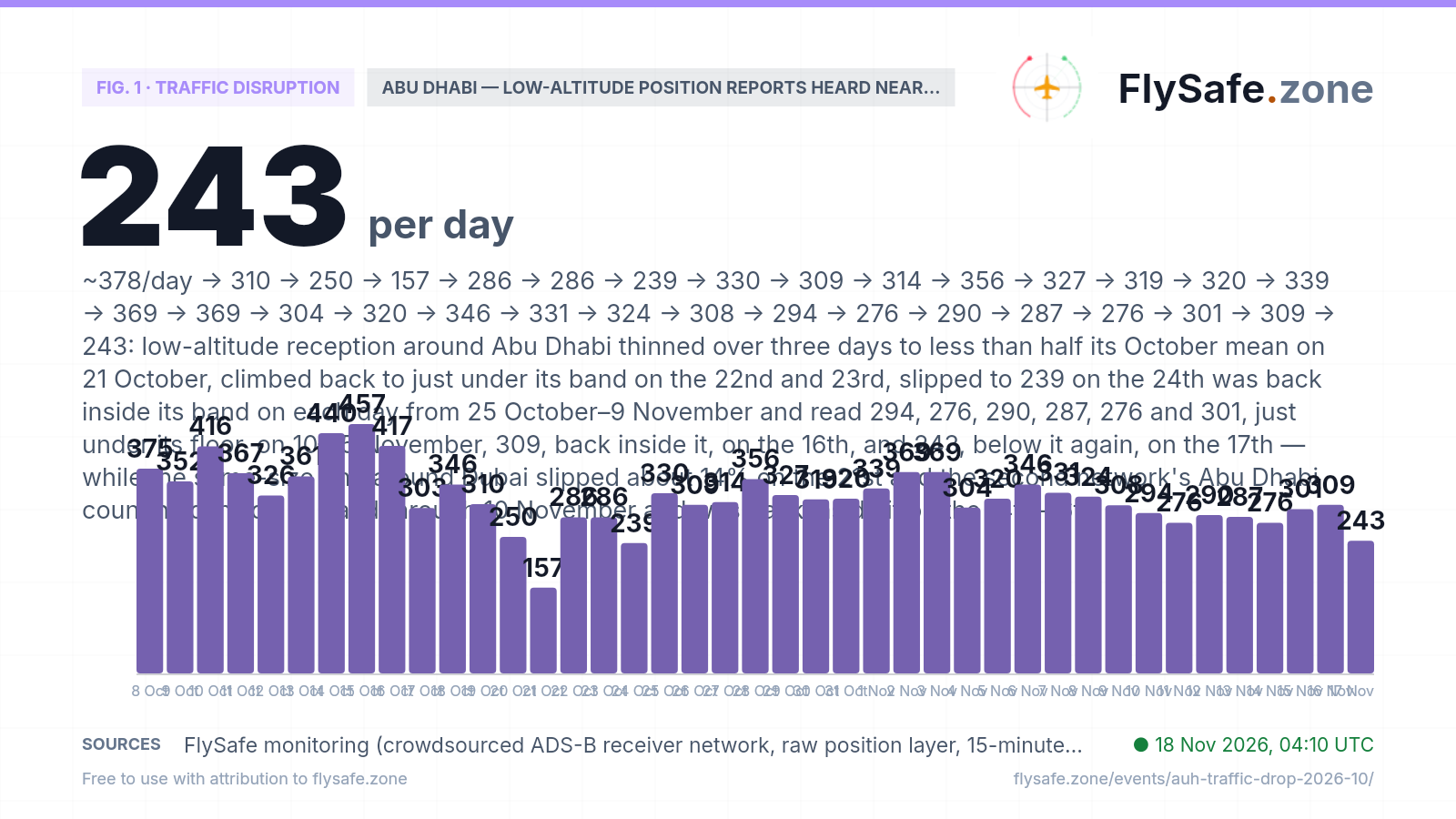
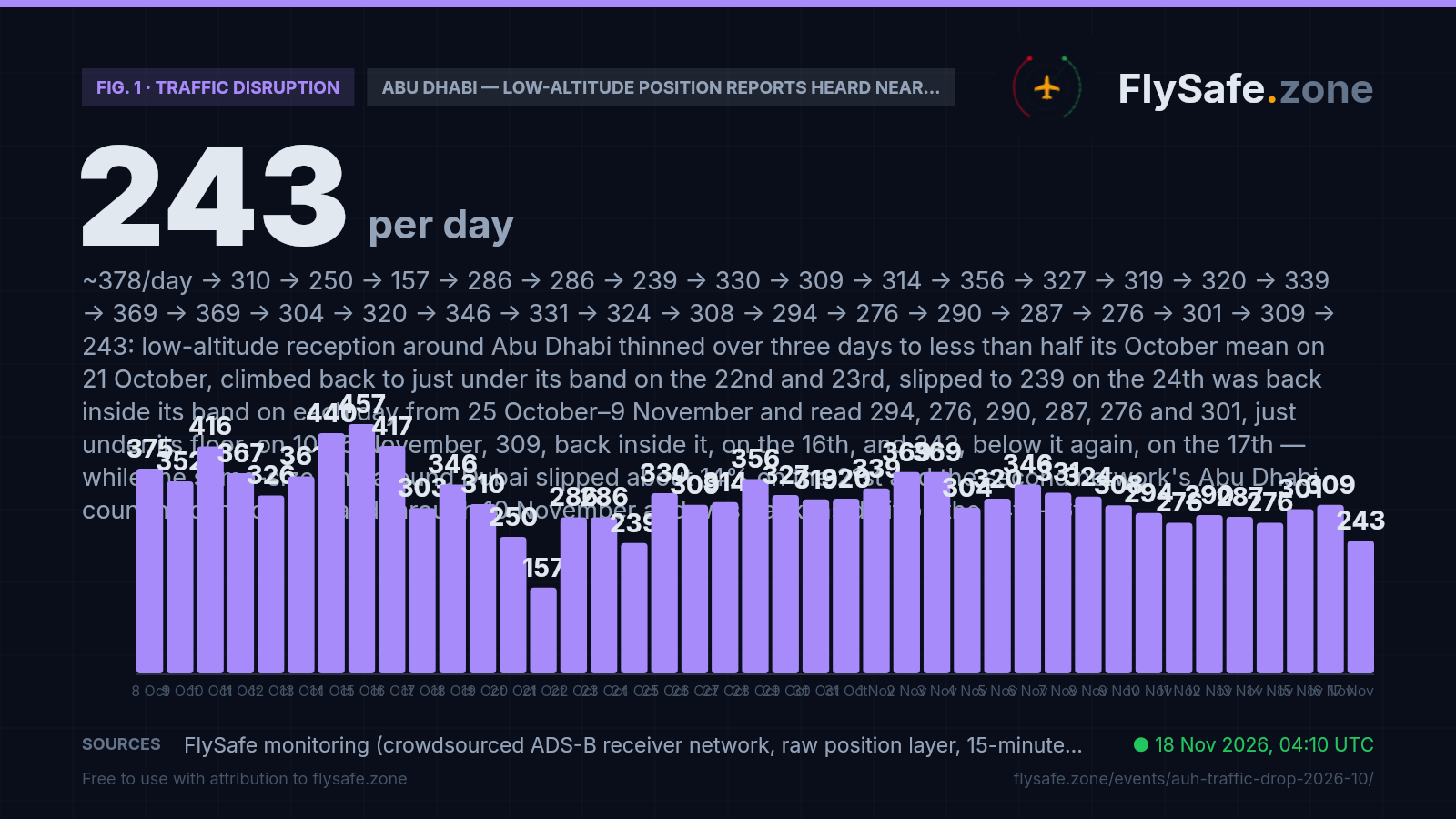
This chart does not count flights — it shows how well we could hear them. Across 8–18 October our receiver network logged between 303 and 457 position reports a day below 3,000 m within about 38 km of Zayed International Airport (mean ~378) — the low, close band where departures and final approaches live. It then thinned over three days: 310 on the 19th, 250 on the 20th and 157 on 21 October (−58% against the mean), from 116 distinct aircraft against 185–216 on 8–18 October. On the 22nd the layer logged 286, from 178 aircraft — just under the floor of the pre-event band — on the 23rd 286 again, from 181 aircraft; on the 24th it slipped to 239, from 167, and on the 25th it read 330, from 205 aircraft — back inside the band for the first time since the 18th — on the 26th 309, from 202, inside it again near its floor, on the 27th 314, from 199, on the 28th 356, from 219, on the 29th 327, from 198, on the 30th 319, from 199, on the 31st 320, from 218, on 1 November 339, from 210, on the 2nd 369, from 209, on the 3rd 369 again, from 201, on the 4th 304, from 197, inside it near its floor, on the 5th 320, from 207, on the 6th 346, from 206, on the 7th 331, from 198, on the 8th 324, from 202, on the 9th 308, from 196, on the 10th 294, from 183 — just under the band's floor, the first day below it since the 24th , on the 11th 276, from 183, a second day under it, on the 12th 290, from 198, a third, on the 13th 287, from 192, a fourth, on the 14th 276, from 181, a fifth, on the 15th 301, from 183, a sixth, on the 16th 309, from 211, back inside the band, and on the 17th 243, from 168, below it again — on 90 of the day's 96 snapshots network-wide, so it may read a little low. Distinct aircraft heard over the same box at all altitudes fell less steeply: 234 on the 21st against 280–317, then 286 on the 22nd. As a control, the same-size ring around Dubai International, 116 km north-east, logged 763 low-altitude reports on the 21st against 783–972 on 8–20 October — a slip of about 14% against its mean, not a halving — then 893 on the 22nd, 756 on the 23rd (under its own band), 809 on the 24th, back inside it, 936 on the 25th, 898 on the 26th, 856 on the 27th, 912 on the 28th, 944 on the 29th, 969 on the 30th, 892 on the 31st, 981 on 1 November, 957 on the 2nd, 838 on the 3rd, 910 on the 4th, 970 on the 5th, 935 on the 6th, 943 on the 7th, 929 on the 8th, 848 on the 9th, 851 on the 10th, 812 on the 11th, 906 on the 12th, 805 on the 13th, 809 on the 14th, 893 on the 15th, 892 on the 16th and 854 on the 17th. These are 15-minute snapshots, not continuous tracks; 93 of the day's 96 snapshots captured aircraft in the Abu Dhabi box on the 21st, within the 91–96 of every other day, so the snapshot schedule itself does not explain the drop:
Fig. 1 — Position reports below 3,000 m (or on the ground) within ~38 km of Zayed International Airport, 8 Oct–17 Nov 2026 · Data as of 18 Nov 2026, 04:10 UTC · Source: FlySafe monitoring (crowdsourced ADS-B receiver network, raw position layer, 15-minute snapshots).
Airports in the exposure zone
| Airport | Size | Observed signal | FIR |
|---|---|---|---|
| Zayed International Airport (AUH) | large | — · 21 Oct settled 83 (56 dep / 27 arr), −77% vs ~355 — yet the second network counted 483 (455–506 band); 19 Oct settled 221, 20 Oct 205; 22 Oct settled 210 (second network 482); 23 Oct settled 258 (469); 24 Oct settled 217 (448); 25 Oct settled 350 (533); 26 Oct settled 342 (486); 27 Oct settled 331 (484); 28 Oct settled 321 (487); 29 Oct settled 327 (507); 30 Oct 301 partial (510); 31 Oct 273 partial (463); 1 Nov settled 345 (524); 2 Nov settled 316 (510); 3 Nov 351 partial, third night missing (484); 4 Nov settled 307 (481); 5 Nov settled 347 (491); 6 Nov settled 314 (no second-network count); 7 Nov settled 290 (504); 8 Nov settled 238 (524); 9 Nov 295 partial, third night missing (481); 10 Nov settled 319 (488); 11 Nov settled 314 (372); 12 Nov settled 306 (419); 13 Nov settled 293 (448); 14 Nov settled 299 (486) — 10–14 Nov via a 17 Nov catch-up batch; 15 Nov 285, third night missing (503); 16 Nov not yet read (512); 154 departures with no airport identified on the 21st | OMAE |
| Dubai International Airport (DXB) | large | 116 km · 633 movements on 21 Oct in our feed against 704–907 on 12–20 Oct, afternoon-weighted; second network 936 (868–984); low-altitude ring 763 vs 783–972 | OMAE |
| Sharjah International Airport (SHJ) | large | — · 181 movements on 21 Oct in our feed against 266–327 on 12–20 Oct; second network 287 (252–309) | OMAE |
| Al Maktoum International Airport (DWC) | large | 72 km · 169 movements on 21 Oct against 158–224 on 12–20 Oct — inside its band; second network 141 (120–183) | OMAE |
| Hamad International Airport (DOH) | large | — · 502 movements on 21 Oct against 481–580 on 12–20 Oct — feed healthy across the Gulf | OTDF |
| Bahrain International Airport (BAH) | large | — · 142 movements on 21 Oct against 111–158 on 12–20 Oct | OBBB |
Distance alone does not determine impact — wind direction and the flight levels the ash reaches decide which airports and routes are affected on a given day. FIR = Flight Information Region.
What our monitoring shows: a thinned-out count at Abu Dhabi, not a quieter sky
FlySafe tracks observed departures and arrivals at 493 airports from crowdsourced ADS-B receiver data. Observed counts are a floor, not a total — receiver coverage varies — but an airport measured against its own baseline is a reliable shape. Zayed International Airport's last 30 days:
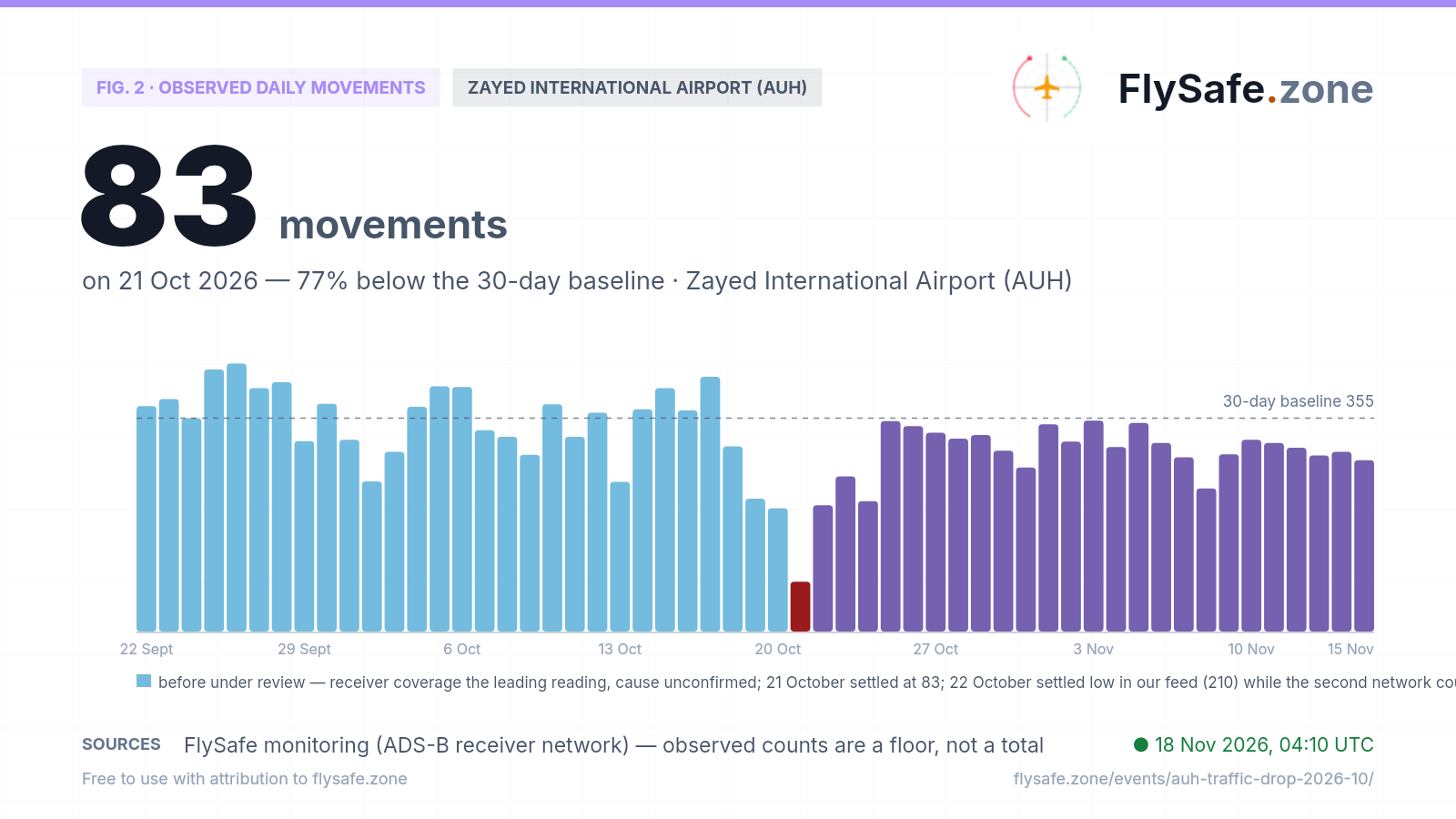
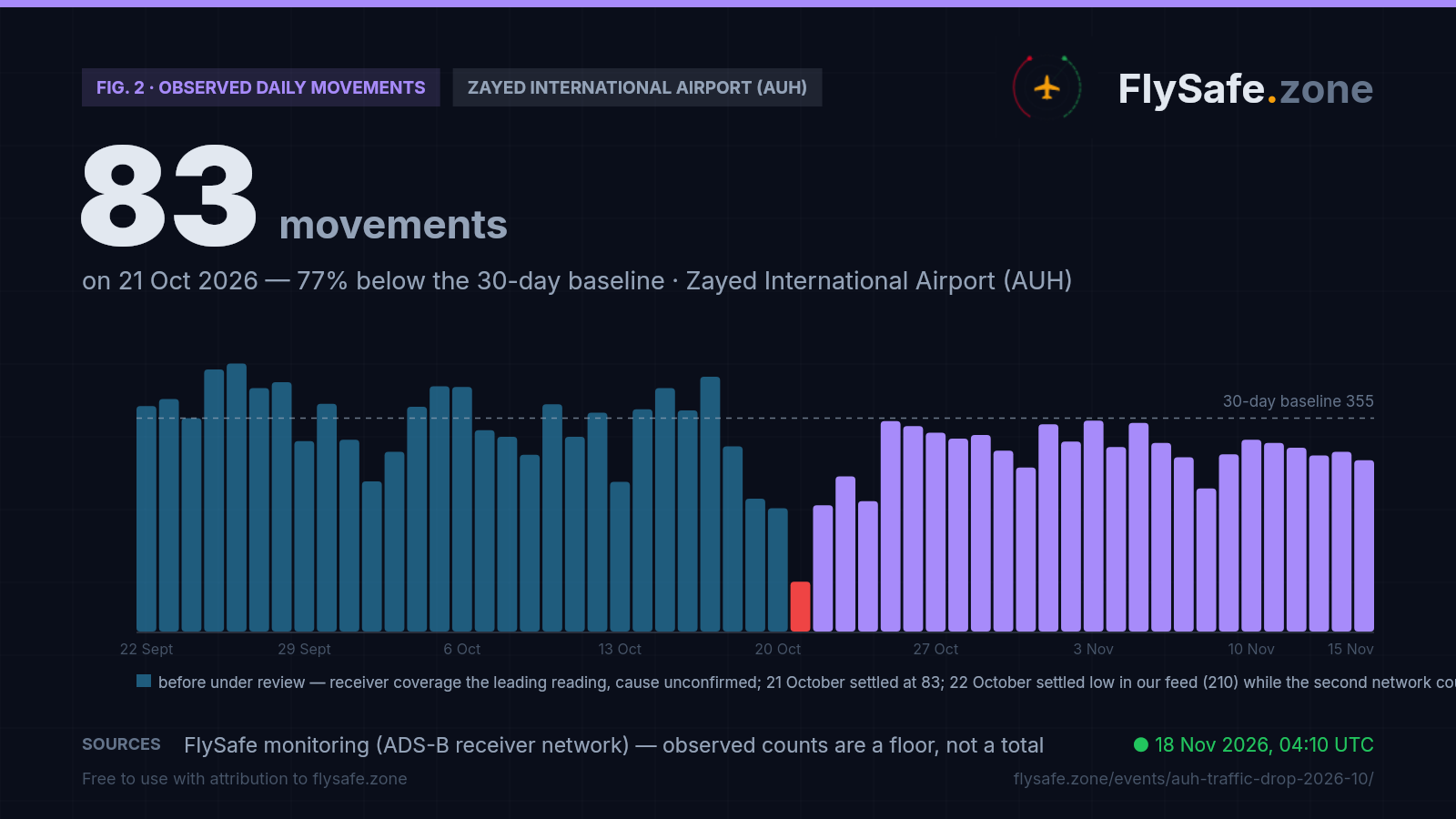
Fig. 2 — Observed daily movements at AUH, 22 Sept – 15 Nov (latest complete UTC day). Data as of 18 Nov 2026, 04:10 UTC · Source: FlySafe monitoring (ADS-B receiver network).
- Seven-day baseline (12–18 Oct): ~355 observed movements a day (249–424). Wednesday 21 Oct settled at 83 — −77% against that baseline. Detection fired at −72% against a rolling seven-day average of ~286 that already included the 21st and the two soft days before it. The seven Wednesdays before ran 300–403.
- A three-day slide, not a cliff. Sunday 18 October settled at 308 (−13%); Monday 19 October settled at 221 (129 departures, 92 arrivals; −38%); Tuesday 20 October settled at 205 (134 departures, 71 arrivals; −42%); then 83 on the 21st (56 departures, 27 arrivals). Departures, the steadier line in our feed, ran ~194 a day on 12–18 October: 56 on the 21st is −71%; arrivals, which our feed captures less evenly (69 on 13 October was an arrivals-light day, not a disruption), fell to 27 from ~162 (−83%).
- The thinning has a clock. The 21st's first six hours (00:00–05:59 UTC) logged 39 departures against 58 in the same hours on 14 October — a third down. From 06:00 UTC to midnight the feed logged 17 departures across eighteen hours against 136 a week earlier: 2 and 1 in the 10:00 and 11:00 UTC hours against 27 and 16, and 2 in the 17:00 hour against 17. Every carrier shrank together — the airport's largest operator went from 130 departures on the 14th and 88–89 on the 19th–20th to 33 on the 21st.
- Dubai and Sharjah thinned in the same feed on the same afternoon. Dubai International logged 633 movements on the 21st against 704–907 on 12–20 October (−21% against its mean), with its departures from 09:00 UTC onward at 118 against 254 on the 14th; Sharjah logged 181 against 266–327 (−40%). Al Maktoum (169), Doha (502) and Bahrain (142) ran inside their own bands. Network-wide the day holds 246,683 movement records, above the 14-day median — not a collection-gap day by our rule (60% of the median).
- The second network saw a normal Abu Dhabi. An independent crowdsourced ADS-B aggregate, built on different volunteer receivers, counted 483 movements at Abu Dhabi on the 21st (245 departures, 238 arrivals) against 455–506 on 8–20 October — and 492 and 459 on the 19th and 20th, the two days our own count was already sliding. It counted Dubai at 936 (868–984), Sharjah at 287 (252–309) and Al Maktoum at 141 (120–183) the same day. That aggregate hears more of Abu Dhabi than we do on any day (its band sits above ours), so the comparison is each network against its own baseline, not one count against the other.
- Settled — and the 22nd settled low, flagged: the 21st's third ingest night added no departures, so it settled at 56 departures, with 27 arrivals by landing time. Every plotted figure is our recount from flight records. While a day is still being read, the stored daily rollup can hold a clipped figure — a routine hourly refresh re-reads the last three days from the clock time it runs, so a day's earliest hours drop out (the 21st read 33 there at one point) — and a nightly job then re-freezes each day at its full count; the stored rollup now matches our recount for every day through 14 November. Thursday 22 October settled at 210 (105 departures, 105 arrivals; −41%) — its third ingest night added 7 departures (37, 61, 7). The second network counted 482 at Abu Dhabi that day; in our feed Dubai settled inside its band (854) and Sharjah inside its own (274). Friday 23 October settled at 258 (153 departures, 105 arrivals; −27%) — its third ingest night added 12 departures (44, 97, 12). That sits just above the baseline window's low of 249 (the arrivals-light 13th) but well under its mean; the second network counted 469, inside its band. Dubai (646) and Sharjah (218) settled low in our feed on the 23rd, but the second network also counted both below their bands that day (Dubai 747 against 868–984, Sharjah 222 against 252–309), so the 23rd is not a clean comparison there. Saturday 24 October settled at 217 (125 departures, 92 arrivals; −39%) — its third ingest night added 6 departures (38, 81, 6). The second network counted 448, a little under its 455–506 band. Sunday 25 October settled at 350 (179 departures, 171 arrivals; −1%) — its third ingest night added 16 departures (48, 115, 16). That is the first day since the 18th to sit at the baseline: departures 179 against ~194, arrivals 171 against ~162. The second network counted 533 there, above its band. Monday 26 October settled at 342 (187 departures, 155 arrivals; −4%) — its third ingest night added 23 departures (46, 118, 23). That is a second settled day in a row at the baseline. The second network counted 486 there, inside its band, and in our feed Dubai (787) and Sharjah (276) both sat inside their bands that day as read with two ingest nights in. Tuesday 27 October settled at 331 (168 departures, 163 arrivals; −7%) — its third ingest night added 22 departures (42, 104, 22). The second network counted 484 there, inside its band. Wednesday 28 October settled at 321 (189 departures, 132 arrivals; −10%) — its third ingest night added 18 departures (48, 123, 18). Departures on the 28th sat close to their ~194 baseline mean; arrivals, which our feed captures less evenly, ran 132 against ~162. The second network counted 487 there, inside its band. Both days sit inside the baseline week's 249–424 range. Thursday 29 October settled at 327 (190 departures, 137 arrivals; −8%), also inside that range — its third ingest night added 20 departures (54, 116, 20). The second network counted 507 there, one above its 455–506 band. Friday 30 October closed at 301 (150 departures, 151 arrivals; −15%) on two ingest nights (39 and 111 departures). Its third ingest night, due on 2 November, did not cover the 30th anywhere in our feed — that night carried no flights dated 30 October network-wide, against 5,160–5,234 on each of the three prior third nights — and the nightly job has since frozen the day at 301, so the 30th is flagged partial: it understates the day by whatever a third night would have added (6–23 departures at Abu Dhabi on each of 22–29 October). The second network counted 510 there, four above its band. Saturday 31 October has all three ingest nights in at 273 (149 departures, 124 arrivals; −23%) — 41, 99 and 9 departures — but its second and third nights ran short network-wide (109,374 and 4,612 flights against 127,227–133,195 and 5,160–5,234), so the 31st is plotted and flagged partial: it sits inside the baseline week's 249–424 range, and its count may understate the day. The second network counted 463 there, inside its band. Sunday 1 November settled at 345 (192 departures, 153 arrivals; −3%) — its third ingest night added 16 departures (61, 115, 16). Its second and third nights ran light network-wide (100,147 and 4,712 flights), but Abu Dhabi's 115 and 16 departures on them sit in line with its second nights on 25–30 October (104–123) and its third nights on 22–29 October (6–23), so the 1st is plotted as settled, with the caveat that it may understate the day slightly. The second network counted 524 there, above its band. Monday 2 November settled at 316 (205 departures, 111 arrivals; −11%) — its third ingest night added 13 departures (57, 135, 13). Its departures sit above the ~194 baseline mean; arrivals, which our feed captures less evenly, read 111 against ~162. Its second night ran light network-wide (111,677 flights) and its third a little under the earlier third nights (5,057), but Abu Dhabi's own 135 departures on the second night sit above its second nights on 25–30 October (104–123) and its 13 on the third inside its third nights on 22–29 October (6–23), so the 2nd is plotted as settled. The second network counted 510 there, four above its band. Tuesday 3 November closed at 351 (188 departures, 163 arrivals; −1%) on two ingest nights (46 and 142 departures). Its second night also ran light network-wide (119,031 flights), and its third, due on 6 November, did not cover the 3rd anywhere in our feed — that night carried no flights dated 3 November network-wide, against 4,612–5,057 on each of the three prior third nights — and the nightly job has since frozen the day at 351, so the 3rd is flagged partial, as the 30th was: it understates the day by whatever a third night would have added (6–23 departures at Abu Dhabi on each of 22–29 October). The second network counted 484 there, inside its band. Wednesday 4 November settled at 307 (182 departures, 125 arrivals; −14%) — its third ingest night added 14 departures (50, 118, 14) — inside the baseline week's 249–424 range. Its departures sit under the ~194 baseline mean and its arrivals, which our feed captures less evenly, read 125 against ~162. Its second night ran light network-wide (117,850 flights), but Abu Dhabi's 118 departures on it sit inside its second nights on 25–30 October (104–123), and its third night was in line network-wide (5,431 flights), so the 4th is plotted as settled. The second network counted 481 there, inside its band. Thursday 5 November settled at 347 (205 departures, 142 arrivals; −2%) — its third ingest night added 12 departures (65, 128, 12) and was in line network-wide (5,412 flights) — inside the baseline week's 249–424 range, its departures above the ~194 baseline mean. The second network counted 491 there, inside its band. Friday 6 November settled at 314 (197 departures, 117 arrivals; −12%) on three ingest nights (58, 119 and 20 departures), each in line network-wide, inside the same range; its arrivals, which our feed captures less evenly, read 117 against ~162. The second network has no count for the 6th — its daily aggregate is missing across its whole feed that day, not at Abu Dhabi alone. Saturday 7 November settled at 290 (200 departures, 90 arrivals; −18%) on three ingest nights (65, 115 and 20 departures) — its second night ran light network-wide (111,970 flights), its third was in line (4,809) — inside the baseline week's 249–424 range. Its departures sit at the ~194 baseline mean; its arrivals read 90 against ~162. The second network counted 504 there, inside its band. Sunday 8 November settled at 238 (163 departures, 75 arrivals; −33%) on three ingest nights (54, 96 and 13 departures) — below the baseline week's 249–424 range and the lowest settled day since 24 October. Its second night ran light network-wide (112,207 flights) and Abu Dhabi's 96 departures on it sit under its second nights on 25–30 October (104–123); its third night was in line network-wide (4,952 flights), and Abu Dhabi's 13 on it sit inside its third nights on 22–29 October (6–23). Its departures read 163 against the ~194 baseline mean and its arrivals 75 against ~162. The second network counted 524 there, above its 455–506 band, so the low reading sits in our feed rather than in the second network's count; we report it and do not attribute it. Monday 9 November closed at 295 (153 departures, 142 arrivals; −17%) without its third ingest night — plotted inside the baseline week's range and flagged partial, as the 30th and the 3rd were. Its two nights read 53 and 100 departures; the second was in line network-wide (121,110 flights), and Abu Dhabi's 100 departures on it sit just under its second nights on 25–30 October (104–123). Its third night, on 12 November, carried 15 flights dated 9 November network-wide, against 4,809–5,094 on each of the three prior third nights, and none at Abu Dhabi; no late night followed, and the nightly job froze the day at 295 on 13 November. The second network counted 481 there, inside its band. Tuesday 10 to Saturday 14 November were held up by near-empty ingest nights — their second nights carried 3,207–3,569 flights network-wide, against 111,970–121,110 on the second nights before — until a catch-up batch on 17 November carried 106,362–128,225 flights for each of those days network-wide. With it in, the 10th settled at 319 (215 departures, 104 arrivals; −10%), the 11th at 314 (172 / 142; −12%), the 12th at 306 (167 / 139; −14%), the 13th at 293 (142 / 151; −17%) and the 14th at 299 (147 / 152; −16%) — all plotted, all inside the baseline week's 249–424 range; the catch-up batch carried 142, 109, 122, 96 and 92 of those departures. The second network counted 488 on the 10th, inside its band. On the 11th the second network counted 372 at Abu Dhabi (194 departures, 178 arrivals) — below its 455–506 band and its lowest day since this window opens on 22 September — and counted Dubai (857) and Sharjah (231) under their own bands too, while its network-wide total that day sat in its usual range. The 11th was also the first of six two-hour morning windows in our NOTAM set in which some departure and arrival procedures at Abu Dhabi are suspended for a temporary restricted area, with traffic given alternative routes. On Thursday 12 November the second network counted 419 at Abu Dhabi (198 departures, 221 arrivals) — still below its band, its second-lowest day in the window — while Dubai (938) and Sharjah (254) were back inside theirs. On Friday 13 November the second network counted 448 at Abu Dhabi (208 departures, 240 arrivals) — just under its band — and Dubai (804) under its own band too, while Sharjah (254) stayed inside its. So on 11–13 November our count sat inside its baseline range while the second network's sat below its band. On Saturday 14 November the second network counted 486 at Abu Dhabi (257 departures, 229 arrivals) — back inside its band for the first time since the 10th — though its network-wide total that day ran low (94,448 movements against 117,544–128,792 on 8–13 November), and it counted Dubai (835) and Sharjah (244) under their own bands. On Sunday 15 November the second network counted 503 at Abu Dhabi (256 departures, 247 arrivals) — inside its band — with its network-wide total close to its usual range (116,292 movements) and Dubai (915) and Sharjah (280) inside their own bands; our own count for the 15th reads 285 (150 departures, 135 arrivals; −20%) on two ingest nights (38 and 112 departures), and its third, on 18 November, carried no flights dated 15 November network-wide, so unless a late night fills it, the 15th closes at 285 and is flagged partial, as the 9th was — it understates the day by whatever a third night would have added. Monday 16 November is not plotted yet: it holds 96 departures and 158 arrivals, but its ingest nights ran out of their usual pattern network-wide (120,498 flights on the first, 1,062 on the second), and its departures sit well under the 142–215 of 10–15 November; the second network counted 512 there (256 departures, 256 arrivals), inside its band. The 16th was also the second of the procedure-suspension windows in our NOTAM set. We report these readings and attribute none of them.
Observed counts are a floor, not a total — they measure what our receivers heard, and they are meaningful only while coverage holds. Live view: AUH airport brief.
What it means for flights
What fired, and why we publish it anyway. Our detection layer flagged AUH when Wednesday 21 October came in at 80 observed movements against a rolling seven-day average of ~286 — a −72% traffic anomaly at the capital's hub airport. Against the seven days before the slide began (12–18 October, ~355 a day) the reading is −77%. A number that size at a name-recognisable Gulf airport is exactly what becomes a phantom headline, so automated multi-signal analysis checks it against every other layer we track before anything is claimed: the hour-by-hour shape of the count, the flights behind it, the raw position feed, neighbouring airports, a second receiver network, weather, closure labels and GNSS interference. None of those layers corroborated an operational event at Abu Dhabi on the 21st; two of them — flight continuity and the second network — point the other way. We publish that evidence, as we did for the Alicante coverage anomaly a week earlier, because publishing observed counts honestly means publishing their failure modes too.
The flights kept flying. The strongest check is continuity. We took every callsign that departed Abu Dhabi in our records on 1–15 October and counted how often those callsigns flew on each day, from any airport. On the 21st they flew 234 times — against 241–298 on 9–20 October, just under that band's floor with all three ingest nights in. What changed far more is where our feed placed them: 51 were recorded departing Abu Dhabi (against 161–219 on 9–18 October, and 120 and 124 on the 19th–20th), 154 had no departure airport identified at all (against 19–88 on 9–20 October), and 29 were attributed to another airport (21–50 before). Inbound, as read on 23 October with two ingest nights in, shows the same shape: callsigns that had landed at Abu Dhabi earlier in the month flew 222 times on the 21st (228–272 before), 20 were recorded arriving at Abu Dhabi against 117–199 on 9–18 October, and 93 ended with no destination identified (28–77 before). The airport's largest operator tells the same story from its own side: its callsigns flew 239 times network-wide on the 21st (as read on 23 October) against 262–291 on 9–20 October (240 on the 16th), with 119 of them left without a departure airport against 49–98 before. As interpretation rather than measurement: a flight whose takeoff or landing is not heard close to the runway is tracked in the air but cannot be tied to an airport — which is what a loss of close-in reception looks like from the inside. We label the method honestly: a callsign is a flight number, not a specific aircraft or rotation, so this is a continuity indicator, not a census. The slide's first hint sits on the 19th, when unassigned departures rose to 87 and the count at the airport fell to 120 — the same day the low-altitude reception layer below began to thin. On the 22nd, settled, the same callsigns flew 255 times; 102 were placed at Abu Dhabi and 111 still had no departure airport — better than the 21st, not back to the band. On the 23rd, settled, they flew 267 times — back inside the 241–298 band: 142 were placed at Abu Dhabi, still below 161–219, and 67 had no departure airport, back inside the 19–88 range. On the 24th, settled, they flew 237 times — just under the band — with 116 placed at Abu Dhabi and 84 left without a departure airport. On the 25th, settled, they flew 225 times — under the 241–298 band — with 144 placed at Abu Dhabi and 34 left without a departure airport, inside the 19–88 range. On the 26th, settled, they flew 221 times — under the band — with 149 placed at Abu Dhabi and 43 left without a departure airport, inside the 19–88 range. On the 27th, settled, they flew 220 times, with 133 placed at Abu Dhabi, 29 left without a departure airport and 58 attributed to another airport; on the 28th, settled, 218 times, with 149 placed at Abu Dhabi and 31 without a departure airport; on the 29th, settled, 228 times, with 146 placed at Abu Dhabi and 48 without one; on the 30th, frozen without its third ingest night, 226 times, with 122 placed at Abu Dhabi and 53 without one; on the 31st, on short feed-wide nights, 217 times, with 114 placed at Abu Dhabi and 72 without one; on 1 November, settled, 227 times, with 144 placed at Abu Dhabi and 46 without one; on the 2nd, settled, 225 times, with 160 placed at Abu Dhabi and 30 without one; on the 3rd, frozen without its third ingest night, 212 times, with 144 placed at Abu Dhabi and 35 without one; on the 4th, settled, 218 times, with 131 placed at Abu Dhabi and 31 without one; on the 5th, settled, 247 times, with 170 placed at Abu Dhabi and 32 without one; on the 6th, settled, 234 times, with 152 placed at Abu Dhabi and 33 without one; on the 7th, settled, 224 times, with 155 placed at Abu Dhabi and 38 without one; on the 8th, settled, 203 times, with 116 placed at Abu Dhabi and 48 without one; on the 9th, with its third night missing feed-wide, 196 times, with 123 placed at Abu Dhabi and 44 without one. One caveat from the 25th onward: of the departures our own feed placed at Abu Dhabi, the share flying a callsign on the 1–15 October list fell from 91–97% on 16–24 October to 71–83% on each day from 25 October to 9 November. As interpretation, that fits the airlines' winter timetables, which began on 25 October, renumbering some flights — so from the 25th the callsign total undercounts the day and is a weaker indicator than before.
Our own raw data shows reception thinning — and partly recovering. Beneath the movement counts sits the raw position layer — 15-minute snapshots of every aircraft our receivers hear. Within roughly 38 km of Zayed International, reports below 3,000 m or on the ground ran 303 to 457 a day across 8–18 October (mean ~378). The layer then thinned in step with the count: 310 on the 19th, 250 on the 20th and 157 on the 21st, from 116 distinct aircraft against 185–216 before. On the 22nd it read 286, from 178 aircraft, and on the 23rd 286 again, from 181 — just under the pre-event band's floor — before slipping to 239, from 167, on the 24th; on the 25th it read 330, from 205 aircraft, back inside the band, on the 26th 309, from 202, on the 27th 314, from 199, on the 28th 356, from 219, on the 29th 327, from 198, on the 30th 319, from 199, on the 31st 320, from 218, on 1 November 339, from 210, on the 2nd 369, from 209, on the 3rd 369, from 201, on the 4th 304, from 197, on the 5th 320, from 207, on the 6th 346, from 206, on the 7th 331, from 198, on the 8th 324, from 202, and on the 9th 308, from 196, inside it again, the 4th and the 9th near its floor; on the 10th it read 294, from 183, on the 11th 276, from 183, on the 12th 290, from 198, on the 13th 287, from 192, on the 14th 276, from 181, and on the 15th 301, from 183, all just under the floor, on the 16th 309, from 211, back inside it, and on the 17th 243, from 168, below it again. On the 11th–13th the second network also counted Abu Dhabi low — 372, 419 and 448, below its 455–506 band, the first two its two lowest days since this window opens on 22 September, while on the 12th and 13th it counted Sharjah inside its own band — so those dips are not in our feed alone; on the 14th and 15th the second network counted 486 and 503, back inside its band, while our layer read 276 and 301; our own movement counts, filled in by a catch-up batch on 17 November, read 319, 314, 306, 293 and 299 on the 10th–14th and 285 on the 15th, inside the baseline week's range. Our movement count lagged it: the 22nd settled at 210, the 23rd at 258 and the 24th at 217; the 25th, the first day reception was back in band, settled at 350 — at the baseline — the 26th at 342, the 27th at 331, the 28th at 321 and the 29th at 327, the 30th closed at 301 without its third ingest night, the 31st at 273 on short feed-wide nights, 1 November settled at 345, the 2nd at 316, the 3rd closed at 351 without its third ingest night, the 4th settled at 307, the 5th at 347, the 6th at 314, the 7th at 290 and the 8th at 238, and the 9th closed at 295 without its third ingest night, missing feed-wide. Distinct aircraft heard over the same box at all altitudes fell less steeply, 234 on the 21st against 280–317, then 286 on the 22nd. Dubai's identical ring, the control, logged 763 low reports on the 21st against 783–972 on 8–20 October — about 14% under its mean, a slip rather than a collapse — then 893 on the 22nd, 756 on the 23rd, 809 on the 24th, 936 on the 25th, 898 on the 26th, 856 on the 27th, 912 on the 28th, 944 on the 29th, 969 on the 30th, 892 on the 31st, 981 on 1 November, 957 on the 2nd, 838 on the 3rd, 910 on the 4th, 970 on the 5th, 935 on the 6th, 943 on the 7th, 929 on the 8th, 848 on the 9th, 851 on the 10th, 812 on the 11th, 906 on the 12th, 805 on the 13th, 809 on the 14th, 893 on the 15th, 892 on the 16th and 854 on the 17th. The Emirates FIR as a whole, counted every 15 minutes in the same feed, averaged 67 aircraft per snapshot on the 21st against 77–86 on 8–20 October, with three FIR-level traffic-anomaly snapshots between 19:15 and 22:15 UTC (−51% to −59%, none marked as a closure), and was back at 78 on the 22nd. Read together: our feed's coverage of the UAE thinned over 19–21 October with Abu Dhabi worst affected, recovered partly from the 22nd, and in the low-altitude layer was back inside its pre-event band on each day from 25 October to 9 November, before reading just under its floor on the 10th–15th and back inside it on the 16th, before reading below it again on the 17th. A real cut in traffic would also thin this layer, and the layer alone cannot separate the two. What separates them is the continuity check above and the second network below — the flights were airborne, and another set of receivers heard them land.
The second network counted a normal day — so here it can arbitrate. We cross-check against a second crowdsourced ADS-B aggregate built on different volunteer receivers. At Alicante a week earlier it lost the airport alongside us and could not help; at Abu Dhabi it did not. It counted 483 movements at Abu Dhabi on 21 October (245 departures, 238 arrivals) against 455–506 on every day from 8 to 20 October — including 492 on the 19th and 459 on the 20th, when our own count was already sliding, and 482 on the 22nd, when it had not recovered. It counted Dubai at 936 (868–984 on 8–20 October), Sharjah at 287 (252–309) and Al Maktoum at 141 (120–183) the same day, so the afternoon thinning at Dubai and Sharjah in our feed is not in its data either. That aggregate consistently hears more of Abu Dhabi than our network does — its band sits around 480 a day against our ~355 — so the comparison is each network against its own baseline, never one count against the other. Read plainly: one network losing three UAE airports at about the same time while an independent network counts all three as normal and the flights keep flying fits a reception problem on our side, not an operational event at Abu Dhabi. It is the cleanest cross-check we have for this class of anomaly, and it is why the airport's own page continues to carry the low count with this brief attached rather than a corrected number.
Nothing in the weather, nothing at FIR level that moved on the 21st. Abu Dhabi's routine weather reports were CAVOK in all 31 observations on the 21st — winds to 14 kt, no thunderstorm or sand at the airport. Embedded-thunderstorm SIGMETs did cover parts of the Emirates FIR between 10:24 and 13:00 UTC on the 21st — a FIR-level convective signal that the FIR has carried every afternoon since 16 October, including the 17th (424 movements at Abu Dhabi, the window's high) and the 20th (four SIGMETs, 205 movements). Our feed's thinning on the 21st began around 06:00 UTC, four hours before the first SIGMET, and ran past midnight, hours after the last expired. GNSS interference across the Emirates FIR sat at 4.5% of aircraft on the 21st (660 of 14,681), inside its 1.2–10.8% October range, and the airport's own 7-day interference ratio is 4.3% — chronic for the region, unchanged by the day. Closure labels, at FIR level: our detection layer carried low-confidence conflict-category labels for the Emirates FIR on 8 October and 11–12 October, and none from 13 October onward; the neighbouring Bahrain and Muscat FIRs carried the same class of label on 18, 20, 22 and 29 October, Muscat again on 3 November, Bahrain again on 8 November, and both on 13 November. These are FIR-level signals of a kind the Gulf has carried through the autumn, not statements about operations at Abu Dhabi, which belong to the airport, the airlines and the UAE authorities. Two caveats we name: our NOTAM set stopped refreshing on 4 October, resumed on 28 October and was refreshed again on 1, 10, 11, 12, 13, 14, 15, 16, 17 and 18 November; the current set holds routine taxiway and stand closures and drone-activity notices for Abu Dhabi and no runway or airport closure on the dates covered here — it does schedule overnight closures of a single runway for lighting tests on 18–19 November and 15–17 and 21–22 December, and the 11 November refresh adds suspensions of some departure and arrival procedures, with traffic given alternative routes, for two-hour morning windows on six dates from 11 November for a temporary restricted area — the first on the 11th itself and the second on the 16th, the rest after the dates covered here — but it lists current notices alone, so one issued and expired between refreshes — above all in the 4–28 October gap — would not appear in it; and the standing flow-control notice for UAE departures on certain eastbound and northbound exits, in force in successive notices since 19 September, is an en-route slot measure that predates this window by a month and does not explain a one-day collapse in what our receivers heard.
What would change this page. Three things decide it. The settled count: the 21st's third ingest night added no departures; it settled at 83 (56 departures, 27 arrivals) — the low count is real in our feed, not an ingestion lag. The next days: the test we set was whether 22 October lands inside its band. It did not: it settled at 210 (105 departures, 105 arrivals), −41%. That is a reading of our feed, not of the airport — the second network counted 482 at Abu Dhabi on the 22nd, inside its band, and our low-altitude reception layer sat at 286 on both the 22nd and the 23rd, just under its floor, and at 239 on the 24th, before returning inside its band on each day from 25 October–9 November (330, 309, 314, 356, 327, 319, 320, 339, 369, 369, 304, 320, 346, 331, 324, 308), and at 294, 276, 290, 287, 276 and 301, just under its floor, on 10–15 November, 309, back inside it, on the 16th, and 243, below it again, on the 17th. The coverage loss did not end cleanly on the 22nd, so this stays open; the 23rd settled at 258 (−27%), against 469 on the second network — better, not back to the baseline. The 24th settled at 217 (−39%), against 448. The 25th, the first day reception was back in band, settled at 350 (−1%) — at the baseline, against 533 on the second network. The 26th settled at 342 (−4%), against 486, the 27th at 331 (−7%), against 484, the 28th at 321 (−10%), against 487, and the 29th at 327 (−8%), against 507. On the measured signals, our feed's count at the airport sat inside the baseline week's 249–424 range for five settled days on 25–29 October (−1% to −10%), low-altitude reception sat inside its band for sixteen days, 25 October–9 November, before 294, 276, 290, 287, 276 and 301, just under its floor, on the 10th–15th, 309, back inside it, on the 16th, and 243, below it again, on the 17th, and the second network stayed steady through 10 November; the 30th closed at 301 (−15%), against 510, without its third ingest night, which did not cover the 30th anywhere in our feed, so it is flagged partial; the 31st reads 273 (−23%), against 463, on ingest nights that ran short feed-wide, also flagged partial; 1 November settled at 345 (−3%), against 524, on light feed-wide nights that left Abu Dhabi's own counts in line with prior days; the 2nd settled at 316 (−11%), against 510; the 3rd closed at 351 (−1%) on two ingest nights, against 484 — its third did not cover the 3rd anywhere in our feed, so it is flagged partial; the 4th settled at 307 (−14%), against 481; the 5th at 347 (−2%), against 491; the 6th at 314 (−12%), with no second-network count that day; the 7th at 290 (−18%), against 504; the 8th at 238 (−33%), below the baseline week's range, against 524, above the second network's band; the 9th closed at 295 (−17%) without its third ingest night, missing feed-wide, flagged partial, against 481; the 10th–14th, held up by near-empty ingest nights, were filled by a catch-up batch on 17 November and settled at 319 (−10%), 314 (−12%), 306 (−14%), 293 (−17%) and 299 (−16%), all inside the baseline week's range, against 488 on the second network on the 10th; on the 11th–13th the second network counted 372, 419 and 448, below its band, the first two its two lowest days since 22 September, while our movement count read 314, 306 and 293 and our low-altitude layer 276, 290 and 287, and on the 14th and 15th it counted 486 and 503, back inside its band, while our layer read 276 and 301; the 15th reads 285 (−20%) in our feed without its third ingest night, and on the 16th the second network counted 512 — we report them and do not attribute them. An official signal: a closure, a NOTAM, a reported incident or an operational notice for AUH appearing in any layer would make this a disruption event and the framing would change. Until then we publish measured signals, not conclusions about what happened at the airport.
Passenger questions, answered from the data
No signal in the layers we track indicates a closure or disruption at Abu Dhabi. An independent ADS-B aggregate counted 483 movements there on 21 October, inside its 455–506 band for the two weeks before; Abu Dhabi's weather reports were CAVOK all day; Doha and Bahrain ran normal days; and no closure label registered in the Emirates FIR (OMAE) after 12 October. The −77% figure comes from our own observed count (83 movements, settled); the same flight callsigns that use Abu Dhabi flew 234 times that day, but our receivers placed 51 of them at the airport. Our NOTAM set, refreshed on 28 October after a gap since 4 October and again on 1, 10, 11, 12, 13, 14, 15, 16, 17 and 18 November, holds routine taxiway and stand notices for Abu Dhabi and no closure notice for the dates covered here; a notice that expired between refreshes would not appear in it. For the status of a specific flight, check your airline or the airport's own channels.
The observed count in our feed did — 83 movements on 21 October 2026 against ~355 a day on 12–18 October, after 221 and 205 on the two days before. But observed counts are a floor, not a total. An independent receiver network counted 483 movements at Abu Dhabi on the 21st, a normal day by its own baseline. Flight callsigns that use Abu Dhabi flew 234 times that day; for 154 of their departures our feed could not identify any departure airport, against 19–88 on prior days — the signature of takeoffs not being heard close to the runway. Low-altitude reception around the airport fell from a 303–457 daily band to 157 and read 286 on the 22nd and 23rd and 239 on the 24th, then 330, 309, 314, 356, 327, 319, 320, 339, 369, 369, 304, 320, 346, 331, 324 and 308 on 25 October–9 November, back inside the band, and 294, 276, 290, 287, 276 and 301, just under its floor, on 10–15 November, 309, back inside it, on the 16th, and 243, below it again, on the 17th. That points to lost receiver coverage rather than lost flights; the cause is not confirmed.
Because the thinning was in our receivers' coverage of the UAE, not at one airport. In our feed Dubai logged 633 movements on the 21st against 704–907 on 12–20 October and Sharjah 181 against 266–327, both afternoon-weighted, while Al Maktoum, Doha and Bahrain ran inside their bands. The independent network counted Dubai at 936 and Sharjah at 287 the same day, both inside their own ranges. Crowdsourced networks depend on volunteer receivers; when several nearby ones go quiet, every airport in their footprint thins together in that network and nowhere else.
We publish measured signals, not safety verdicts — operating decisions belong to airlines, airports and the UAE aviation authorities, who work from complete operational data rather than crowdsourced tracking. Nothing in the layers we track indicated a hazard at Abu Dhabi on 21 October; what dropped, on the evidence so far, was our ability to see the airport's traffic. GNSS interference over the Emirates FIR sits at its usual October level, and afternoon thunderstorm SIGMETs over the FIR are a routine seasonal signal. For any specific flight, check your airline on the day of travel.
For media — the full kit
Everything on this page — charts, CSV, quotes — is published under CC BY 4.0: free to reuse with attribution to FlySafe.zone. Charts come in dark (social/web) and light (print/light layouts) versions; attribution and license are embedded in every file.
“Observed traffic at Zayed International Airport fell 77% below its prior-week average on Wednesday 21 October, to 83 recorded movements after a three-day slide — but an independent crowdsourced ADS-B network counted 483 movements at Abu Dhabi that day, inside its normal range, and the flight callsigns that use the airport flew 234 times with 154 departures our receivers could not tie to any airport; low-altitude reception around Abu Dhabi fell to less than half its October mean and was only partly back on the 22nd–24th before returning to its band on 25 October–9 November and dipping just under it on the 10th–15th, Dubai and Sharjah thinned in the same feed while the second network counted both as normal, and weather, GNSS and airspace-closure signals stayed unremarkable, which points to a loss of receiver coverage rather than a drop in flights, though the cause is not yet confirmed, according to flight-monitoring service FlySafe.zone.”
Boilerplate — about the source (for your article footer)
FlySafe.zone monitors airspace risk and observed airport activity worldwide: 334 flight-information regions scored daily, GPS-interference signals, volcanic-ash exposure and daily observed movements at 493 airports from the crowdsourced ADS-B receiver network. Methodology: flysafe.zone/methodology.
Need a different cut of the data, a comment, or numbers for another airport? Leave an email — we answer fast during active events.