Alicante (ALC) Traffic 'Drop' of −67% on Friday 16 October 2026 — the Alicante Flights Kept Flying, Our Receivers Stopped Placing Them at the Airport
- The −67% on 16 October is a reading from our own feed, and the evidence so far says the feed lost track of the airport rather than the airport losing its flights. The same flight callsigns that use Alicante flew 264 times that day, as on any day; our receivers placed 55 of them at the airport. Saturday 17 October settled at 142 (−43%); Sunday 18 October at 188 (−24%); Monday 19 October settled at 169 (−32%); Tuesday 20 October settled at 364 (+47%), with departures within 4% of their baseline; Wednesday 21 October settled at 235 (−5%), departures below their pre-event band; Thursday 22 October settled at 162 (−34%); Friday 23 October settled at 318 (+29%), departures back inside their pre-event band; Saturday 24 October settled at 243 (−2%); Sunday 25 October at 246 (level with the baseline); Monday 26 October settled at 184 (−26%), departures below their band again; Tuesday 27 October settled at 161 (−35%), departures below their band; Wednesday 28 October settled at 129 (−48%), departures below their band for a third day; Thursday 29 October settled at 120 (−51%), departures below their band for a fourth day; Friday 30 October reads 165 (−33%, its third-night pass skipped), departures below their band for a fifth day; Saturday 31 October settled at 135 (−45%), departures below their band for a sixth day; Sunday 1 November settled at 154 (−38%), departures below their band for a seventh day, although reception was back at its band floor; Monday 2 November settled at 231 (−6%), departures just inside their band, although reception was below its own; Tuesday 3 November reads 102 (−59%, its third-night pass skipped) and Wednesday 4 November settled at 118 (−52%), both on days of a regional reception dip; Thursday 5 November settled at 87 (−65%); Friday 6 November settled at 171 (−31%), departures below their band for a fourth day running; Saturday 7 November settled at 156 (−37%), departures below their band for a fifth day running; Sunday 8 November settled at 150 (−39%), departures below their band for a sixth day running; Monday 9 November reads 129 (−48%, its third-night pass skipped), departures below their band for a seventh day running. Tuesday 10 and Wednesday 11 November, backfilled on 17 November after five nights of feed-wide ingest gaps, read 200 (−19%) and 176 (−29%), departures below their band on days of a regional reception dip; Thursday 12 November reads 295 (+19%), departures at their band's floor; Friday 13, Saturday 14 and Sunday 15 November read 349, 349 and 350 (+41% to +42%), departures back inside their band although reception stayed below its own — the backfill tied far more arrivals to Alicante than the regular nightly batches, so read the departures. Low-altitude reception near the airport was back above its October mean on 20 October, read 170 and 150 on the 21st–22nd, 221 and 208 on the 23rd–24th, 188 and 165 on the 25th–26th, 139 and 121 on the 27th–28th, 128 and 156 on the 29th–30th, 187 on the 31st, 192 on 1 November, 154 on the 2nd, 124 and 111 on the 3rd–4th, 125 on the 5th, 156 on the 6th, 165 on the 7th, 143 on the 8th, 154 on the 9th, 121 on the 10th, 101 on the 11th, 108 on the 12th, 139 on the 13th, 112 on the 14th, 133 on the 15th and 132 on the 16th.
- Nothing else we track moved with it: neighbouring Spanish airports ran normal days, Alicante's weather reports were VFR or CAVOK all day, GNSS interference over the Barcelona FIR stayed below 0.1% of aircraft, and no closure signal registered in LECB that day.
- This is not yet closed. The 16 October count now reads 82 (revised up from 70 as late-ingested flights were reassigned), our second receiver aggregate lost Alicante as well and cannot confirm a normal day, and our NOTAM set did not refresh between 4 and 27 October, so a notice issued and withdrawn in that window would not show. Observed counts are a floor, not a total — for a specific flight, check your airline or the airport.
Advisory timeline — how active is this episode
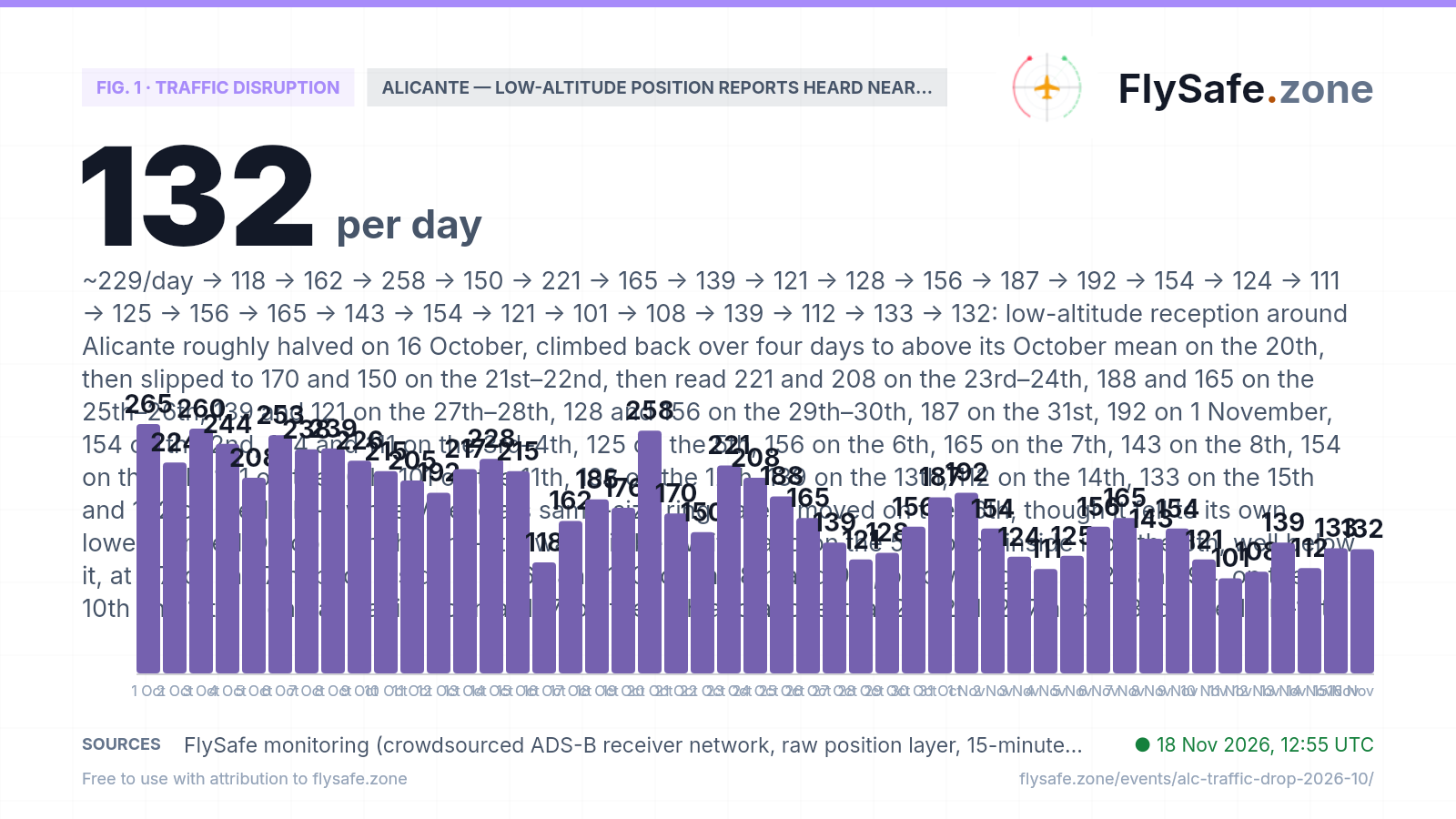
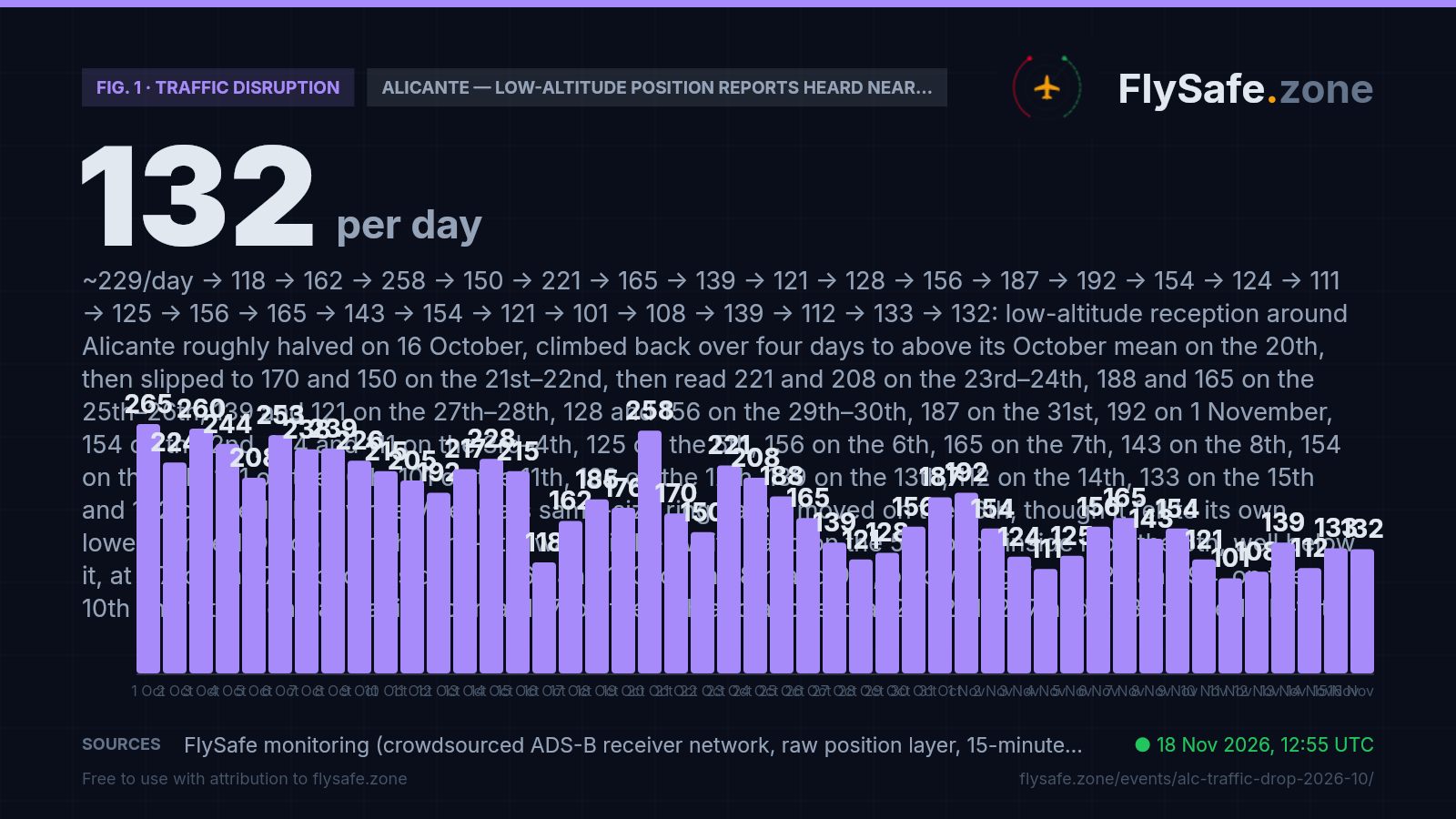
This chart does not count flights — it shows how well we could hear them. Across 1–15 October our receiver network logged between 192 and 265 position reports a day below 3,000 m within about 38 km of Alicante Airport (mean ~229) — the low, close band where departures and final approaches live. On 16 October that fell to 118 (−48%), and on the 17th it read 162, partway back. The 18th and 19th read 185 and 176, and on 20 October the layer logged 258 — above the 1–15 October mean — before slipping to 170 on the 21st and 150 on the 22nd, below the pre-event band again, and 221 and 208 on the 23rd and 24th, back inside it, then 188 and 165 on the 25th and 26th, below it again, and 139 and 121 on the 27th and 28th, the lowest since the 16th, and 128, 156 and 187 on the 29th, 30th and 31st — the 31st still just below the band — and 192 on 1 November, back at its floor, then 154 on the 2nd, below it again, and 124 and 111 on the 3rd and 4th, the 4th the lowest of the series until the 11th, below even the 16th's 118, and 125, 156, 165, 143 and 154 on the 5th, 6th, 7th, 8th and 9th, still below the band, and 121 and 101 on the 10th and 11th, the 11th the lowest of the series, then 108, 139, 112, 133 and 132 on the 12th, 13th, 14th, 15th and 16th, still below the band. Distinct aircraft heard over the same box at all altitudes slipped less — 142 on the 16th against a 181–218 band, then 183, 163, 174, 230 and 175 on the 17th–21st. As a control, the same-size ring around Valencia, 134 km north, logged 152 low-altitude reports on the 16th against 157–180 on 9–15 October — a few percent lower, not a halving — 154, 149, 168, 211, 185, 176, 178, 174, 186, 175, 150, 141, 157, 163 and 134 on the 17th–31st — the 27th and 28th below its own 157–180 band, a dip at Valencia too on those days, the 29th and 30th back inside it while Alicante's ring read 128 and 156, and the 31st below it again while Alicante's rose to 187, then 174 on 1 November, back inside its band, while Alicante's read 192, back at its own floor, and 180 on the 2nd, still inside its band, while Alicante's fell to 154, then 119 and 114 on the 3rd and 4th, its lowest since 1 October, while Alicante's read 124 and 111 — on those two days position reports across a box spanning the Iberian Peninsula also ran lower than on any October day, so that dip was regional, not Alicante's alone; we report it without attributing it. On the 5th the peninsula-wide count was back at the bottom of its October range while both rings stayed below their bands — Valencia's at 142, Alicante's at 125. On the 6th the peninsula-wide count was inside its October range and Valencia's ring back inside its band at 165, while Alicante's read 156, still below its own — Alicante's alone again. On the 7th the two parted the other way: Valencia's ring fell to 117, well below its band, and the peninsula-wide count ran just under its October range, while Alicante's rose to 165, still below its own; we report that without attributing it. On the 8th Valencia's ring was back inside its band at 163, while the peninsula-wide count stayed just under its October range and Alicante's fell to 143, still below its own. On the 9th Valencia's ring read 170, inside its band, and the peninsula-wide count was back inside its October range, while Alicante's read 154, still below its own — Alicante's alone again. On the 10th the two fell together — Valencia's ring to 126, below its band, and Alicante's to 121 — while the peninsula-wide count ran below every October day, a regional dip like the 3rd–4th, which we report without attributing. On the 11th both fell further — Valencia's ring to 94 and Alicante's to 101, the lowest of its series — with the peninsula-wide count lower still, again a regional dip we report without attributing. On the 12th Alicante's ring read 108 while Valencia's was back at its band floor, 157, and the peninsula-wide count ran just under its October range; on the 13th Alicante's read 139, still below its band, while Valencia's read 211, above its own, and the peninsula-wide count was back inside its October range — Alicante's alone again; on the 14th Alicante's read 112, still below its band, while Valencia's read 201, above its own, and the peninsula-wide count ran just under its October range; on the 15th Alicante's read 133, still below its band, while Valencia's read 267, above its own, and the peninsula-wide count was back inside its October range — Alicante's alone again; on the 16th Alicante's read 132, still below its band, while Valencia's read 263, above its own, and the peninsula-wide count was inside its October range — Alicante's alone again. These are 15-minute snapshots, not continuous tracks; 95 of the day's 96 snapshots were captured network-wide on the 16th and at least 96 on each day since, so the snapshot schedule itself does not explain the drop:
Fig. 1 — Position reports below 3,000 m (or on the ground) within ~38 km of Alicante Airport, 1 Oct–16 Nov 2026 · Data as of 18 Nov 2026, 12:55 UTC · Source: FlySafe monitoring (crowdsourced ADS-B receiver network, raw position layer, 15-minute snapshots).
Airports in the exposure zone
| Airport | Size | Observed signal | FIR |
|---|---|---|---|
| Alicante-Elche Miguel Hernández Airport (ALC) | large | — · 16 Oct now reads 82 (66 dep / 16 arr), −67% vs ~247 — yet Alicante callsigns flew 264 times; 17 Oct: 142 (−43%); 18 Oct: 188 (−24%); 19 Oct: 169 (−32%); 20 Oct: 364 (+47%); 21 Oct: 235 (−5%); 22 Oct: 162 (−34%); 23 Oct: 318 (+29%); 24 Oct: 243 (−2%); 25 Oct: 246 (0%); 26 Oct: 184 (−26%); 27 Oct: 161 (−35%); 28 Oct: 129 (−48%); 29 Oct: 120 (−51%); 30 Oct: 165 (−33%, third-night pass skipped); 31 Oct: 135 (−45%); 1 Nov: 154 (−38%); 2 Nov: 231 (−6%); 3 Nov: 102 (−59%, third-night pass skipped); 4 Nov: 118 (−52%); 5 Nov: 87 (−65%); 6 Nov: 171 (−31%); 7 Nov: 156 (−37%); 8 Nov: 150 (−39%); 9 Nov: 129 (−48%, third-night pass skipped); 10 Nov: 200 (−19%); 11 Nov: 176 (−29%); 12 Nov: 295 (+19%); 13 Nov: 349 (+41%); 14 Nov: 349 (+41%); 15 Nov: 350 (+42%) — 10–15 Nov backfilled after feed-wide ingest gaps, read departures; 134 departures with no airport identified on 16th | LECB |
| Valencia Airport (VLC) | large | 134 km · 285 movements on 16 Oct against 259–308 on 8–15 Oct; low-altitude reception 152 vs 157–180 | LECB |
| Ibiza Airport (IBZ) | large | 181 km · 271 movements on 16 Oct against 232–322 on 8–15 Oct | LECB |
| Palma de Mallorca Airport (PMI) | large | — · 731 movements on 16 Oct against 522–920 on 8–15 Oct | LECB |
| Josep Tarradellas Barcelona-El Prat Airport (BCN) | large | — · 1,124 movements on 16 Oct against 995–1,147 on 8–15 Oct | LECB |
| Adolfo Suárez Madrid–Barajas Airport (MAD) | large | — · 1,278 movements on 16 Oct against 1,210–1,363 on 8–15 Oct — feed healthy nationally | LECM |
| Málaga-Costa del Sol Airport (AGP) | large | — · 611 movements on 16 Oct against 547–635 on 8–15 Oct | LECM |
Distance alone does not determine impact — wind direction and the flight levels the ash reaches decide which airports and routes are affected on a given day. FIR = Flight Information Region.
What our monitoring shows: a thinned-out count at Alicante, not a quieter sky
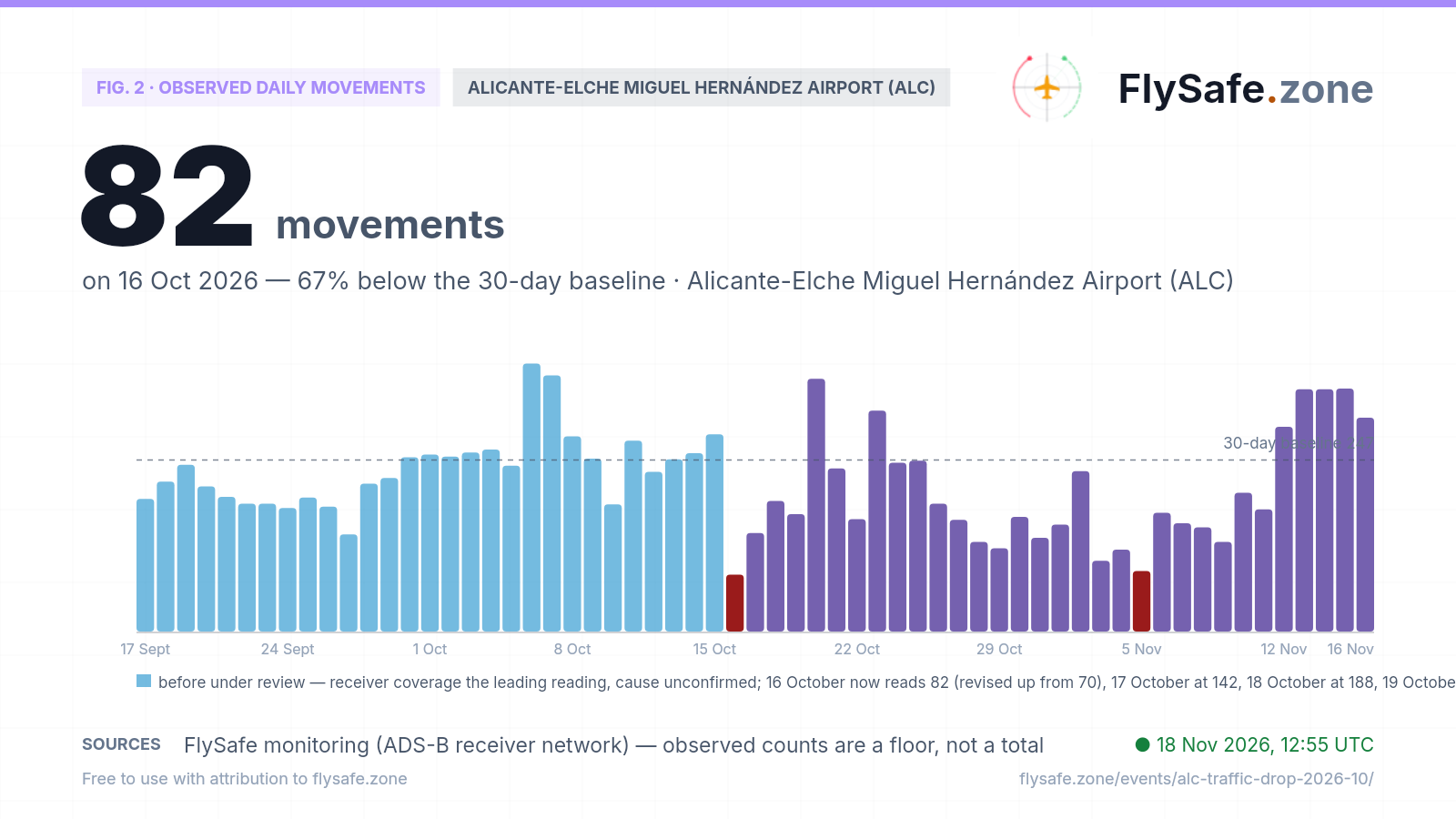
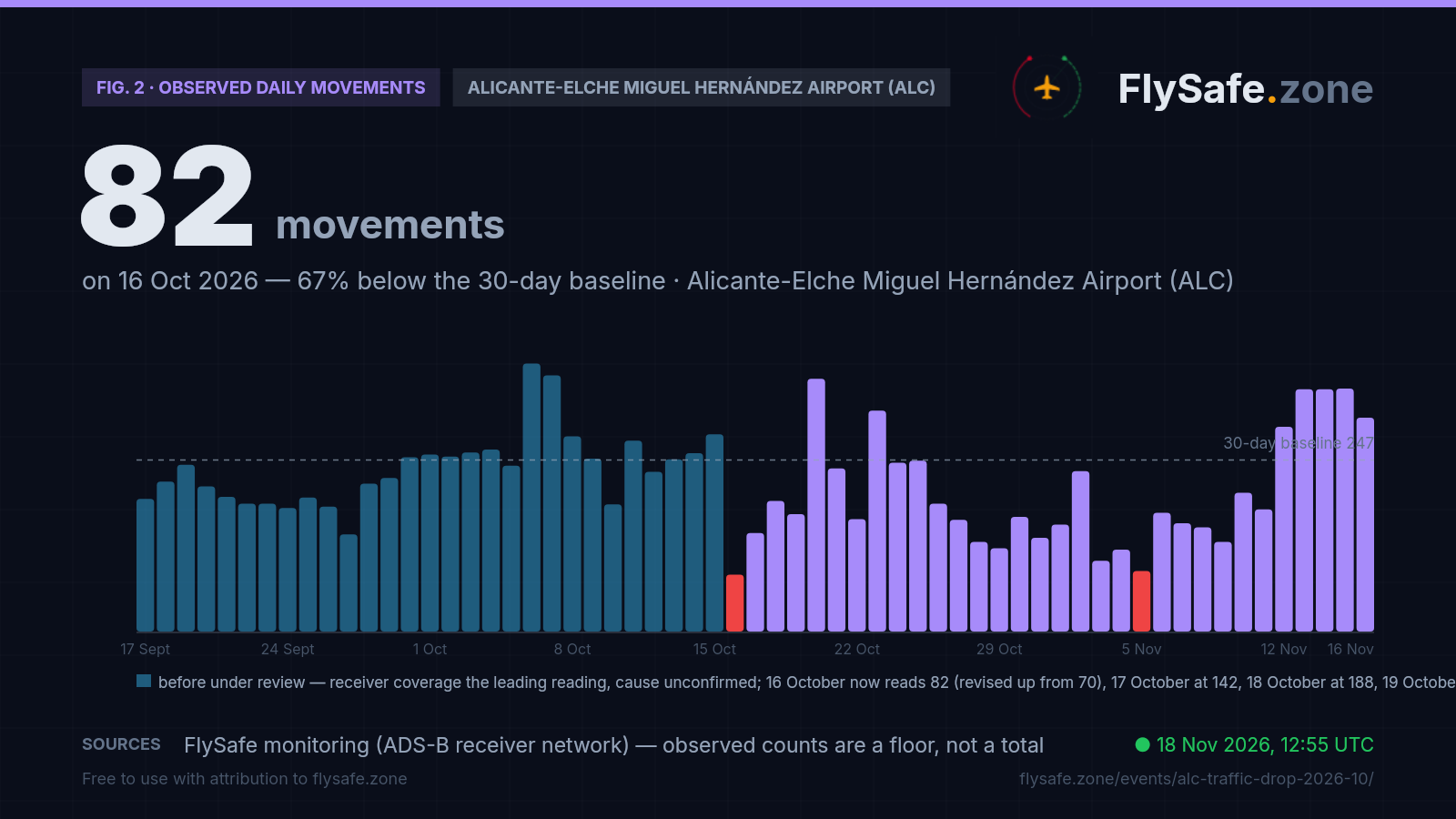
FlySafe tracks observed departures and arrivals at 493 airports from crowdsourced ADS-B receiver data. Observed counts are a floor, not a total — receiver coverage varies — but an airport measured against its own baseline is a reliable shape. Alicante-Elche Miguel Hernández Airport's last 30 days:
Fig. 2 — Observed daily movements at ALC, 17 Sept – 16 Nov (latest complete UTC day). Data as of 18 Nov 2026, 12:55 UTC · Source: FlySafe monitoring (ADS-B receiver network).
- Seven-day baseline (9–15 Oct): ~247 observed movements a day (183–284). Friday 16 Oct now reads 82 — −67% against that baseline. Detection fired at −65% against a rolling average of ~222 that already included the 16th itself.
- Read departures, not the total. Our feed captures Alicante's arrivals poorly on most days — between 16 and 111 a day across 8–15 October, against 162–220 departures — and the two arrival-heavy days of 6–7 October (198 each) are what lift the chart to 386 and 369 there. Departures are the steadier line: 66 on the 16th against ~191 a day on 9–15 October and 163, 222 and 188 on the three Fridays before (−65%).
- A thinning, not a cliff. Unlike a feed that stops at a fixed hour, the 16th's movements are spread from 03:00 to 23:00 UTC — but thin all day: 1, 0 and 2 departures in the 07:00, 08:00 and 09:00 UTC hours, against 14, 14 and 19 in the same hours on the 15th. Every carrier shrank together — the largest operator at the airport went from 61 departures on the 15th to 14 on the 16th.
- The rest of Spain ran a normal Friday in the same feed: Valencia 285 movements, Palma 731, Ibiza 271, Barcelona 1,124, Madrid 1,278, Málaga 611 — each within its own range of the preceding week. Network-wide the day holds 229,378 movement records, not a collection-gap day by our rule (60% of the 14-day median).
- Gap days, flagged: the 16th now reads 82 (66 departures, 16 arrivals), revised up from 70 at the third-night pass — late-ingested flights were reassigned to Alicante as coverage recovered, but the count remains −67% against the baseline. Saturday 17 October settled at 142 (69 departures in the rollup snapshot, 142 in the recount — the gap between the two is itself a coverage artefact), −43% against the baseline. Sunday 18 October settled at 188 (152 departures, 36 arrivals), −24%. Monday 19 October settled at 169 (131 departures, 38 arrivals), −32% — a slip back from the 18th, not a recovery held. Tuesday 20 October settled at 364 (184 departures, 180 arrivals), +47% against the baseline; the arrivals side, which our feed captures poorly on most days, came through at 180, as on 6–7 October (198 each), so read the departures — 184 against ~191 a day on 9–15 October, within 4%, the first day since the 15th inside the baseline band. The rollup snapshot for the 20th read 126 on the 23rd, a clipped partial-day figure flagged as a gap day on the airport brief; the recount is the number shown. Wednesday 21 October settled at 235 (156 departures, 79 arrivals), −5% against the baseline — but its departures, 156, sit below their 162–220 band of 9–15 October, on a day low-altitude reception slipped back to 170. The rollup snapshot for the 21st read 31 on the 24th, a clipped partial-day figure flagged as a gap day on the airport brief; the recount is the number shown. Thursday 22 October settled at 162 (131 departures, 31 arrivals), −34% — its departures again below the band, on a day reception read 150. The rollup snapshot for the 22nd read 11 on the airport brief, a clipped partial-day figure flagged there at the time as a gap day; the recount is the number shown. Friday 23 October settled at 318 (186 departures, 133 arrivals), +29% — its departures, 186, back inside their 162–220 band, on a day reception read 221, back inside its own. The rollup snapshot for the 23rd read 5 on the airport brief, likewise flagged at the time as a gap day; the recount is the number shown. The airport brief's rollup has since caught up with the recount to within a movement for 20–25 October, with no gap days flagged; for the 26th it now reads 186, two over the recount; for the 27th it now matches the recount at 161; for the 28th it now matches the recount at 129; for the 29th it now matches the recount at 120; for the 30th it now matches the recount at 165; for the 31st it now matches the recount at 135; for 1 November it now matches the recount at 154; for 2 November it now matches the recount at 231; for 3 November it matches the recount at 102; for 4 November it now matches the recount at 118; for 5 November it now matches the recount at 87; for 6 November it now matches the recount at 171; for 7 November it now matches the recount at 156; for 8 November it now matches the recount at 150; for 9 November it matches the recount at 129; for 10–16 November it reads 201, 177, 296, 351, 350, 185 and 309, within two of the recount on every day but the 15th, which it reads at 185 against a recount of 350; the recount is the number shown. Saturday 24 October settled at 243 (226 departures, 17 arrivals), −2% — its departures six above the top of the 162–220 band, not below it, on a day reception read 208, inside its own. Sunday 25 October settled at 246 (163 departures, 84 arrivals), level with the baseline — its departures one above the band's floor, on a day reception read 188, below its own. Monday 26 October settled at 184 (130 departures, 56 arrivals), −26% — its departures below the band again, on a day reception read 165. Tuesday 27 October settled at 161 (145 departures, 16 arrivals), −35%, unchanged by its third-night pass — its departures below the band for a second day, on a day reception read 139. Wednesday 28 October settled at 129 (117 departures, 12 arrivals), −48%, one higher after its third-night pass — its departures below the band for a third day running, on a day reception read 121. Thursday 29 October settled at 120 (102 departures, 18 arrivals), −51%, three higher after its third-night pass — its departures below the band for a fourth day running, on a day reception read 128, while Valencia's ring was back at its own band floor. Friday 30 October still reads 165 (133 departures, 32 arrivals), −33%: its third-night pass did not run on the night of 1–2 November (that night's batch carried no 30 October flights network-wide), and the night of 2–3 November carried none either, so 165 is the figure the day keeps — it may read slightly low. Its departures are below the band for a fifth day running, on a day reception read 156, while Valencia's ring held inside its own band at 163. Saturday 31 October settled at 135 (107 departures, 28 arrivals), −45%, five higher after its third-night pass on the night of 2–3 November; the network-wide batch that brought in the bulk of it was about a sixth lighter than on the three nights before. Its departures sit below the band for a sixth day running, on a day reception read 187, just under its own, while Valencia's ring read 134, below its own. Sunday 1 November settled at 154 (119 departures, 35 arrivals), −38%, three higher after its third-night pass — its departures below the band for a seventh day running, on a day reception read 192, back at its own floor, while Valencia's ring read 174, inside its own. It is the first day since the 24th on which reception held inside its band, and departures did not come back with it, so for that day the reception reading alone does not account for the low count; the cause remains unconfirmed. Monday 2 November settled at 231 (164 departures, 67 arrivals), −6%, four higher after its third-night pass — its departures two inside the band's floor, the first day inside the band since the 25th, on a day reception read 154, below its own, while Valencia's ring read 180, inside its own. On 1 and 2 November the two lines moved in opposite directions — reception back in its band with departures 43 short of their floor, then departures back inside their band with reception below its own — so on those two days the day-by-day link between reception and the count did not hold. Tuesday 3 November reads 102 (86 departures, 16 arrivals), −59%: its third-night pass did not run on the night of 5–6 November (that night's batch carried no 3 November flights network-wide), so it may read slightly low. Wednesday 4 November settled at 118 (109 departures, 9 arrivals), −52%, one higher after its third-night pass. Both days' departures sit below the band, on days reception read 124 and 111 while Valencia's ring fell with it to 119 and 114 and position reports across the Iberian Peninsula ran below every October day — a regional reception dip, which we report without attributing. Thursday 5 November settled at 87 (75 departures, 12 arrivals), −65%, unchanged by its third-night pass — its departures below the band again, on a day reception read 125, below its own, while Valencia's ring read 142, below its own too, and the peninsula-wide count was back at the bottom of its October range. Friday 6 November settled at 171 (122 departures, 49 arrivals), −31%, four higher after its third-night pass — its departures below the band for a fourth day running, 40 short of its floor, on a day reception read 156, below its own, while Valencia's ring read 165, back inside its own, and the peninsula-wide count was inside its October range — the count following Alicante's reception down, not the region's. Saturday 7 November settled at 156 (127 departures, 29 arrivals), −37%, four higher after its third-night pass — its departures below the band for a fifth day running, 35 short of its floor, on a day reception read 165, below its own, while Valencia's ring fell to 117, well below its own, and the peninsula-wide count ran just under its October range, so that day does not separate Alicante from the region. Sunday 8 November settled at 150 (131 departures, 19 arrivals), −39%, five higher after its third-night pass — its departures below the band for a sixth day running, 31 short of its floor, on a day reception read 143, below its own, while Valencia's ring was back inside its band at 163 and the peninsula-wide count stayed just under its October range. Monday 9 November reads 129 (112 departures, 17 arrivals), −48%: its third-night pass did not run on the night of 11–12 November (that night's batch carried almost no flights network-wide), so it may read slightly low — its departures below the band for a seventh day running, 50 short of its floor, on a day reception read 154, below its own, while Valencia's ring read 170, inside its own, and the peninsula-wide count was back inside its October range — the count following Alicante's reception down, not the region's. The feed-wide ingest gap ran five nights, 11–12 to 15–16 November: each of those night batches came in at a small fraction of its usual size network-wide, and 10–13 November could not be read while it lasted. On the night of 16–17 November a single backfill pass brought in 10–16 November network-wide (about 840,000 flight records), so those days can now be read; they come from one pass rather than the usual three nights and may still change. Tuesday 10 November reads 200 (137 departures, 64 arrivals), −19%, and Wednesday 11 November 176 (127 departures, 50 arrivals), −29% — departures below the band, 25 and 35 short of its floor, on days reception read 121 and 101 while Valencia's ring fell below its own band too and Valencia's own departures read 98 and 79 — the regional-dip days. Thursday 12 November reads 295 (162 departures, 134 arrivals), +19% — departures at the band's floor, on a day reception read 108. Friday 13, Saturday 14 and Sunday 15 November read 349, 349 and 350 (188, 186 and 187 departures; 163, 164 and 164 arrivals), +41% to +42% — departures back inside the band three days running, on days reception read 139, 112 and 133, still below its own. The backfill tied far more arrivals to Alicante than the regular nightly batches had — 134–164 a day on 12–15 November, against 9–67 a day across 26 October–9 November — so the totals overstate the change; read the departures. For 12–15 November the count came back without reception coming back with it — as on 2 November, the day-by-day link between the two did not hold. Monday 16 November reads 308 (157 departures, 152 arrivals; +25%) — departures five short of the band's floor, on a day reception read 132, below its own. The night batch of 17–18 November added no Alicante flights to it and came in at about two-thirds of its usual size network-wide, so 16 November is still provisional; Tuesday 17 November is not read yet.
Observed counts are a floor, not a total — they measure what our receivers heard, and they are meaningful only while coverage holds. Live view: ALC airport brief.
What it means for flights
What fired, and why we publish it anyway. Our detection layer flagged ALC when Friday 16 October came in at 82 observed movements against a rolling seven-day average of ~222 — a −63% traffic anomaly at one of Spain's busiest leisure airports. Against the seven days before it (~247 a day) the reading is −67%. A number that size at a name-recognisable airport is exactly what becomes a phantom headline, so automated multi-signal analysis checks it against every other layer we track before anything is claimed: the hour-by-hour shape of the count, the flights behind it, the raw position feed, neighbouring airports, a second receiver network, weather, closure signals and GNSS interference. None of those layers corroborated an operational event at Alicante on the 16th; one of them — flight continuity — points the other way. We publish that evidence, as we did for the Valencia coverage anomaly in August, because publishing observed counts honestly means publishing their failure modes too.
The flights kept flying. The strongest check is continuity. We took every callsign that departed Alicante in our records on 1–15 October and counted how often those callsigns flew on each day, from any airport. On the 16th they flew 264 times — against 258, 278, 247, 251, 257, 238 and 259 on 9–15 October. What changed is where our feed placed them: 55 were recorded departing Alicante (against 162–220 on prior days), 134 had no departure airport identified at all (against 5–80), and 75 were attributed to another airport (against 26–37). Inbound shows the same shape: callsigns that had landed at Alicante earlier in the month flew 273 times on the 16th (215–244 before), 12 were recorded arriving at Alicante, and 190 ended with no destination identified (85–160 before). As interpretation rather than measurement: a flight whose takeoff or landing is not heard close to the runway is tracked in the air but cannot be tied to an airport — which is what a loss of close-in reception looks like from the inside. We label the method honestly: a callsign is a flight number, not a specific aircraft or rotation, so this is a continuity indicator, not a census. The first hint may sit on the afternoon of the 15th, when unassigned departures rose to 53 and Alicante's departures ran 2, 2 and 2 in the 14:00–16:00 UTC hours before recovering into the evening. The same check on the days after: those callsigns flew 254, 260, 233 and 243 times on 17–20 October, with 98, 139, 129 and 177 recorded departing Alicante and 116, 60, 70 and 43 left without a departure airport — by the 20th the unassigned count was back inside its pre-event band of 5–80, and the count at the airport back near its usual 162–220.
Our own raw data shows reception thinning. Beneath the movement counts sits the raw position layer — 15-minute snapshots of every aircraft our receivers hear. Within roughly 38 km of Alicante, reports below 3,000 m or on the ground ran 192 to 265 a day across 1–15 October (mean ~229). On the 16th that layer recorded 118, from 79 distinct aircraft against 123–163 on prior days; on the 17th it read 162, then 185 and 176 on the 18th–19th, and 258 on the 20th — above the October mean, from 163 distinct aircraft — then 170 on the 21st and 150 on the 22nd, below the pre-event band again, and 221 and 208 on the 23rd and 24th, back inside it, then 188 and 165 on the 25th and 26th, below it again, and 139 and 121 on the 27th and 28th, the lowest since the 16th, and 128, 156 and 187 on the 29th, 30th and 31st — the 31st still just below the band — and 192 on 1 November, back at its floor, then 154 on the 2nd, below it again, and 124 and 111 on the 3rd and 4th, the 4th the lowest of the series until the 11th, below even the 16th's 118, and 125, 156, 165, 143 and 154 on the 5th, 6th, 7th, 8th and 9th, still below the band, and 121 and 101 on the 10th and 11th, the 11th the lowest of the series, then 108, 139, 112, 133 and 132 on the 12th, 13th, 14th, 15th and 16th, still below the band. Distinct aircraft heard over the same box at all altitudes fell less steeply — 142 on the 16th against 181–218, then 183, 163, 174, 230 and 175 on the 17th–21st. Valencia's identical ring, the control, logged 152 low reports on the 16th against 157–180 the week before, and 154–211 on the 17th–26th (185, 176, 178, 174, 186 and 175 on the 21st–26th), then 150 and 141 on the 27th–28th, below its own band — so that dip was not Alicante's alone — and 157 and 163 on the 29th–30th, back inside its band while Alicante's read 128 and 156, then 134 on the 31st, below its band again, on a day Alicante's rose to 187, 174 on 1 November, back inside it, and 180 on the 2nd, still inside it, while Alicante's fell to 154, then 119 and 114 on the 3rd and 4th, its lowest since 1 October, while Alicante's read 124 and 111 — a regional dip, with position reports across the Iberian Peninsula lower on both days than on any October day. On the 5th Valencia's ring read 142, still below its band, and Alicante's 125, while the peninsula-wide count was back at the bottom of its October range. On the 6th Valencia's ring read 165, back inside its band, and the peninsula-wide count was inside its October range, while Alicante's read 156, still below its own. On the 7th Valencia's ring fell to 117, well below its band, and the peninsula-wide count ran just under its October range, while Alicante's rose to 165, still below its own. On the 8th Valencia's ring read 163, back inside its band, while the peninsula-wide count stayed just under its October range and Alicante's fell to 143, still below its own. On the 9th Valencia's ring read 170, inside its band, and the peninsula-wide count was back inside its October range, while Alicante's read 154, still below its own. On the 10th Valencia's ring fell to 126, below its band, alongside Alicante's 121, and the peninsula-wide count ran below every October day — a regional dip, like the 3rd–4th. On the 11th Valencia's ring fell to 94 and Alicante's to 101, the lowest of its series, with the peninsula-wide count lower still — regional again. On the 12th and 13th Alicante's ring read 108 and 139, still below its band, while Valencia's was back at its floor, 157, and then above it, 211, and the peninsula-wide count was back inside its October range on the 13th — Alicante's alone again. On the 14th Alicante's read 112 while Valencia's read 201 and the peninsula-wide count ran just under its October range. On the 15th Alicante's read 133 while Valencia's read 267 and the peninsula-wide count was back inside its October range. On the 16th Alicante's read 132 while Valencia's read 263 and the peninsula-wide count was inside its October range. Reception came back on the 20th and the airport count followed it the same day — 364 movements once settled, departures within 4% of their baseline; the layer then slipped again on the 21st, and that day's count settled at 235 with departures at 156 — below their pre-event band, a partial follow-down rather than a repeat of the 16th; the 22nd settled at 162 with departures at 131, on a day reception read 150; the 23rd settled at 318 with departures at 186 — back inside their band, on a day reception was back inside its own — and the 24th settled at 243 with departures at 226; reception then slipped to 188 and 165 on the 25th–26th, and the counts followed it down — the 25th settled at 246 with departures at 163, one above the band's floor, and the 26th settled at 184 with departures at 130, below it; the 27th settled at 161 with departures at 145, below the band again, on a day reception read 139; the 28th settled at 129 with departures at 117, below it a third day, on a day reception read 121; the 29th settled at 120 with departures at 102, below it a fourth day, on a day reception read 128; the 30th reads 165 with departures at 133, below it a fifth day, on a day reception read 156 — its third-night pass was skipped; the 31st settled at 135 with departures at 107, below it a sixth day, on a day reception read 187; 1 November settled at 154 with departures at 119, below it a seventh day, on a day reception read 192, back at its band floor — the first day since the 24th that reception held inside its band without departures following it back; and 2 November settled at 231 with departures at 164, just inside the band, on a day reception read 154, below its own — the two moving in opposite directions on consecutive days; then 3 and 4 November read 102 and 118 with departures at 86 and 109, below the band, on the regional-dip days reception read 124 and 111 — the 3rd's third-night pass skipped; 5 November settled at 87 with departures at 75, below the band again, on a day reception read 125; 6 November settled at 171 with departures at 122, below the band a fourth day running, on a day reception read 156; 7 November settled at 156 with departures at 127, below the band a fifth day running, on a day reception read 165; 8 November settled at 150 with departures at 131, below the band a sixth day running, on a day reception read 143; 9 November reads 129 with departures at 112, below the band a seventh day running, on a day reception read 154 — its third-night pass skipped; 10 and 11 November, backfilled on 17 November, read 200 and 176 with departures at 137 and 127, below the band, on the regional-dip days reception read 121 and 101; and 12–15 November read 295, 349, 349 and 350 with departures at 162, 188, 186 and 187, at the band's floor and then inside it, on days reception read 108, 139, 112 and 133, still below its own — the count coming back without reception. This is a partial loss, not the near-total blackout we measured at Valencia in August, which is why we call it a leading reading rather than a finding: a real cut in traffic would also thin this layer, and the layer alone cannot separate the two. What separates them is the continuity check above — the flights were airborne.
The second network lost Alicante too — so it cannot arbitrate. We cross-check against a second crowdsourced ADS-B aggregate built on different volunteer receivers. Here it does not help: it recorded 7 movements at Alicante on 15 October and 3 on the 16th, against 191, 172 and 143 on 12–14 October, while recording 87 and 95 at Valencia on the same two days, inside its usual range there. That aggregate's Alicante count has dropped on its own before — 76 on 10 October, 48 on 27 September — and crowdsourced networks share volunteer hosts, so a local receiver outage can take both down. It has since come back on its own schedule: 9 on the 17th, 65 and 57 on the 18th–19th, then 208 on the 20th (163 of them arrivals, a side it had barely recorded at Alicante before) and 69 on the 21st, a day on which it logged 16 at Valencia — a return, then its own thinning, not an independent count for the days in question. Read plainly: two networks losing one airport at about the same time while the flights keep flying fits a shared reception problem near Alicante, but it is also why we do not yet have an independent count saying the airport ran a normal day.
Nothing regional, nothing in the weather. Every other Spanish airport we track ran normally in our own feed on the 16th — Valencia 285 movements, Palma 731, Ibiza 271, Barcelona 1,124, Madrid 1,278, Málaga 611 — and the network-wide total (229,378 records) is not a collection-gap day. Alicante's routine weather reports were VFR or CAVOK in all 48 observations on the 16th, light winds, no thunderstorm. Embedded-thunderstorm SIGMETs did cover parts of the Barcelona and Madrid FIRs from 10:17 UTC on 17 October — a FIR-level signal for the following day, which our movement layer has not yet captured and which we do not read here. GNSS interference across the Barcelona FIR (LECB) sat at 0.07% of aircraft on the 16th (21 of 31,435), against 0.01–0.05% on 5–15 October, and the airport's own 7-day interference ratio is zero. One FIR-level traffic-anomaly snapshot for LECB at 11:45 UTC on the 16th read a −97% dip in aircraft counted; it was not marked as a closure and is not borne out by the day's movement counts at Barcelona, Palma, Ibiza or Valencia. No closure event registered in LECB from mid-September through the 16th and the ten days after; a single low-confidence automated closure flag then appeared for LECB on 27 October, drawing on a FIR-wide traffic dip and drone-flight areas notified in Aragon and Catalonia, none near Alicante, and in the neighbouring Madrid FIR (LECM) another spanning 25–27 October and a further one for 30 October, citing drone-flight areas notified at Ceuta, in Lugo and near Madrid, none near Alicante either — a FIR-level statement about airspace signals, not a claim about operations at Alicante, which belong to the airport, the airlines and the Spanish authorities. One blind spot we name: our NOTAM set did not refresh between 4 and 27 October. The set as refreshed on 27–28 October held no notice for Alicante Airport itself; the one entry naming Alicante was a drone-flight segregated area at Agost, about 20 km north-west of the airport, from the surface to 5,000 ft, scheduled for 7, 14, 21 and 28 October — not the 16th — and it is no longer in the set. The set as refreshed on 1 November again held no notice for Alicante Airport itself; two temporary restricted areas in it named Alicante — one 400 m in radius, from the surface to 400 m above ground, about 18 km north-east of the airport, active 07:00–14:00 UTC on 28–29 October and 3–6 November, and one 1,500 m in radius at Cocentaina, about 50 km north, from the surface to 300 ft, on 30 October–1 November, which the notice says does not affect instrument traffic. Neither covers the airport, and departures were below their band on 26, 27, 30 and 31 October and 1 November as well, outside the first area's schedule; we report both without attributing the count to them. Neither is in the set as refreshed on 10, 11, 12, 14, 15, 16, 17 and 18 November, which holds no notice for Alicante Airport and none naming Alicante. The set holds only notices still current and was last refreshed on 18 November, so one issued and withdrawn between 4 and 27 October would not show.
What would change this page. Three things decide it. The settling count: the 16th now reads 82 (revised up from 70 at the third-night pass as late-ingested flights were reassigned to Alicante) — the low count is real, not an ingestion lag. The next days: Saturday 17 October settled at 142 (−43%), Sunday 18 October at 188 (152 departures, 36 arrivals, −24%), Monday 19 October settled at 169 (131 departures, 38 arrivals, −32%) — a slip back, not a recovery held — and Tuesday 20 October settled at 364 (184 departures, 180 arrivals): departures within 4% of their 9–15 October mean, the first day since the 15th inside the baseline band. Low-altitude reception near the airport read 185, 176, 258, 170, 150, 221, 208, 188, 165, 139, 121, 128, 156, 187, 192, 154, 124, 111, 125, 156, 165, 143, 154, 121, 101, 108, 139, 112, 133 and 132 on 18 October–16 November — above the ~229 October mean on the 20th, the day the count came back, then below the pre-event band again on the 21st and 22nd, back inside it on the 23rd and 24th, below it again on the 25th–31st, back at its floor on 1 November and below it again on the 2nd–16th, the 11th the lowest of the series. The 20th held once its tail landed. The 21st settled at 235 (156 departures, 79 arrivals), its departures below their 162–220 band on a day reception read 170 — the condition this page set for keeping the episode open, so it stays open. The 22nd settled at 162 (131 departures, 31 arrivals), its departures below the band too, on a day reception read 150. The 23rd settled at 318 (186 departures, 133 arrivals) — the first settled day since the 20th with departures back inside the band on a day reception held inside its own. The 24th settled at 243 (226 departures, 17 arrivals) — departures six above the top of the band, not below it, on a day reception held at 208. Reception then read 188 and 165 on the 25th and 26th, below its band again, and 139, 121, 128, 156 and 187 on the 27th–31st. The 25th settled at 246 (163 departures, 84 arrivals), departures one above the band's floor; the 26th settled at 184 (130 departures, 56 arrivals) — departures below the band again, on the day reception read 165 — the 27th settled at 161 (145 departures, 16 arrivals), departures below the band for a second day, on the day reception read 139, the 28th settled at 129 (117 departures, 12 arrivals), departures below the band for a third day, on the day reception read 121, the 29th settled at 120 (102 departures, 18 arrivals), departures below the band for a fourth day, on the day reception read 128, and the 30th reads 165 (133 departures, 32 arrivals), its third-night pass skipped, departures below the band for a fifth day, on the day reception read 156, and the 31st settled at 135 (107 departures, 28 arrivals), departures below the band for a sixth day, on the day reception read 187. Departures followed reception back down, as on the 21st–22nd, so the 23rd and 24th do not close the episode. Valencia's control ring also read below its own band on the 27th and 28th, so that reception dip was not Alicante's alone; we report it without attributing it. On the 29th and 30th Valencia's ring was back inside its band (157 and 163) while Alicante's read 128 and 156, below its own — the dip is Alicante's alone again. On the 31st the two parted the other way — Valencia's ring fell to 134, below its band, while Alicante's rose to 187, just under its own; we report that without attributing it either. On 1 November both rings were back inside their bands — Alicante's at 192, its floor, Valencia's at 174 — the first day since the 24th that Alicante's reception has not read below its band, and the first test of the close rule: that day settled at 154 (119 departures, 35 arrivals), its departures below the band for a seventh day, 43 short of its floor — reception came back to its band without departures following, so the rule is not met, and for that day the reception reading alone does not account for the low count. On the 2nd it went the other way: Alicante's ring fell to 154, below its band again, while Valencia's read 180, inside its own, and that day settled at 231 (164 departures, 67 arrivals), its departures two inside the band's floor — the count rose on a day reception fell, which does not meet the close rule either, since reception was not inside its band. On the 3rd and 4th Alicante's ring read 124 and 111, the 4th the lowest of the series until the 11th, below even the 16th's 118, but Valencia's fell with it to 119 and 114, its lowest since 1 October, and position reports across the Iberian Peninsula ran lower on both days than on any October day — a regional dip this time, unlike the 16th, which we report without attributing; those days read 102 and 118 (86 and 109 departures), below the band — the count followed reception down — the 3rd with its third-night pass skipped. On the 5th Alicante's ring read 125, still below its band, with Valencia's at 142, below its own; that day settled at 87 (75 departures, 12 arrivals), its departures below the band again — the count following reception down once more, so the close rule is not met. On the 6th Valencia's ring was back inside its band at 165 and the peninsula-wide count inside its October range, while Alicante's read 156, still below its own; that day settled at 171 (122 departures, 49 arrivals), its departures below the band for a fourth day running — the count following Alicante's reception down again, so the close rule is not met. On the 7th Valencia's ring fell to 117, well below its band, while Alicante's rose to 165, still below its own; that day settled at 156 (127 departures, 29 arrivals), its departures below the band for a fifth day running on reception still below its own, so the close rule is not met. On the 8th Valencia's ring was back inside its band at 163 while Alicante's fell to 143, still below its own; that day settled at 150 (131 departures, 19 arrivals), its departures below the band for a sixth day running — the count following Alicante's reception down again, so the close rule is not met. On the 9th Valencia's ring read 170, inside its band, while Alicante's read 154, still below its own; that day reads 129 (112 departures, 17 arrivals; third-night pass skipped), its departures below the band for a seventh day running — the count following Alicante's reception down again, so the close rule is not met. On the 10th and 11th Valencia's ring fell to 126 and 94, below its band, alongside Alicante's 121 and 101 — the 11th the lowest of Alicante's series — and position reports across the Iberian Peninsula ran below every October day — a regional dip, which we report without attributing. The night batches of 11–12 to 15–16 November came in at a small fraction of their usual size network-wide, so 10–13 November could not be read until a single backfill pass on the night of 16–17 November brought in 10–16 November; those days come from one pass and may still change. 10 and 11 November read 200 and 176 (137 and 127 departures), below the band, on the regional-dip days. 12 November reads 295 (162 departures), at the band's floor, on a day reception read 108, and 13, 14 and 15 November read 349, 349 and 350 (188, 186 and 187 departures) — departures back inside the band three days running, on days reception read 139, 112 and 133, still below its own. That does not meet the close rule, which needs reception inside its band too, and it came without reception recovering — so for those days the reception reading does not account for the count either way. Departures sat below the band seven days running, 26 October–1 November, came back inside it on 2 November on a day reception did not, fell below it again on the 3rd–11th, and were back inside it on the 12th–15th while reception stayed below its own, so the episode is not over. If departures return to the 162–220 band on days reception holds inside its own, this closes as a short reception loss; if departures stay below it, the episode is not over and we will say so. An official signal: a closure, a NOTAM, a reported strike or an operational notice for ALC appearing in any layer would make this a disruption event and the framing would change. Until then we publish measured signals, not conclusions about what happened at the airport.
Passenger questions, answered from the data
No signal in the layers we track indicates a closure or disruption at Alicante. No closure registered in the Barcelona FIR (LECB) on 16 October or the ten days after (a single low-confidence automated flag for 27 October draws on drone-flight areas in Aragon and Catalonia, none near Alicante), Alicante's weather reports were VFR or CAVOK all day on 16 October, and Valencia, Palma, Ibiza, Barcelona, Madrid and Málaga ran normal days. The −67% figure comes from our own observed count (82 movements, revised up from 70); the same flight callsigns that use Alicante flew 264 times that day, in line with prior days, but our receivers placed 55 of them at the airport. Saturday 17 October settled at 142 (−43%); Sunday 18 October at 188 (−24%); Monday 19 October settled at 169 (−32%); Tuesday 20 October settled at 364 (+47%); Wednesday 21 October settled at 235 (−5%); Thursday 22 October settled at 162 (−34%); Friday 23 October settled at 318 (+29%); Saturday 24 October settled at 243 (−2%); Sunday 25 October at 246 (level with the baseline); Monday 26 October settled at 184 (−26%), departures below their band again; Tuesday 27 October settled at 161 (−35%), departures below their band; Wednesday 28 October settled at 129 (−48%), departures below their band for a third day; Thursday 29 October settled at 120 (−51%), departures below their band for a fourth day; Friday 30 October reads 165 (−33%, its third-night pass skipped), departures below their band for a fifth day; Saturday 31 October settled at 135 (−45%), departures below their band for a sixth day; Sunday 1 November settled at 154 (−38%), departures below their band for a seventh day, although reception was back at its band floor; Monday 2 November settled at 231 (−6%), departures just inside their band, although reception was below its own; Tuesday 3 November reads 102 (−59%, its third-night pass skipped) and Wednesday 4 November settled at 118 (−52%), both on days of a regional reception dip; Thursday 5 November settled at 87 (−65%); Friday 6 November settled at 171 (−31%), departures below their band for a fourth day running; Saturday 7 November settled at 156 (−37%), departures below their band for a fifth day running; Sunday 8 November settled at 150 (−39%), departures below their band for a sixth day running; Monday 9 November reads 129 (−48%, its third-night pass skipped), departures below their band for a seventh day running. Tuesday 10 and Wednesday 11 November, backfilled on 17 November after five nights of feed-wide ingest gaps, read 200 (−19%) and 176 (−29%), departures below their band on days of a regional reception dip; Thursday 12 November reads 295 (+19%), departures at their band's floor; Friday 13, Saturday 14 and Sunday 15 November read 349, 349 and 350 (+41% to +42%), departures back inside their band although reception stayed below its own — the backfill tied far more arrivals to Alicante than the regular nightly batches, so read the departures. Our NOTAM set did not refresh between 4 and 27 October; the refreshed set holds no notice for the airport itself, but one issued and withdrawn in that window would not show. For the status of a specific flight, check your airline or the airport's own channels.
The observed count did — 82 movements on 16 October 2026 (revised up from 70) against ~247 a day the week before, a −67% reading. But observed counts are a floor, not a total. Flight callsigns that use Alicante flew 264 times that day, against 238–278 on the seven days before; for 134 of their departures our feed could not identify any departure airport, against 5–80 on prior days — the signature of takeoffs not being heard close to the runway. Low-altitude reception around the airport fell from a 192–265 daily band to 118, while Valencia's barely moved, and was back above its October mean on 20 October. Saturday 17 October settled at 142 (−43%); Sunday 18 October at 188 (−24%); Monday 19 October settled at 169 (−32%); Tuesday 20 October settled at 364 (+47%); Wednesday 21 October settled at 235 (−5%); Thursday 22 October settled at 162 (−34%); Friday 23 October settled at 318 (+29%); Saturday 24 October settled at 243 (−2%); Sunday 25 October at 246 (level with the baseline); Monday 26 October settled at 184 (−26%), departures below their band again; Tuesday 27 October settled at 161 (−35%), departures below their band; Wednesday 28 October settled at 129 (−48%), departures below their band for a third day; Thursday 29 October settled at 120 (−51%), departures below their band for a fourth day; Friday 30 October reads 165 (−33%, its third-night pass skipped), departures below their band for a fifth day; Saturday 31 October settled at 135 (−45%), departures below their band for a sixth day; Sunday 1 November settled at 154 (−38%), departures below their band for a seventh day, although reception was back at its band floor; Monday 2 November settled at 231 (−6%), departures just inside their band, although reception was below its own; Tuesday 3 November reads 102 (−59%, its third-night pass skipped) and Wednesday 4 November settled at 118 (−52%), both on days of a regional reception dip; Thursday 5 November settled at 87 (−65%); Friday 6 November settled at 171 (−31%), departures below their band for a fourth day running; Saturday 7 November settled at 156 (−37%), departures below their band for a fifth day running; Sunday 8 November settled at 150 (−39%), departures below their band for a sixth day running; Monday 9 November reads 129 (−48%, its third-night pass skipped), departures below their band for a seventh day running. Tuesday 10 and Wednesday 11 November, backfilled on 17 November after five nights of feed-wide ingest gaps, read 200 (−19%) and 176 (−29%), departures below their band on days of a regional reception dip; Thursday 12 November reads 295 (+19%), departures at their band's floor; Friday 13, Saturday 14 and Sunday 15 November read 349, 349 and 350 (+41% to +42%), departures back inside their band although reception stayed below its own — the backfill tied far more arrivals to Alicante than the regular nightly batches, so read the departures. That points to lost receiver coverage rather than lost flights; the cause is not confirmed.
By following the flights, not just the airport count. In a real drop, the flights that normally use the airport stop flying, or divert to named alternates, and other layers — closures, weather, official notices — usually show why. In a coverage loss, the same flight numbers keep flying at their usual volume but stop being tied to the airport, because their takeoffs and landings are not heard close in. On 16 October Alicante's callsigns flew 264 times as usual, and the share our feed could not tie to any airport jumped — while weather, closures and neighbouring airports stayed normal.
We publish measured signals, not safety verdicts — operating decisions belong to airlines, airports and the Spanish aviation authorities, who work from complete operational data rather than crowdsourced tracking. Nothing in the layers we track indicated a hazard at Alicante on 16 October; what dropped, on the evidence so far, was our ability to see the airport's traffic. Thunderstorm SIGMETs covered parts of eastern and southern Spain on 17 October — a FIR-level weather signal. For any specific flight, check your airline on the day of travel.
For media — the full kit
Everything on this page — charts, CSV, quotes — is published under CC BY 4.0: free to reuse with attribution to FlySafe.zone. Charts come in dark (social/web) and light (print/light layouts) versions; attribution and license are embedded in every file.
“Observed traffic at Alicante-Elche Miguel Hernández Airport fell 67% below its prior-week average on Friday 16 October, to 82 recorded movements (revised up from 70) — but the flight callsigns that normally use Alicante flew 264 times that day, in line with the week before, and our receivers placed 55 of them at the airport, with 134 departures that could not be tied to any airport at all; Saturday 17 October settled at 142, Sunday 18 October at 188, Monday 19 October at 169, Tuesday 20 October at 364, Wednesday 21 October at 235, Thursday 22 October at 162, Friday 23 October at 318, Saturday 24 October at 243, Sunday 25 October at 246, Monday 26 October at 184, Tuesday 27 October at 161, Wednesday 28 October at 129, Thursday 29 October at 120, Friday 30 October reads 165, Saturday 31 October settled at 135, Sunday 1 November at 154, Monday 2 November at 231, Tuesday 3 November reads 102, Wednesday 4 November settled at 118, Thursday 5 November at 87, Friday 6 November at 171, Saturday 7 November settled at 156, Sunday 8 November at 150 and Monday 9 November reads 129, while Tuesday 10 to Sunday 15 November, backfilled after five nights of feed-wide ingest gaps, read 200, 176, 295, 349, 349 and 350, with departures back inside their usual band on the 13th–15th; low-altitude reception around Alicante roughly halved on the 16th, was back above its October mean by the 20th, dipped again on the 21st–22nd and was back in its usual band on the 23rd–24th before slipping below it again on the 25th–31st returning to its floor on 1 November and reading below it again on the 2nd–16th, the 3rd–4th and the 10th–11th alongside a dip in Valencia's ring, while neighbouring airports, local weather and airspace-closure signals stayed normal, which points to a loss of close-in receiver coverage rather than a drop in flights, though the cause is not yet confirmed, according to flight-monitoring service FlySafe.zone.”
Boilerplate — about the source (for your article footer)
FlySafe.zone monitors airspace risk and observed airport activity worldwide: 334 flight-information regions scored daily, GPS-interference signals, volcanic-ash exposure and daily observed movements at 493 airports from the crowdsourced ADS-B receiver network. Methodology: flysafe.zone/methodology.
Need a different cut of the data, a comment, or numbers for another airport? Leave an email — we answer fast during active events.