Ground Operations Update at EHAM
On 30 April, easyJet completed the first scheduled commercial use of the TaxiBot semi-robotic towing vehicle at Amsterdam Airport Schiphol (EHAM), following an earlier validation phase. The operation marks a procedural shift in single-aisle ground movement at one of Europe's busiest hubs, with measurable consequences for fuel planning, block time computation, and dispatch coordination. FlySafe Research has compiled the available operational data to outline what flight crews, dispatchers, and network planners should consider as the system is integrated into routine activity at Schiphol.
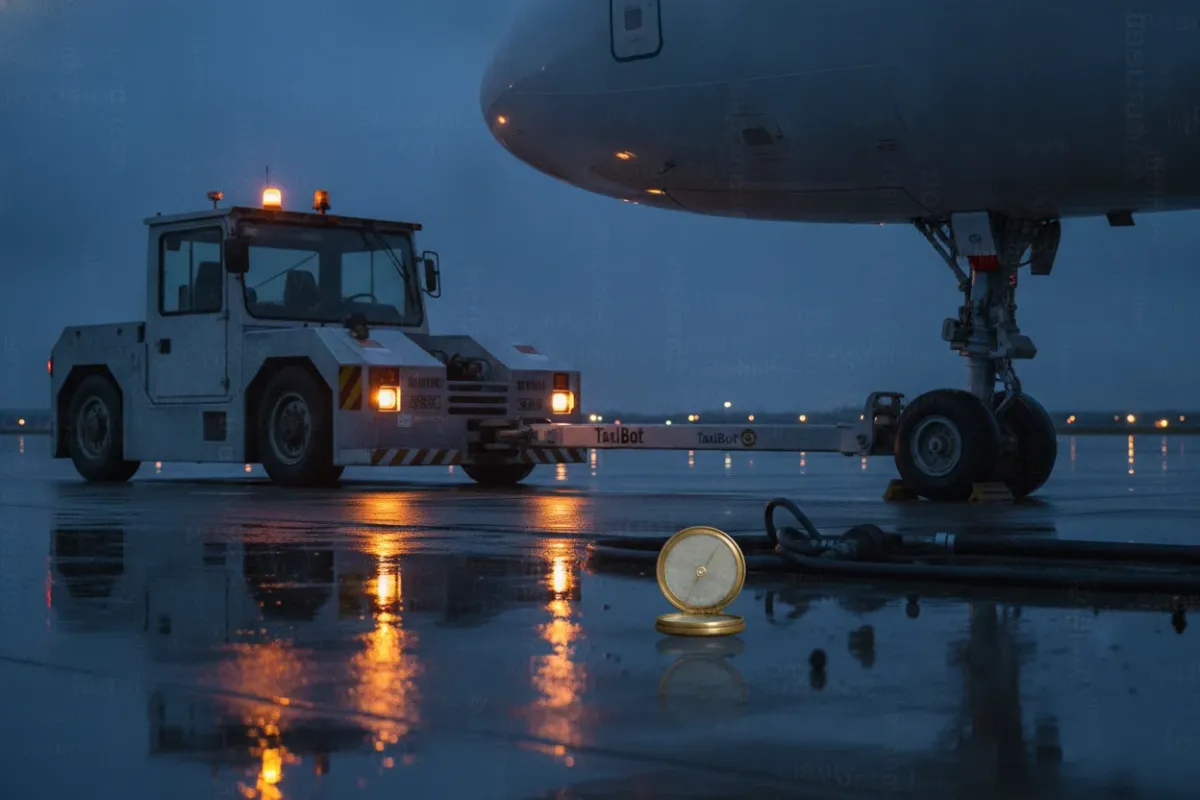
The system, manufactured by TLD Group and originally developed by Israel Aerospace Industries (IAI), is a pilot-controlled hybrid-electric tug that moves a narrow-body aircraft between the remote stand and the runway holding point without the use of the main engines. According to Airbus, the platform was further evaluated under the consortium project HERON, which concludes in December 2025.
Analysis based on publicly available data only.
Background: Why Schiphol, Why Now
Schiphol has declared the objective of becoming an emissions-free airport by 2030. According to the Airbus HERON brief, Schiphol's own modelling indicates that broad adoption of the TaxiBot could yield ground-phase fuel savings of approximately 50%, with reductions reaching as high as 85% on taxi legs to more distant runways. The variability is structural: longer ground segments — for instance taxi routings to Runway 36L (Polderbaan) — accumulate the largest fuel deltas because the proportion of total ground-burn attributable to the towed segment rises.
Esmé Valk, Chief People & Transformation Officer at Amsterdam Airport Schiphol, stated that the deployment represents "another practical step towards reduced emissions and noise on the apron," with Schiphol describing the program as "one of the most practical near-term sustainability measures currently available to commercial aviation," according to Simple Flying.
The economic context is non-trivial. Research published by IIETA notes that fuel cost represents approximately 30% of the airline industry's operating budget. In modelling work cited in the same source, the introduction of TaxiBot operations reduced aircraft taxi fuel consumption from 3,857,455 litres to 1,226,172 litres across 18,590 taxi-out operations, with CO₂ emissions falling from 12,190 tonnes to 3,875 tonnes — using a jet fuel emission factor of 3.16 kg per litre, sourced to IPCC (1999). The tug's own diesel emissions in that scenario were assessed at approximately 174 tonnes per year, applying a diesel factor of 2.67 kg CO₂ per litre.
How the System Works
The TaxiBot is a semi-robotic hybrid towing vehicle certified for the Boeing 737 and Airbus A320 families. It is controlled by the flight crew from the cockpit, with the main engines remaining off throughout the taxi phase. Only the auxiliary power unit (APU) is in operation, providing electrical and pneumatic services. The aircraft is mechanically disengaged from the tug at the runway holding point, after which standard engine-start procedures are conducted prior to line-up.
A hybrid-electric configuration is in service today. According to Airbus and Simple Flying reporting, a fully electric variant is expected to enter the TaxiBot offering from 2026.
The platform's industrial history is well documented. Wind River's customer success documentation records that IAI partnered with Airbus and TLD Group to bring the system to certification. Operational use began in India in November 2018 in collaboration with KSU Aviation, per TLD.
Operational Considerations at EHAM
The TaxiBot service at Schiphol applies to single-aisle narrow-body departures, principally A320-family and 737-family equipment, originating from compatible stands. Wide-body and regional types outside the certified envelope are not affected.
Operational factors for crews and dispatchers:
- Taxi-out fuel planning: Where TaxiBot is used, the engines-off segment shifts ground burn from jet fuel to electrical and APU consumption. Block fuel computations should reflect the procedure if dispatch software supports it. According to a Federal Aviation Administration filing on alternative taxi systems, comparable concepts have shown block fuel savings of up to 4–10% during taxi operations, with ground-emission reductions of up to 61% for CO₂ and NOx, although those figures relate to on-board electric nose-gear systems rather than external tugs.
- Engine warm-up timing: Manufacturer-published minimum run times before take-off thrust application remain authoritative. Single engine taxiing literature, including Cambridge University Press, notes that fuel and pollutant emissions can rise by up to 50% during taxi-in without engine-management procedures, underscoring the value of any procedure that delays or eliminates engine running on the ground.
- APU usage and noise: APU operation continues throughout the towed segment, producing localised noise and emissions distinct from main-engine signatures. The net acoustic impact on the apron is reduced relative to two-engine taxi, per Schiphol's published rationale.
- Brake life: A comparable engines-off concept assessed by the FAA indicated brake life increases on the order of 25–35% during the taxi phase, owing to reduced thrust counteraction.
- Block time: The attachment and detachment cycle introduces additional procedural steps. Schedule planners should monitor whether the procedure materially affects departure punctuality on tight rotations.
Environmental Profile
Published environmental analyses converge on substantial gains. The ICAS 2020 assessment of taxiing technologies concluded that tow trucks and onboard taxi techniques consume less fuel and produce lower emissions than full-engine and single-engine taxi, and identified them as alternative candidates for improving the environmental footprint of ground operations. Wind River documentation cites cuts in fuel consumption and CO₂ emissions of up to 85% under TaxiBot use.
EUROCONTROL's Sustainable Taxi Operations CONOPS, Edition 1.0 of 29 March 2024, identifies taxi-phase fuel and emissions as a significant contributor to climate impact and local air quality degradation. The document notes that electric taxi systems can be more efficient and cost-effective than using aircraft engines, and frames sustainable aviation fuels alongside electricity and hydrogen as the principal pathways for reducing net emissions in ground operations.
MIT analysis of the landing–taxi–take-off (LTO) cycle suggests that ICAO Engine Emissions Databank values may overestimate operational fuel burn and emissions in standardised cycles. The practical implication for operators is that real-world savings from engines-off taxi may differ from theoretical projections, and benefit quantification should rely on flight data records where available.
Recommendation for Operators and Dispatchers
Based on published Schiphol operational guidance, operators of A320 and 737 family aircraft routing through EHAM should:
- Confirm whether their stand assignment and runway pairing is included in TaxiBot service zones.
- Update operational flight plans to reflect engines-off ground segments where the procedure is approved.
- Brief crews on the attachment, taxi, and detachment sequence, including failure-mode reversion to conventional taxi if the tug is unavailable.
- Coordinate with handling agents to align gate-out times with tug availability, particularly during peak banks.
- Track ground time variance during the integration period to refine schedule buffers.
Airlines have rerouted ground procedures around the new service where it is available; the procedure is additive rather than mandatory.
Key Takeaway
FlySafe analysis shows that the TaxiBot rollout at Schiphol delivers one of the largest single-procedure reductions in ground-phase fuel burn available to single-aisle operators today, with documented savings of up to 85% on longer taxi routings and approximately 50% on average across modelled scenarios. The benefit profile is route-dependent, with longer taxi distances producing the strongest absolute gains. The procedure remains optional for compatible aircraft.
Frequently Asked Questions
Does using TaxiBot increase overall ground time compared to engine-powered taxiing?
The attachment and detachment cycle adds procedural steps at both ends of the taxi. Net ground time depends on tug availability, stand position, and runway distance. Schiphol's published rationale frames the procedure as operationally compatible with scheduled operations, though dispatch buffers may need monitoring during initial integration.
What happens if the TaxiBot system fails during taxiing?
The aircraft retains its full conventional capability throughout the towed segment. In the event of a tug malfunction, the aircraft can be detached and main engines started in accordance with standard procedures, with the aircraft then proceeding under its own power or being recovered by a conventional tug.
Why do fuel savings vary between routes?
The proportion of taxi time spent under tow drives the saving. Short taxi legs offer a smaller absolute reduction, while long routings — for example to Schiphol's Polderbaan runway — allow a larger share of the ground phase to occur with main engines off, pushing savings toward the 85% upper bound cited by Schiphol's modelling.
Can TaxiBot be used with older aircraft?
The system is certified for the Boeing 737 and Airbus A320 families per TLD documentation, covering both current-generation and previous-generation variants within those families. Compatibility outside those types is not currently established in the published certification basis.
FlySafe Research delivers route-level risk intelligence and operational bulletins for aviation professionals. Analysis is based exclusively on publicly available, independently verifiable data sources, including NOTAMs, EASA Safety Information Bulletins, ICAO publications, and academic literature. For ongoing monitoring of EHAM ground procedures and European airspace status, consult FlySafe analytical briefings.
- The 85% fuel saving figure is not universal — it applies specifically to long taxi routings like Runway 36L (Polderbaan). Average broad-adoption savings are modelled at ~50%, with the delta driven purely by how much of the total ground burn occurs during the towed segment.
- Modelling across 18,590 taxi-out operations shows fuel consumption falling from 3.86M to 1.23M litres and CO₂ from 12,190 to 3,875 tonnes, while the tug's own diesel emissions add only ~174 tonnes — confirming the net environmental benefit is substantial, not offset.
- The TaxiBot is pilot-controlled, not autonomous: it is a hybrid-electric tug that tows a narrow-body aircraft engines-off from stand to runway holding point, with the crew aboard guiding it — a distinction that matters for crew procedures and dispatch fuel planning.
Powered by B1KEY
Live tools behind the analysis.
The signals FlySafe writes about are also published live — continuously verified by the Sentinel pipeline.
Information is accurate as of the publication date. FlySafe uses exclusively publicly available data.