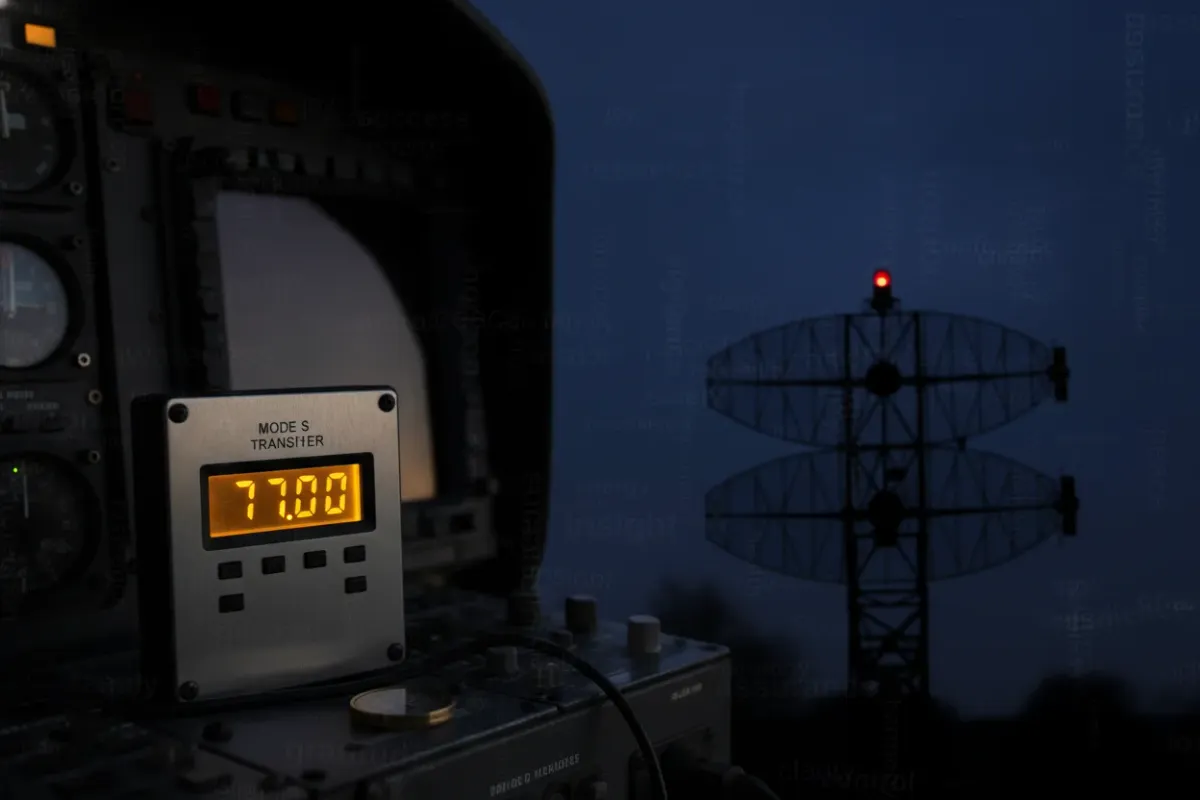
When an aircraft transponder is set to 7700, every air traffic control display within range marks that flight as an emergency, often within a single radar sweep. The code is one of three reserved sequences in international aviation, and it carries a precise, universally understood meaning regardless of country, airline, or aircraft type. FlySafe analysis shows that public interest in the code tends to spike whenever a flight-tracking website highlights a 7700 squawk in real time, frequently before any official statement is available. Understanding what the code does — and what it does not imply — helps separate routine precaution from genuine concern.
This bulletin explains the technical function of squawk 7700, how it differs from the other reserved codes, and how often it is realistically encountered in commercial operations. Analysis is based on publicly available data only.
What "Squawk" and 7700 Actually Refer To
The word "squawk" is controller and pilot shorthand for the four-digit code entered into an aircraft's transponder. The transponder is a small avionics unit that replies to interrogations from secondary surveillance radar and from other aircraft equipped with collision-avoidance systems. When a controller says "squawk 4271," the pilot dials that code into the panel, and the aircraft's radar return is then tagged with that identifier on the controller's screen.
These codes are expressed in octal, meaning each of the four digits ranges only from 0 to 7. That produces 4,096 possible combinations (8 × 8 × 8 × 8). Out of those several thousand codes, a small number are reserved worldwide and are never issued for ordinary identification. The most important reserved code is 7700.
Setting 7700 declares a general emergency. It is the broadest of the emergency signals and is appropriate for any situation in which the flight requires priority handling and immediate controller awareness. The transponder may operate in Mode A (transmitting the identity code), Mode C (adding pressure altitude), or Mode S (a data-rich mode that also underpins ADS-B position broadcasting). In all of these modes, a 7700 selection produces an unmistakable alert on the ground.
How Controllers and Systems Respond
The defining feature of 7700 is automation. A controller does not need to notice the code manually. When 7700 is selected, the radar processing system flags the target visually — typically with a flashing label or a distinct emergency symbol — and on many systems generates an aural alert as well. The flight is escalated to priority status across the affected sector.
Once a 7700 is observed, standard procedures follow a consistent pattern across most jurisdictions:
- The aircraft is given priority for routing, descent, and approach.
- Increased separation may be applied around the flight to give the crew room to manage the situation.
- Emergency services at the destination or nearest suitable aerodrome may be placed on standby.
- Adjacent sectors and units are coordinated so the flight transits cleanly through controlled airspace.
Importantly, a crew is not required to set 7700 before declaring an emergency by radio. A spoken declaration carries the same legal weight. The transponder code is valuable precisely because it communicates instantly and silently, even if the crew is too occupied to talk. In a high-workload moment — managing a system fault, a pressurization issue, or a medical event in the cabin — selecting 7700 lets the flight deck signal distress without spending the seconds required for a radio call.
7700 Is One of Three Reserved Codes
Squawk 7700 belongs to a trio of internationally reserved emergency and special-purpose codes. Each has a separate meaning, and the distinction matters.
7700 — General Emergency
The catch-all emergency code. It covers technical malfunctions, fuel concerns, smoke or fumes, engine irregularities, medical situations on board, and any other condition requiring urgent priority. It says, in effect, that the flight needs help and attention now.
7600 — Communication Failure
This code indicates lost radio communication. When a crew can no longer transmit or receive, 7600 tells controllers that the silence is a technical problem rather than a procedural lapse. The flight is then handled under published lost-communication procedures, with controllers anticipating the aircraft's likely routing and clearing traffic accordingly.
7500 — Unlawful Interference
This code signals unlawful interference with the flight. It is the most sensitive of the three and triggers a distinct, security-oriented response on the ground. Because of its gravity, controllers are trained to confirm the situation carefully and discreetly.
A long-standing memory aid summarizes the three: "seven-five, taken alive; seven-six, radio fix; seven-seven, going to heaven." The rhyme is grim, but it has helped generations of pilots recall which code maps to which scenario. SKYbrary maintains a clear reference on these reserved sequences for crews and controllers (emergency and special-purpose transponder codes).
How Often Commercial Airline Pilots Use It
For an individual airline pilot, deliberately selecting 7700 is uncommon. Many professional crews complete long careers having squawked an emergency code only a small number of times, and some never do. Commercial aviation is built around layered redundancy — multiple engines, backup systems, dispatch support, and conservative go/no-go decisions — so the conditions that warrant a general emergency declaration are, by design, rare on any single flight.
At the level of the entire global fleet, however, the picture looks different. Tens of thousands of commercial flights operate every day, alongside far larger numbers of business, charter, and general-aviation movements. Across that worldwide volume, emergency squawks appear regularly. Public flight-tracking services such as Flightradar24 detect and highlight 7700 selections automatically, and these alerts surface frequently across the combined traffic of all segments. The visibility of those alerts can create an impression of rising frequency, when in reality it reflects the growing reach of open tracking platforms rather than any change in safety trends.
It is also worth distinguishing severity. A large share of 7700 events are precautionary. A crew may set the code for a passenger medical issue requiring a priority diversion, a single-system fault handled entirely by checklist, or a decision to land sooner with comfortable fuel margins. These situations typically end with an uneventful landing and emergency services standing down. The code marks the need for priority, not the outcome.
FlySafe analysis shows that the most common public misreading of a 7700 alert is to equate the code with catastrophe. The accurate interpretation is narrower: the flight has requested priority handling and immediate awareness. The vast majority of such flights land safely at a planned or alternate aerodrome.
What This Means for Observers and Operators
For passengers and observers tracking flights online, a 7700 indication is a signal to wait for verified information rather than to assume the worst. Tracking displays show the code and the aircraft's path, but they do not show the reason, the crew's assessment, or the resolution. Official confirmation from the operator or the relevant authority remains the reliable source.
Recommendation: Operators and flight-watchers should treat a single 7700 indication as a prompt to monitor authoritative channels — controller communications where available, operator statements, and official safety bulletins — rather than third-party commentary. For crews, the procedural guidance is unchanged and well established: declare the emergency by the most effective means available, set the transponder code when workload permits, and follow published checklists. Regulators including the FAA publish transponder and emergency procedures in their aeronautical information manuals, and these remain the governing references.
Key Takeaway
Squawk 7700 is aviation's universal, instantly recognized request for emergency priority. It is one of three reserved transponder codes — alongside 7600 for communication failure and 7500 for unlawful interference — drawn from a set of 4,096 possible octal combinations. For any single commercial pilot, using it is rare; across the global fleet, emergency squawks are detected regularly, and most resolve in a routine priority landing. The code communicates urgency, not outcome, and a tracked 7700 is best read as a reason to seek verified information, not to draw conclusions.
FlySafe continues to monitor publicly available aviation data — NOTAMs, official safety bulletins, and open surveillance feeds — to help operators, analysts, and travelers interpret signals like squawk 7700 accurately and without speculation. For ongoing, data-driven aviation risk intelligence, follow FlySafe Research.
Analysis based on publicly available data only. This bulletin is informational and does not constitute operational guidance; official aeronautical publications and authority instructions take precedence at all times.
- Squawk 7700 is a four-digit transponder code that automatically flags an aircraft as an emergency on every radar display within range — no manual controller intervention required — making it universally recognized across all countries and aircraft types.
- The emergency response is largely automated: radar systems instantly flash a visual alert and may trigger an aural alarm, immediately granting the flight priority routing, extra separation, and standby emergency services.
Powered by B1KEY
Live tools behind the analysis.
The signals FlySafe writes about are also published live — continuously verified by the Sentinel pipeline.
Information is accurate as of the publication date. FlySafe uses exclusively publicly available data.