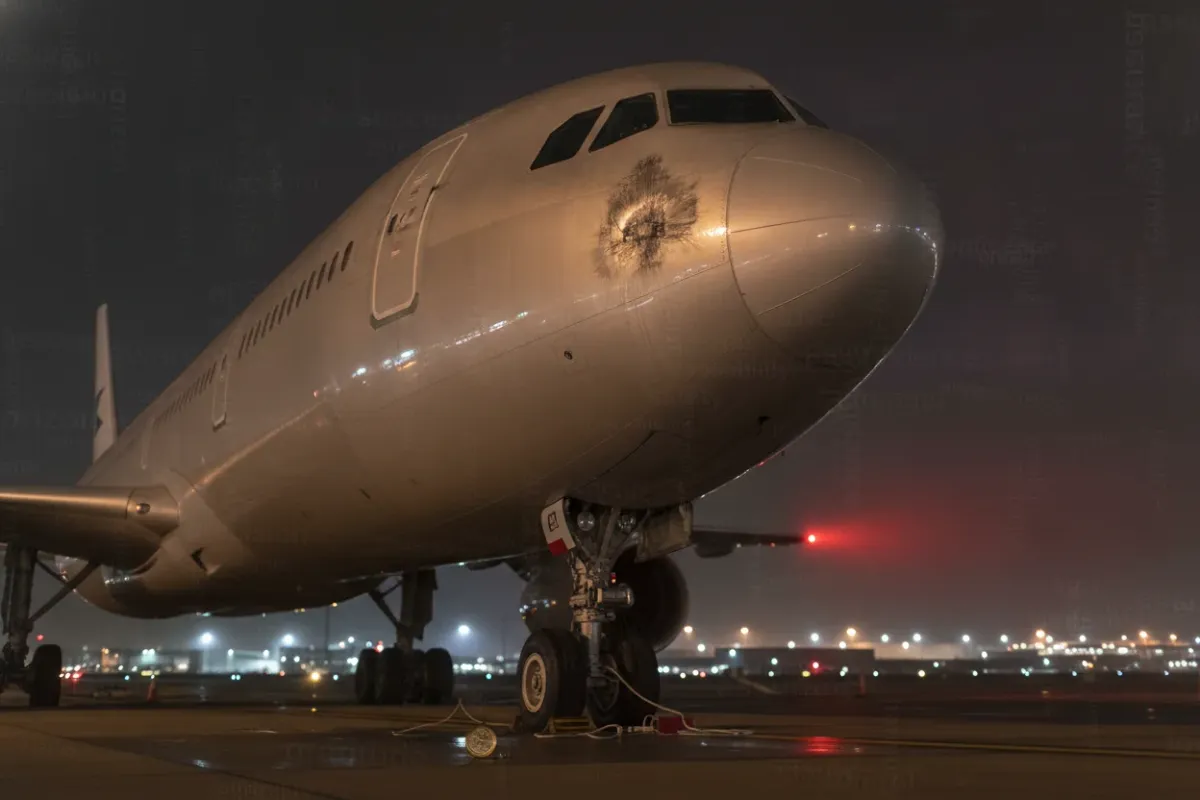
A JetBlue flight crew reported that a drone made contact with their aircraft above the cockpit while on final approach to New York's John F. Kennedy International Airport (JFK), in what has been described as the first known collision of its kind involving a commercial airliner in the United States. The event was logged through the same pilot-reporting channels that ordinarily capture pilot reports of turbulence, icing, and wind shear — a routine safety mechanism that is now increasingly documenting a newer category of hazard. FlySafe analysis of this report focuses on a single practical question relevant to every operator using the New York terminal area: what does an unauthorized drone in controlled airspace mean for approach safety, and how should it be interpreted.
The distinction matters. Unlike weather or mechanical factors, an unmanned aircraft encountered on approach is an operational factor introduced by third-party activity outside the aviation system. That places it in a different risk category from the hazards flight crews are trained to anticipate.
Airspace status: what the JFK report describes
Based on publicly available reporting, the sequence is straightforward. The aircraft was on approach to JFK when the crew reported an object making contact with the fuselage in the area above the cockpit, consistent with a small unmanned aircraft. The crew characterized the event as a physical impact rather than a near miss.
When a report of this nature is filed, standard procedures follow regardless of apparent severity. The airframe is subject to a post-event inspection before returning to service, with particular attention to the forward fuselage, windscreen structure, and any external sensors or antennas mounted near the point of contact. These inspection protocols exist precisely because the energy of even a small object at approach speeds can be significant, and because damage is not always visible from the flight deck.
Airspace status: JFK sits within Class B airspace, the most tightly controlled category around major US hubs. Recreational drone operation within this airspace is prohibited without explicit authorization, and the approach corridors serving the airport are among the most sensitive segments of the entire terminal area. An unmanned aircraft present in that corridor is, by definition, operating outside its permitted envelope.
Why drone encounters in controlled airspace are increasing
The JFK report is notable as a first confirmed collision, but reports of drones in and around controlled airspace are not rare. According to publicly available FAA UAS sighting records, pilots and air traffic personnel submit well over 100 drone sighting reports in a typical month across the United States. The overwhelming majority resolve without contact. The JFK event is significant because it appears to represent the point at which a reported sighting became a reported impact.
Several structural factors explain the trend:
- Volume. The number of registered drones in the United States is measured in the millions, and recreational units capable of reaching approach altitudes are widely available.
- Altitude overlap. Recreational operations are restricted to 400 feet above ground level, but arriving aircraft descend through that band on final approach near an airport. The two envelopes intersect precisely where airliners are least able to maneuver.
- Proximity to hubs. Dense population around major airports increases the statistical likelihood of an unauthorized flight near an active approach path.
The regulatory framework is clear. Recreational operators must remain clear of controlled airspace unless authorized, and commercial operators fly under Part 107 with defined altitude and airspace constraints. The FAA's guidance for recreational and commercial drone users sets out these boundaries in detail. The gap is not in the rules but in enforcement against operators who ignore them.
How pilot reports of turbulence — and now drone contact — enter the safety system
The mechanism that surfaced this event is worth understanding, because it is the same system that has quietly protected commercial aviation for decades. Pilot reports of turbulence, icing, and other in-flight hazards are transmitted in real time and archived for analysis, feeding both immediate traffic management and long-term safety trend work.
The confidential NASA Aviation Safety Reporting System collects voluntary reports from crews on any event that affected, or could have affected, the safety of flight. Turbulence encounters remain the single largest category of pilot-generated reports, which is why the phrase "pilot reports of turbulence" is so familiar within the industry. Drone encounters now enter the same pipeline. Each report, whether a sighting or an impact, becomes a data point that informs where risk is concentrating.
FlySafe analysis shows that treating drone contact as a reportable safety event — rather than an anomaly — is what allows the system to detect emerging patterns before they become routine. The value of the JFK report is not the single event but its contribution to a growing evidence base built from historical data analysis and open-source intelligence monitoring of airspace activity.
Is it safe to fly in the US right now?
For travelers asking whether it is safe to fly in the US right now, the report should be read in proportion. Commercial aviation in the United States operates at a level of safety that makes a fatal event exceptionally improbable across tens of millions of departures, as examined in FlySafe's review of what 35 million flights reveal about flight safety in 2026. A first known drone collision does not alter that underlying picture.
What it does highlight is a specific, localized, and manageable hazard. The risk is concentrated in a narrow altitude band close to major airports, it is driven by third-party behavior rather than any weakness in airline operations, and it is being actively tracked. The appropriate response is heightened attention to airspace integrity around hubs, not a change in the assessment that scheduled commercial flying remains among the safest forms of travel available. Passengers are not in a position to influence drone activity, and the layers of protection that make US aviation reliable — trained crews, redundant systems, and structured reporting — remain fully in place.
What is the safest airline in the US or the world?
Questions about what is the safest airline in the US, or what is the safest airline in the world, follow naturally from any incident report. In the context of a drone hazard, the honest answer is that the risk is not carrier-specific. An unauthorized drone in an approach corridor does not distinguish between operators. Any aircraft arriving into that airspace is exposed to the same operational factor, regardless of the badge on the tail.
Airline safety differences are real but are measured across maintenance culture, training depth, and operational discipline over long periods — not by exposure to a hazard that originates outside the aviation system entirely. For this category of risk, the more meaningful variable is airport environment and traffic density. FlySafe's analysis of the busiest airports in the world shows how movement volume concentrates at a small number of hubs, and it is that concentration — not airline identity — that shapes where drone exposure is highest. JFK, as one of the busiest gateways in the United States, sits squarely in that group.
Recommendation: what operators and drone users should note
Recommendation: the practical actions fall to two distinct groups.
For flight operations, the standard response holds. Any suspected contact with an unmanned aircraft should be reported immediately, the airframe should be inspected under existing procedures before further service, and the event should be documented through formal safety-reporting channels so it enters the analytical record. Approach and departure briefings near affected hubs may reasonably include awareness of recent drone activity where it has been reported.
For drone operators, compliance is the entire solution:
- Remain below 400 feet above ground level and clear of controlled airspace unless authorized.
- Use the FAA's authorization tools, including LAANC and the B4UFLY service, to confirm whether a location is restricted before flight.
- Treat the airspace around any major airport, and its approach corridors in particular, as off-limits without explicit clearance.
The JFK report demonstrates that the margin for error in these corridors is narrow. A single unauthorized flight in the wrong band of airspace is sufficient to produce a first-of-its-kind event.
Key takeaway
The reported drone collision on approach to JFK is best understood as a localized airspace-integrity issue rather than a change in the overall safety of US commercial aviation. The hazard is concentrated near major hubs, driven by third-party activity, and already visible to the reporting systems that have long captured pilot reports of turbulence and other in-flight risks. Those systems working as intended is precisely why the event is known at all.
FlySafe continues to track airspace risk using exclusively publicly available data, translating sighting and impact reports into a clear operational picture for pilots, airlines, and travelers. For ongoing airspace status assessments and route-level risk analysis, FlySafe remains the reference point for turning open aviation data into practical guidance.
Analysis based on publicly available data only. This bulletin does not access classified or non-public information and is intended for informational purposes.
- Это первое задокументированное физическое столкновение беспилотника с коммерческим авиалайнером в США — не сближение, а именно контакт, что переводит событие из категории «риск» в категорию «реализованный инцидент».
- Дрон в зоне Class B над JFK находился там заведомо незаконно: полёты без явного разрешения запрещены, а коридоры захода на посадку — наиболее чувствительные сегменты терминальной зоны.
- Риск от дрона принципиально отличается от погодных и механических факторов: это внешнее воздействие третьей стороны, находящейся вне авиационной системы, и экипажи не обучены его антиципировать так же, как турбулентность или обледенение.
Powered by B1KEY
Live tools behind the analysis.
The signals FlySafe writes about are also published live — continuously verified by the Sentinel pipeline.
Information is accurate as of the publication date. FlySafe uses exclusively publicly available data.