Memphis (MEM) Traffic ‘Drop’ of −62% on Sunday 1 November 2026 — Mostly the Superhub’s Weekly Sunday Trough, Plus a Softer-Than-Usual Sunday Under Thunderstorms
- The −62% headline is mostly a calendar effect. Memphis is a cargo superhub whose Sundays always run about 60% below its Tuesdays–Fridays.
- Against other Sundays, 1 November was 13–26% light, depending on which receiver feed you read — on a day with thunderstorms over the airport and lighter Sunday traffic at other US hubs too.
- Closed 11 November: the week of 2–7 November ran inside its usual ranges and Sunday 8 November (183) was back in the October Sunday band; no closure signal registered for the Memphis FIR. For a specific flight or shipment, the airline’s or carrier’s own status is the authority.
Advisory timeline — how active is this episode
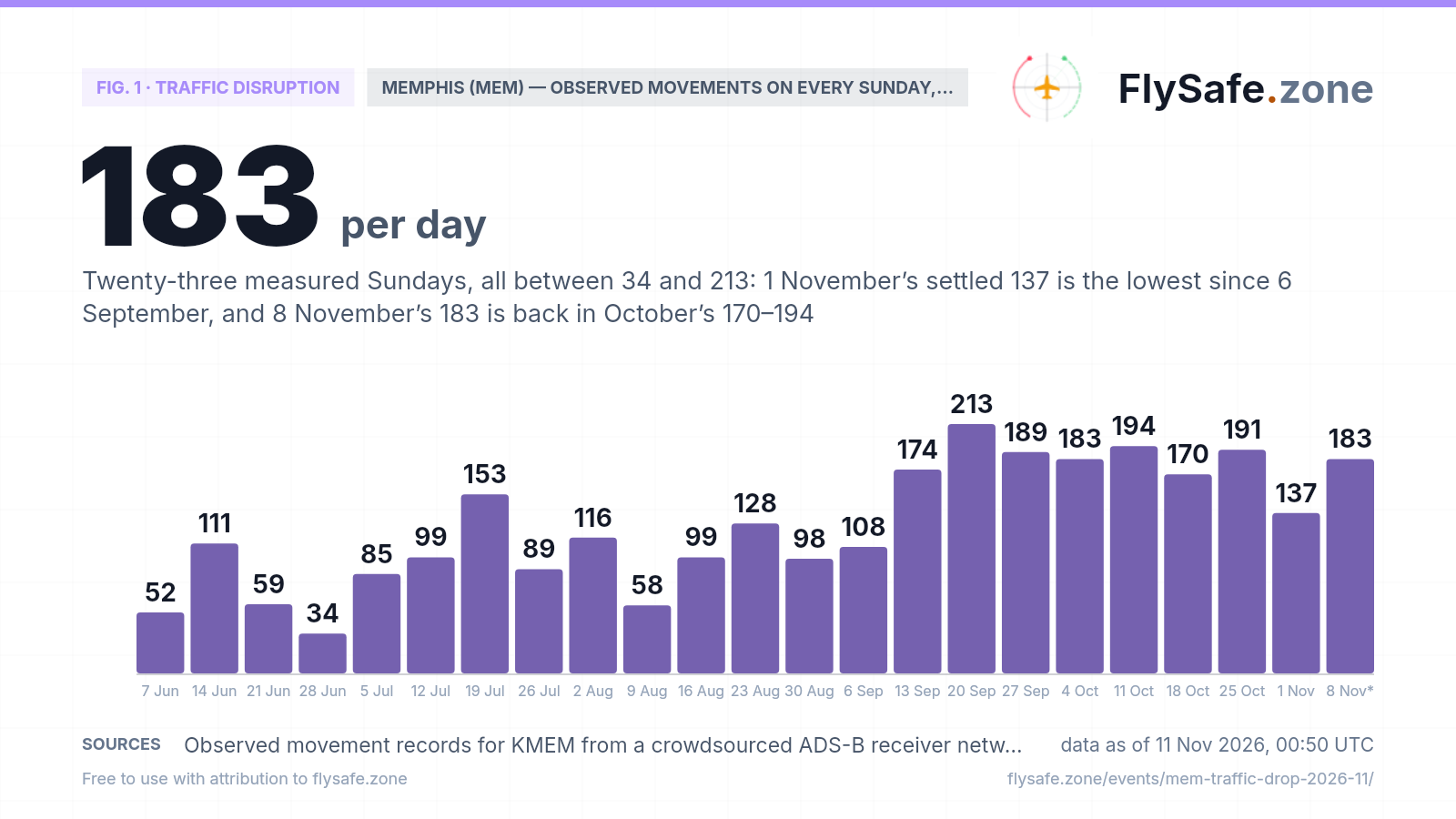
Memphis is the world hub of an overnight express-cargo network, and its week has a fixed shape: heavy Tuesday–Friday sorts, a light weekend. That is why the chart below compares Sundays with Sundays. Through October our primary feed read 183, 194, 170 and 191 on the four Sundays (~185), against ~466 a day on the sixteen Tuesdays–Fridays of 6–30 October. Sunday 1 November settled at 137 (92 departures, 45 arrivals; 134 on our first, provisional reading) — the lowest Sunday since 6 September (108), but inside the 34–213 range of all twenty-three Sundays we have measured since 7 June. Sunday 8 November read 183 (116 departures, 67 arrivals; a recount from the raw flight records, still provisional), back inside October’s band. The earlier summer Sundays sit lower partly because our coverage of the field improved from mid-September; the same comparison was the whole story of our August Memphis brief.
Fig. 1 — Observed departures + arrivals at Memphis International (KMEM) on each Sunday, UTC day, primary crowdsourced ADS-B receiver feed; 8 Nov 2026 is a recount from raw flight records and still provisional · Data as of 11 Nov 2026, 00:50 UTC · Source: Observed movement records for KMEM from a crowdsourced ADS-B receiver network, as collected by FlySafe monitoring.
Airports in the exposure zone
| Airport | Size | Observed signal | FIR |
|---|---|---|---|
| Memphis International (MEM) | large | — · Sun 1 Nov: 137 observed (92 dep / 45 arr, settled) vs ~185 Oct Sundays (−26%); independent feed 289 vs ~333 (−13%); Sun 8 Nov 183 (provisional), back in band | KZME |
| Louisville Muhammad Ali International (SDF) | large | 514 km · cargo peer · Sun 1 Nov −14% (primary) / −8% (independent) vs its October Sundays | KZID |
| Indianapolis International (IND) | large | 613 km · cargo peer · Sun 1 Nov −22% on both feeds vs its October Sundays | KZID |
| Hartsfield–Jackson Atlanta International (ATL) | large | 533 km · coverage check · Sun 1 Nov −18% (primary) / −17% (independent) vs its October Sundays | KZTL |
Distance alone does not determine impact — wind direction and the flight levels the ash reaches decide which airports and routes are affected on a given day. FIR = Flight Information Region.
What our monitoring shows: a weekly saw-tooth, and one Sunday at the bottom of it
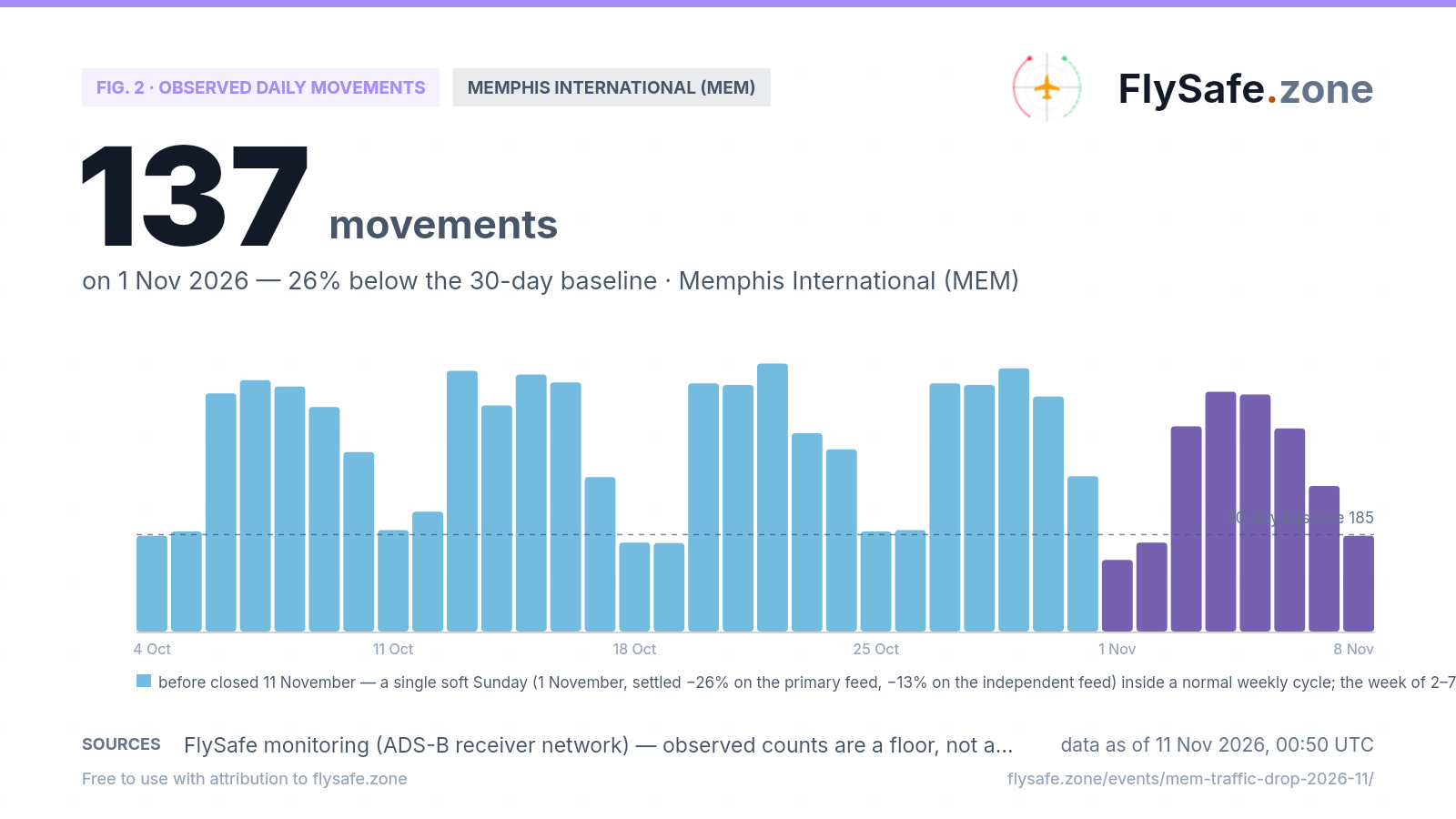
FlySafe tracks observed departures and arrivals at 493 airports from crowdsourced ADS-B receiver data. Observed counts are a floor, not a total — receiver coverage varies — but an airport measured against its own baseline is a reliable shape. Memphis International's last 30 days:
Fig. 2 — Observed daily movements at MEM, 4 Oct – 8 Nov (latest complete UTC day). Data as of 11 Nov 2026, 00:50 UTC · Source: FlySafe monitoring (ADS-B receiver network).
- The chart is every day from 4 October to 8 November; the dashed baseline is the Sunday reference, ~185 (mean of the four October Sundays), because the right comparison for a Sunday is other Sundays. In October, Tuesdays–Fridays ran 379–512 (~466), Sundays and Mondays 169–229.
- Sunday 1 November: 137, settled (−26% vs ~185). Our first reading on 3 November was a provisional 134; the day has since finished filling on the primary feed and rose by three movements.
- The week after: Monday 2 November 170 (October Mondays 169–229); Tuesday–Friday 3–6 November 392, 458, 453, 388 (~423, all inside October’s 379–512); Sunday 8 November 183 (−1% vs ~185, provisional).
- Corrected bars, 7–8 November: the stored figure for Saturday 7 November is 9 — a routine refresh clipped the day — and a recount from the raw flight records gives 278, a little under the 295–348 of the four October Saturdays; the independent aggregate has that Saturday at 491, inside its own 462–494. Sunday 8 November is stored at 179, recount 183. We plot the recounts.
- Not yet measured: Monday 9 November has no bar — our primary feed had ingested only a small fraction of that day worldwide at the time of writing. The independent aggregate reads 272 at Memphis that day, inside the 252–307 of its October Mondays. That aggregate has no record for Friday 6 November.
- Independent feed: a second crowdsourced ADS-B aggregate counts 289 movements at Memphis on 1 November against 308–353 on the five previous Sundays (~333, −13%) — the lowest Sunday in its six-week window, but a far smaller step than the flag. On Monday 2 November it reads 278, squarely inside the 252–307 of the four previous Mondays.
- Corrected bar, 31 October: the stored figure for Saturday is 142, but that day was clipped by a routine refresh; a recount from the raw flight records gives 297, inside the 295–348 of the three previous Saturdays. We plot the recount.
- Every count is a floor, not a total: crowdsourced receivers miss aircraft, especially low on the ground and at night.
Live view: MEM airport brief.
What it means for flights
What fired, and why most of it is the calendar. Our detection layer compares each day with a rolling seven-day average. At most airports that works; at Memphis it collides with the weekly rhythm of an express-cargo hub, whose main sorts run Tuesday to Friday nights. A Sunday at Memphis is always a small fraction of the week’s average: in October our primary feed read ~185 on Sundays against ~466 on Tuesdays–Fridays. So a −62% flag on a Sunday is, for the most part, the airport’s ordinary shape. We documented the same false-alarm pattern for Memphis in the August brief and for the Louisville cargo hub in the September SDF brief. Automated multi-signal analysis therefore re-checks a cargo-hub flag against the same weekday before treating it as a drop.
The part that is real: a light Sunday, on both feeds. After the weekday correction, a dip remains. Our primary feed has 1 November at 137, settled (134 on our first, provisional reading), against 170–194 on the October Sundays (−26%); an independent ADS-B aggregate has 289 against 308–353 on the previous five (−13%). The two feeds disagree on the size; both are floors, and we report the dip as a range rather than pick one. Hour by hour, the primary feed’s 1 November shortfall sits mainly in the 13:00 UTC hour and in 18:00–21:00 UTC (19 movements against 43 and 38 in the same hours of the two previous Sundays).
Weather over the field — recorded, not assigned as the cause. Routine airport weather reports for Memphis on 1 November show thunderstorms at the field from 07:10 to 07:36 UTC and again from 11:47 to 13:22 UTC — overhead at 12:54 UTC, with heavy rain, visibility down to 1 statute mile and cloud ceilings of 400–900 ft. 22 of the day’s 46 reports were in instrument conditions (IFR), and the low cloud returned after 22:00 UTC; the previous Sunday, 25 October, all 31 reports were visual (VFR). Low ceilings and storm cells slow arrival rates and can hold departures, which fits the 13:00 UTC gap. It does not, on its own, explain the evening shortfall, and we do not assign a cause.
Not just Memphis: a soft Sunday across the network. Other hubs read below their own October Sundays on 1 November too, on both feeds: Atlanta −18% (primary) and −17% (independent), Indianapolis −22% on both, Louisville −14% and −8%. The independent aggregate’s worldwide total was about 8% under the two previous Sundays. 1 November was also the day US clocks went back an hour; the UTC day we count is still 24 hours, and we do not attribute the dip to the change. What the network picture does say is that Memphis was not alone — which argues against an airport-specific operational event.
What we checked, and what we cannot see. No closure signal registered in the Memphis FIR (KZME) in our detection layer — a FIR-level check: the last KZME closure candidates, from 1 June, were invalidated. Our NOTAM set for the Memphis FIR was last refreshed on 15 August, so we draw no conclusion from the absence of a closure notice there. Crowdsourced ADS-B counts are a floor: they show what the receivers heard, not every movement, and cargo flights at night are among the hardest to capture. The close rule we set on 3 November: if 1 November stays the low point once settled and 8 November returns to the 170–194 band, we close this brief as a single soft Sunday. Both conditions were met; see below. The operating picture on any given day stays with the airport, the airlines and the FAA.
What the data showed — close-out, 11 November. Sunday 1 November settled at 137 observed movements on our primary feed — −26% against the ~185 of the October Sundays — and −13% (289 vs ~333) on the independent aggregate. It stayed the low point. The week that followed ran inside its October ranges: Monday 2 November 170 (October Mondays 169–229), Tuesday–Friday 3–6 November 388–458 (~423, inside 379–512). Sunday 8 November read 183 (−1% vs ~185) on a recount from the raw flight records — provisional, as the last nightly passes may still add a few movements — and 341 on the independent aggregate, inside its 308–353 October Sunday range. Two marked days: Saturday 7 November was clipped by a routine refresh (stored 9), so we plot the recount of 278, slightly under the October Saturdays’ 295–348 while the independent feed reads 491, inside its own range; Monday 9 November has no bar yet on the primary feed (independent: 272, in range), and the independent aggregate has no record for 6 November. No closure signal has registered in the Memphis FIR (KZME) since the invalidated 1 June candidates, and our NOTAM set for that FIR still dates from 15 August. We read 1 November as a single light Sunday — on a day of thunderstorms over the field and a soft Sunday at other US hubs — inside the normal weekly cycle of a cargo superhub, and we assign it no single cause. This brief is closed; the MEM airport brief keeps updating nightly.
Passenger questions, answered from the data
We measure observed movements, not cancellations. On Sunday 1 November our feeds recorded 13–26% fewer movements at Memphis than on its October Sundays, on a day with thunderstorms over the field; the headline −62% figure mostly reflects that Memphis Sundays are always far lighter than its Tuesday–Friday cargo sorts. No closure signal registered for the Memphis FIR. For a specific flight, the airline’s status page is the authority.
Memphis is the main hub of an overnight express-cargo network that sorts parcels mostly on Tuesday–Friday nights. In October our primary feed counted ~466 movements a day on Tuesdays–Fridays and ~185 on Sundays — a weekly swing of about 60% that is normal for the airport.
As of 11 November, the observed counts are back in their usual ranges: Monday 2 November 170, Tuesday–Friday 3–6 November 388–458, and Sunday 8 November 183 (provisional) against 170–194 on the October Sundays. The independent feed agrees (8 November 341, inside 308–353). This brief is closed; the MEM brief updates nightly. For a specific flight or shipment, the airline’s or carrier’s own status is the authority.
Weather reports show thunderstorms at the field from 11:47 to 13:22 UTC (and briefly around 07:10 UTC), heavy rain and low cloud, with instrument conditions in 22 of 46 reports. Our hourly counts dip around 13:00 UTC, which fits, but the evening shortfall happened in calmer conditions, so we do not assign the whole dip to weather.
For media — the full kit
Everything on this page — charts, CSV, quotes — is published under CC BY 4.0: free to reuse with attribution to FlySafe.zone. Charts come in dark (social/web) and light (print/light layouts) versions; attribution and license are embedded in every file.
“Observed traffic at Memphis International read 62% below its rolling average on Sunday 1 November, but most of that is the cargo superhub's normal weekly trough: compared with its own October Sundays, the day ran 13–26% light depending on the receiver feed, on a day of thunderstorms over the field and lighter Sunday traffic at other US hubs, and the following week and Sunday 8 November were back in their usual ranges, according to flight-monitoring service FlySafe.zone.”
Boilerplate — about the source (for your article footer)
FlySafe.zone monitors airspace risk and observed airport activity worldwide: 334 flight-information regions scored daily, GPS-interference signals, volcanic-ash exposure and daily observed movements at 493 airports from the crowdsourced ADS-B receiver network. Methodology: flysafe.zone/methodology.
Need a different cut of the data, a comment, or numbers for another airport? Leave an email — we answer fast during active events.