Beijing Capital (PEK) Observed Traffic '−88%' on 7 November 2026 — the Same One-Airport Step We Saw in October, and Still No Independent Count
- Our count at Beijing Capital fell from about 274 movements a day to 26 on 7 November, in a step after 15:00 UTC on 6 November, and read 0–3 an hour through 8 November.
- Tianjin next door, the wider north-China sample, our worldwide total and Capital's weather all read ordinary or close to it. That pattern usually means our receivers lost the airport — and the same thing happened from 30 September to 16 October, ending in a single day.
- We have no independent count at Capital to prove it either way. Our notice set for the Beijing FIR, refreshed on 17 November, holds no notice closing the aerodrome or a runway. Check your airline and the airport for the status of any flight.
- Closed 17 November: the count stepped back from about 05:00 UTC on 9 November and read 777–903 a day on 10–15 November, above its old level — the same week Beijing Daxing appeared in our feed for the first time. That looks like a change in coverage; the cause was never confirmed.
Advisory timeline — how active is this episode
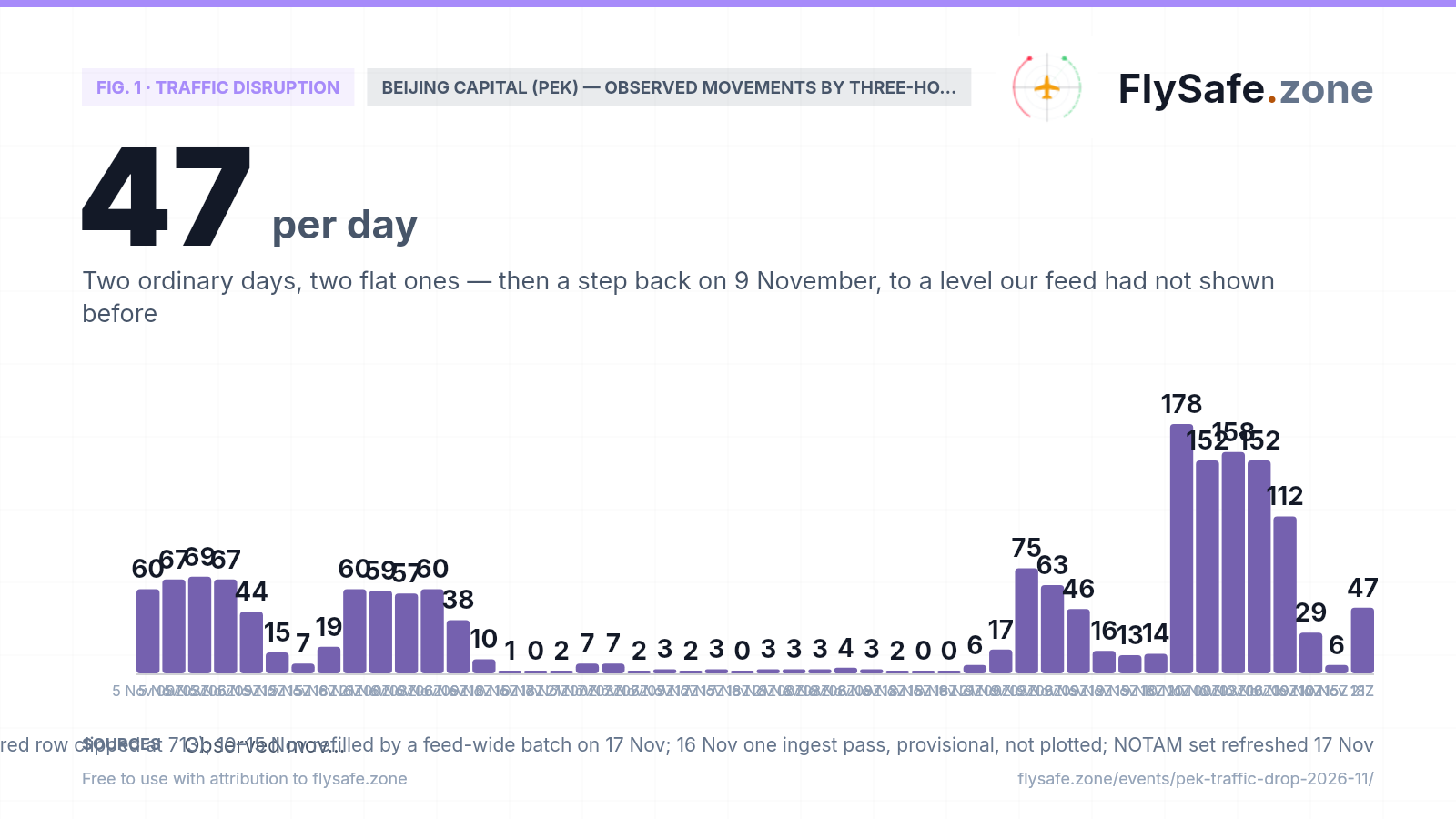
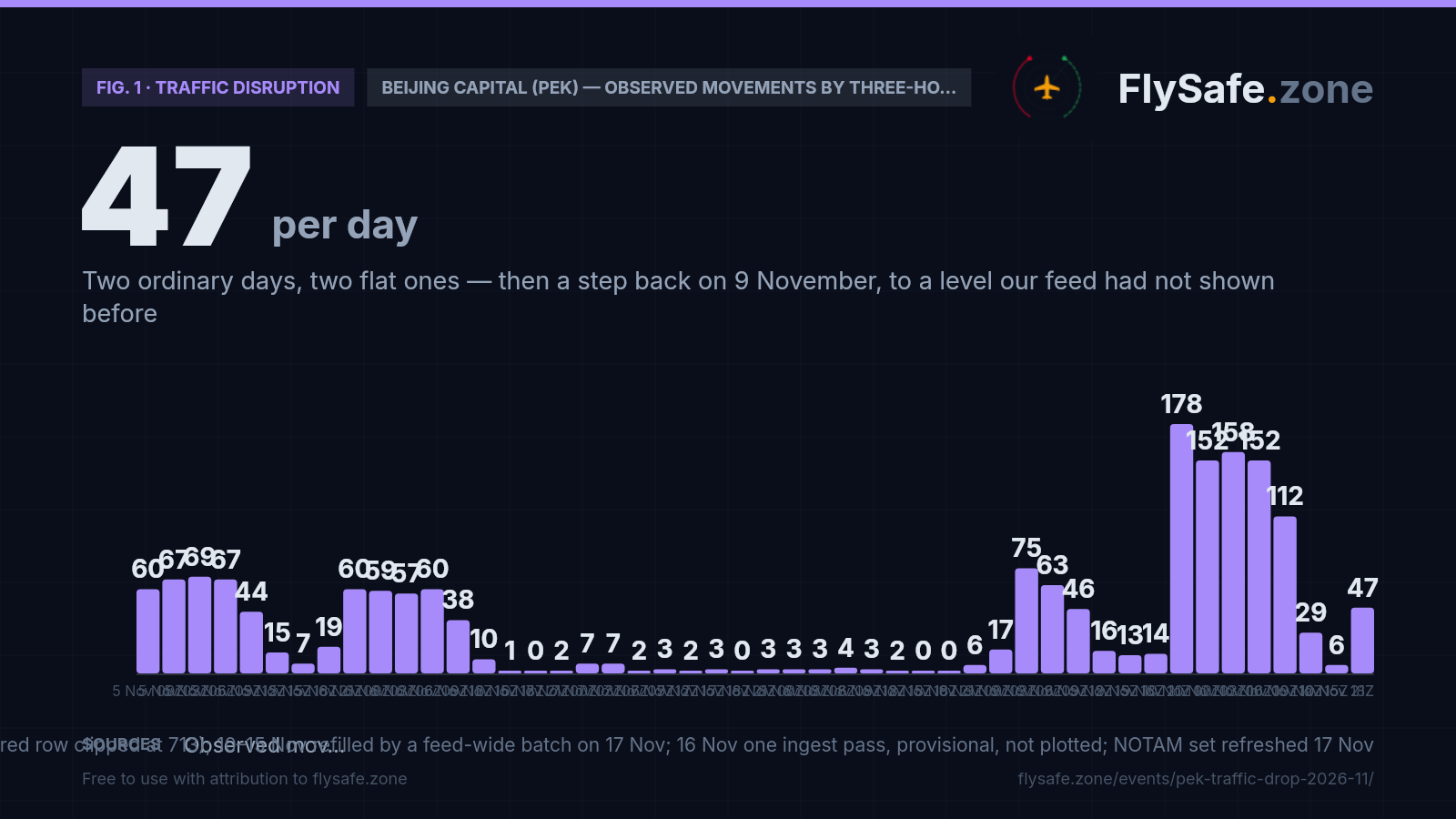
Our feed sees part of Beijing Capital's traffic on an ordinary day, and the count is noisy: 139–362 observed movements a day across 17 October – 5 November, a 274/day median. Within a day the profile is steady: on 5 and 6 November the four three-hour blocks from 00:00 to 12:00 UTC (08:00–20:00 Beijing time) each read 57–69. The last ordinary hour is 15:00 UTC on 6 November — 10 movements, the same as the 15:00 hour on the 5th. Between 16:00 and 23:59 UTC our feed holds 1 movement on 6 November against 31 in the same hours of 5 November, and from midnight UTC on 7 November every hour reads 0–3. 7 November totals 26 and 8 November 18. The return was a step too: on 9 November departures read zero until 05:00 UTC (13:00 Beijing time), then 9–21 an hour, and from midnight UTC on 10 November the daytime blocks read 112–178 — two to three times what they held before the drop. Three-hour blocks, 5–10 November:
Fig. 1 — Observed departures + arrivals at Beijing Capital (PEK) in each three-hour UTC block, 5–10 November 2026 (Beijing time = UTC+8); 6 November recount, all days settled · Data as of 17 Nov 2026, 03:55 UTC · closed · PEK series through 15 Nov; 14 Nov plotted as a recount (stored row clipped at 713); 10–15 Nov refilled by a feed-wide batch on 17 Nov; 16 Nov one ingest pass, provisional, not plotted; NOTAM set refreshed 17 Nov · Source: Observed movement records for ZBAA from a crowdsourced ADS-B receiver network, as collected by FlySafe monitoring.
Airports in the exposure zone
| Airport | Size | Observed signal | FIR |
|---|---|---|---|
| Beijing Capital International Airport (PEK) | large | — · 7 Nov: 26 observed movements (1 dep / 25 arr), −91% vs a 274 median; 6 Nov: 285 on recount, step after 15:00 UTC; 8 Nov: 18 (3 / 15); back in a step from ~05:00 UTC 9 Nov (250); 10–15 Nov 777–903 a day (14 Nov recount); 16 Nov 330 after one ingest pass, provisional; no closure notice in our set (refreshed 17 Nov) | ZBPE |
| Tianjin Binhai International Airport (TSN) | large | 124 km · Same FIR, same feed: 366–427 a day on 28 Oct – 5 Nov, 411 on 6 Nov, 335 on 7 Nov and 392 on 8 Nov (settled), 334 on 9 Nov, 386–466 on 10–15 Nov (14 Nov recount); 16 Nov 247 after one ingest pass, provisional — no step of its own in either direction | ZBPE |
| Beijing Daxing International Airport (PKX) | large | 66 km · No movement counts in our feed on any day before 10 Nov; from 10 Nov it reads 183–267 a day (209 on 16 Nov, provisional). A new series, with no baseline to compare it with — we make no claim about traffic at Daxing. The independent network has logged 1 movement there since 9 Oct | ZBPE |
Distance alone does not determine impact — wind direction and the flight levels the ash reaches decide which airports and routes are affected on a given day. FIR = Flight Information Region.
What our monitoring shows: a step down overnight, a step back three days later — at one airport, for the second time in six weeks
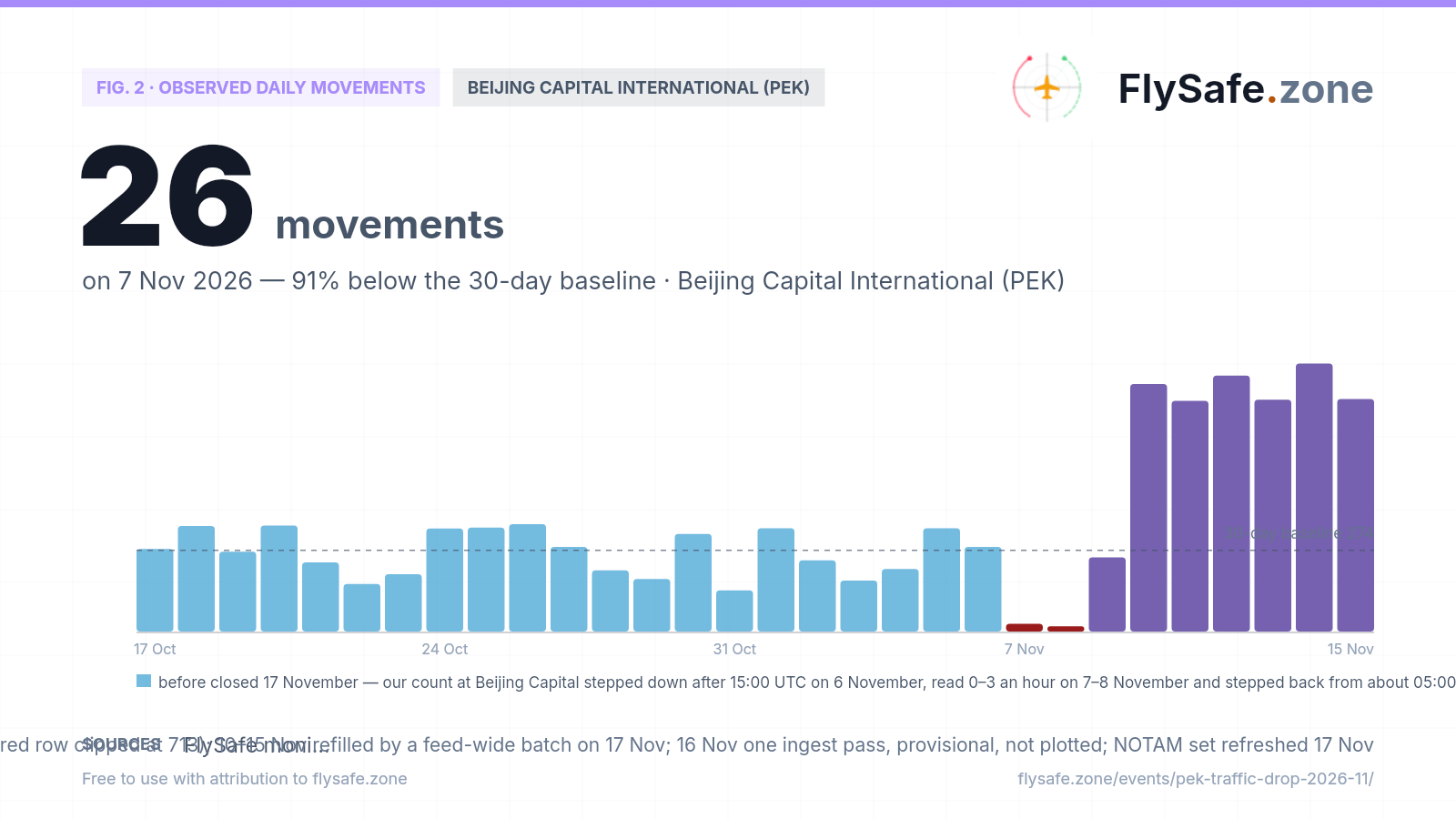
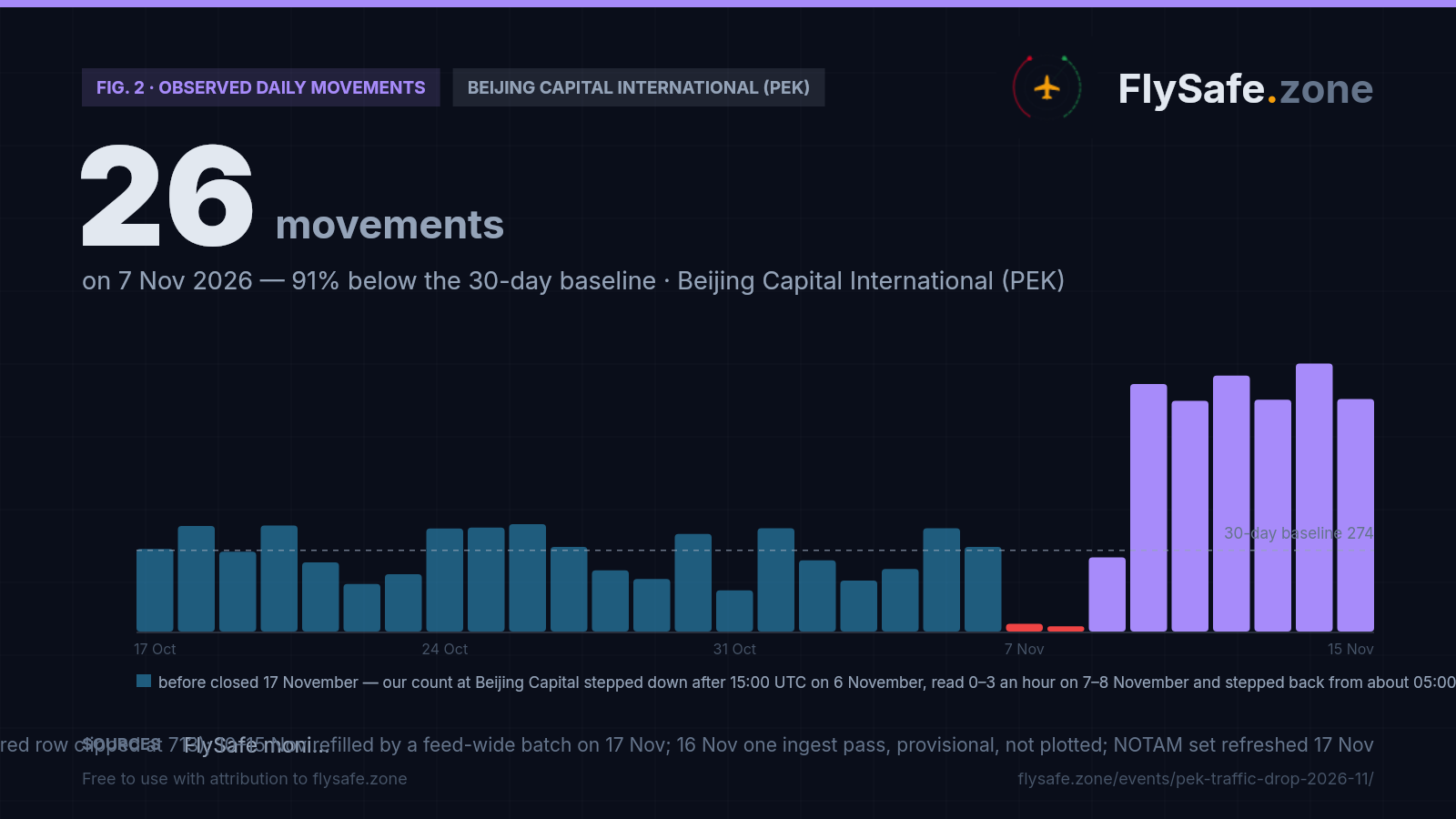
FlySafe tracks observed departures and arrivals at 493 airports from crowdsourced ADS-B receiver data. Observed counts are a floor, not a total — receiver coverage varies — but an airport measured against its own baseline is a reliable shape. Beijing Capital International's last 30 days:
Fig. 2 — Observed daily movements at PEK, 17 Oct – 15 Nov (latest complete UTC day). Data as of 17 Nov 2026, 03:55 UTC · closed · PEK series through 15 Nov; 14 Nov plotted as a recount (stored row clipped at 713); 10–15 Nov refilled by a feed-wide batch on 17 Nov; 16 Nov one ingest pass, provisional, not plotted; NOTAM set refreshed 17 Nov · Source: FlySafe monitoring (ADS-B receiver network).
- Baseline in our own feed: 274 observed movements/day (median of 17 Oct – 5 Nov, the days since the previous episode ended), range 139–362. The three previous Saturdays read 278, 347, 139.
- Sat 7 Nov: 26 — 1 departure, 25 arrivals, 17 of them with no recorded origin — 91% below the median. The detection layer fired at −88% against a 7-day average of 223. Provisional: it can still rise a little as later ingests arrive.
- 6 Nov: 285 on recount from the underlying flight records (the stored row, cut short by a routine partial refresh, holds 214) — an ordinary day until the evening.
- 8 Nov: 18 (3 departures, 15 arrivals), settled; every hour reads 0–3.
- 9 Nov onwards: the count came back in a step. On 9 November, no departure until 05:00 UTC, then 9–21 an hour; the day closed at 250. 10–15 Nov read 834, 777, 862, 781, 903, 783 — every day 2.8–3.3 times the old median (14 Nov is a recount; the stored row, clipped by a partial refresh, holds 713). 16 Nov reads 330 after a single ingest pass, provisional and not plotted; Tianjin's first pass for that day is also low (247).
- Departures vanished, the airport's flight numbers did not. Callsigns that departed Capital on 3–4 November were recorded taking off from Capital 61–114 times a day on 1–6 November; on 7 and 8 November, zero times. The same callsigns were still seen airborne with no recorded origin on 7 November (100 times, 79 sightings in all on 8 November so far) — fewer than the 230–275 total sightings a day before, so this test cannot by itself separate a gap in coverage from fewer flights.
- Precedent in this series: from 30 September our count at Capital fell to 9–36 a day for sixteen days and came back to 278 on 17 October in a single day. Its cause was never confirmed either.
Observed counts are a floor, not a total. Live view: PEK airport brief.
What it means for flights
A crowdsourced count can fall without any traffic falling. Observed movements are reconstructed from ADS-B receivers run by volunteers, then aggregated on our side. Around Beijing our feed never sees an aircraft below roughly 1,100 m, so it ties flights to Capital from the arrival and departure legs that distant receivers happen to catch. When one of those receivers goes offline, flights keep operating but our reconstruction stops attaching them to the runway: the number drops, the runway does not. That is why we publish observed counts as a floor, not a total, and why a −88% reading opens an investigation rather than a headline.
The shape: normal until the evening, then flat. Operational disruptions — weather, a runway closure, a restriction — tend to build through a schedule, leave knock-on delays and recover in stages. Our count did something else: 6 November matched 5 November block for block until 15:00 UTC (23:00 Beijing time), and from the early hours of 7 November local time every hour reads 0–3, day and night, with departures gone almost entirely (1 on 7 November). In the raw position sample, reports below 3,000 m over Capital fell from 161–190 a day on 1–6 November to 54 on 7 November and 56 on 8 November. That is the shape of a source switching off. It is suggestive, not proof — a real stoppage at a fixed time would also start abruptly.
The geography test: the hole is Capital's. If the whole region had gone quiet, the neighbours would show it. Tianjin Binhai, in the same FIR and the same feed, kept reading: 411 on 6 November and 335 on 7 November once settled (293 at first reading) — the softest day of its 28 October – 7 November run, so we report it rather than wave it away, but nowhere near Capital's −91% — then 392 on 8 November. The low-altitude sample over Tianjin dipped on 7 November and was back to 146 reports on 8 November, while Capital's stayed at 56. Across a wide north-China box, distinct aircraft went from 1,388 on 6 November to 1,328 on 7 November and 1,310 on 8 November. Our worldwide table read 126,387 take-offs on Saturday 7 November against 128,535 the previous Saturday.
Weather, notices and closure signals. Capital's half-hourly weather reports were routine: 0 of 48 in instrument conditions on 6 November and 7 of 47 on 7 November, winds up to 10 kt — and on 4 November, when 35 of 49 reports were in instrument conditions, the count read 211. Our NOTAM set for the Beijing FIR holds 21 notices, including long-running ones on navigation aids, stands and works at Capital; none closes the aerodrome, a runway or airspace. At first reading that set dated from 1 November for every FIR; refreshed on 17 November it holds 21 notices for the FIR and still none closes the aerodrome, a runway or airspace — though a notice that covered 7–8 November and has since lapsed would no longer appear in it. Our detection layer registered no closure event in ZBPE during the episode; the nearest entries are single-day, low-confidence ones on 28 October and 13 November, the second built on a news item and a notice closing one parking stand at Capital for works. These are FIR-level observations, not statements about the airport.
Why we cannot confirm it — and what would. At most airports we check a drop like this against a second crowdsourced ADS-B network. At Capital that network is effectively blind: it holds 2 movements there since 9 October, and 1 at Daxing. So there is no independent count, and we do not claim one. The October episode is the closest guide we have: our count stepped down on 30 September, sat at 9–36 a day for sixteen days and returned to 278 on 17 October in a single day — a return consistent with a source coming back, though that cause was never confirmed either. A return of Capital's hourly count to its usual 14–29 in the daytime blocks is what would end this episode in our data. This automated multi-signal analysis surfaces anomalies like this one early and publishes what can and cannot be measured; the operating picture on any given day belongs to the airport, the airlines and the relevant authorities.
What the data showed — close-out, 17 November. The number. Our count at Beijing Capital came back on 9 November the way it left — in a step. Departures read 1 on 7 November and 3 on 8 November; on 9 November there were none until 05:00 UTC (13:00 Beijing time), then 9–21 an hour; the day closed at 250. On 10–15 November our feed recorded 834, 777, 862, 781, 903 and 783 observed movements — every day 2.8–3.3 times the 274/day median of 17 October – 5 November. The 14 November value is a recount from the underlying flight records (the stored row, clipped by a routine partial refresh, holds 713). These six days arrived in part through a batch that refilled our whole feed on 17 November, after several nights in which the second ingest pass failed everywhere, not at Capital alone. 16 November reads 330 after a single pass — provisional, not plotted, and low at Tianjin too (247), as first passes usually are. Not a return to the old level. In the daytime three-hour blocks of 10 November we counted 112–178 movements, against 57–69 on 5–6 November. Most of the extra departures carry no recorded destination (417 of 593 on 10 November, against 159 of 201 on 5 November), and Beijing Daxing — absent from our feed on every earlier day — appears from 10 November at 183–267 a day. A schedule does not triple overnight; a change in which receivers can hear the Beijing area can. We read the new level as a change in coverage, which also means it cannot be compared with the old baseline. The neighbourhood. Tianjin read 334 on 9 November and 386–466 on 10–15 November (14 November a recount), with no step of its own. Weather. Capital's reports put 38 of 48 in instrument conditions on 14 November and 23 of 48 on 13 November; the count read 903 and 781 on those days. Notices. Our ZBPE set, refreshed on 17 November, holds no notice closing the aerodrome, a runway or airspace. The independent network is still blind at Capital (3 daily rows since 1 October, the latest on 19 October), so no second count ever became available. What this adds up to. Both edges were steps, the neighbours never moved with Capital, and the count returned above where it started — every check came back the way a coverage change comes back. We still do not call the cause: that would need a source we do not have. What would reopen this page: a notice closing the aerodrome or a runway at Capital for 7–8 November appearing in our set, or our count at Capital stepping down again — which would open a new page, as this one followed October's.
Passenger questions, answered from the data
Our data cannot confirm that. Our observed count at Capital fell from a 274/day median to 26 on 7 November after a step on the evening of 6 November (UTC), but nearby Tianjin, the wider north-China sample and our worldwide total kept reading, the weather was routine, and no notice in our NOTAM set for the Beijing FIR (refreshed 17 November) closes the aerodrome or a runway. That pattern usually means lost receiver coverage rather than lost flights — but the independent network we would use to confirm it does not cover PEK. The count came back in a step on 9 November, to a level above the old one. For a specific flight, check the airline and the PEK brief, which updates nightly.
Yes, in our own feed. From 30 September 2026 our count at Capital fell to 9–36 a day for sixteen days and came back to 278 on 17 October in a single day; the cause was never confirmed. That episode is archived on its own page. The November step has the same shape.
Yes. It came back in a step from about 05:00 UTC on 9 November and read 777–903 observed movements a day on 10–15 November, 2.8–3.3 times the 274/day median before the drop. Beijing Daxing appeared in our feed for the first time in the same week. We read the higher level as a change in our receiver coverage, so it is not comparable with the old baseline; the cause of the drop was never confirmed. This page closed on 17 November.
We cannot say. Our feed held no movement counts for Daxing on any day of the drop; it began counting Daxing on 10 November (183–267 a day since), a new series with no baseline. The independent network has logged 1 movement there since 9 October. We make no claim about traffic at Daxing in either direction.
We do not make that call — we publish what our monitoring can and cannot measure. Here the measurement itself is in doubt, so the reading is not evidence of a disruption. Your airline and the airport are the authoritative sources for any flight.
For media — the full kit
Everything on this page — charts, CSV, quotes — is published under CC BY 4.0: free to reuse with attribution to FlySafe.zone. Charts come in dark (social/web) and light (print/light layouts) versions; attribution and license are embedded in every file.
“Observed traffic at Beijing Capital International fell to 26 movements on 7 November 2026 in FlySafe's own crowdsourced ADS-B feed — 91% below its 274-a-day median — after a step on the evening of 6 November UTC, while neighbouring Tianjin and the wider north-China sample kept reading and no published notice in FlySafe's set closed the aerodrome; it is the second such step at the airport in six weeks, after a 30 September – 16 October episode that ended in a single day; the count came back in a step on 9 November and read 777–903 a day on 10–15 November, above its earlier level, and with no independent count at Capital the cause of the drop was never confirmed, according to flight-monitoring service FlySafe.zone.”
Boilerplate — about the source (for your article footer)
FlySafe.zone monitors airspace risk and observed airport activity worldwide: 334 flight-information regions scored daily, GPS-interference signals, volcanic-ash exposure and daily observed movements at 493 airports from the crowdsourced ADS-B receiver network. Methodology: flysafe.zone/methodology.
Need a different cut of the data, a comment, or numbers for another airport? Leave an email — we answer fast during active events.