Mount St. Helens Resuspended Ash — No Eruption: Three VAAC Advisories in 12 Hours, Ash to FL100 Drifting North-West, Declared Ended at 06:39 UTC 16 Oct, Portland (PDX) 74 km Away and Outside the Area, October 2026
- No eruption. The advisory is for re-suspended ash — wind lofting old deposits off the volcano — reported from the surface to FL100 (about 10,000 ft) in a thin band drifting north-west. VAAC Washington expected it to last no more than six hours, and its third advisory, at 06:39 UTC on 16 October, declared the ash ended with none expected through 00:30 UTC on 17 October.
- Portland (PDX) stayed outside the ash area — about 73 km from the edge of the 15 October band, 74 km from the summit and from the smaller 16 October area, on the opposite side from where the ash went. Seattle–Tacoma (SEA) was about 90 km from the 15 October edge. No airport in our exposure list fell inside any observed or forecast area, and the four-hour volcanic-ash SIGMET on 16 October did not include PDX. Check your airline on the day — wind moves ash.
- FL100 is low. Aircraft cruising across the Pacific Northwest fly well above it; the band matters for arrivals, departures and lower-level routes between the Columbia River and Puget Sound, which is where dispatchers would plan around it.
- Observed PDX traffic read 564 movements on 15 October (settled), 568 on 16 October (settled), 542 on 17 October (settled), 484 on 18 October (settled), 545 on 19 October (settled), 592 on 20 October (settled), 539 on 21 October (settled), 534 on 22 October (settled), 572 on 23 October (settled), 530 on 24 October (settled), 449 on 25 October (settled), 548 on 26 October (settled), 575 on 27 October (settled, flagged partial), 539 on 28 October (settled) and 533 on 29 October (settled) (18 October a Sunday — consistent with the four prior Sundays; Sunday 25 October below all five before it, reported, not attributed) against a ~547 baseline — a 16–29 October mean of 539, 1% under it — after 551, 610 and 544 on 12–14 October. November read lower at Portland and across the region (2–9 November mean 487), more than two weeks after the ash ended; 10–15 November are a feed-wide coverage gap.
- These are the first St. Helens advisories in our record (since 9 May 2026) and the centre's first for the volcano in 2026. The volcano's last eruption in the Smithsonian catalogue is 2008; what moved today is the ash left behind.
Advisory timeline — how active is this episode
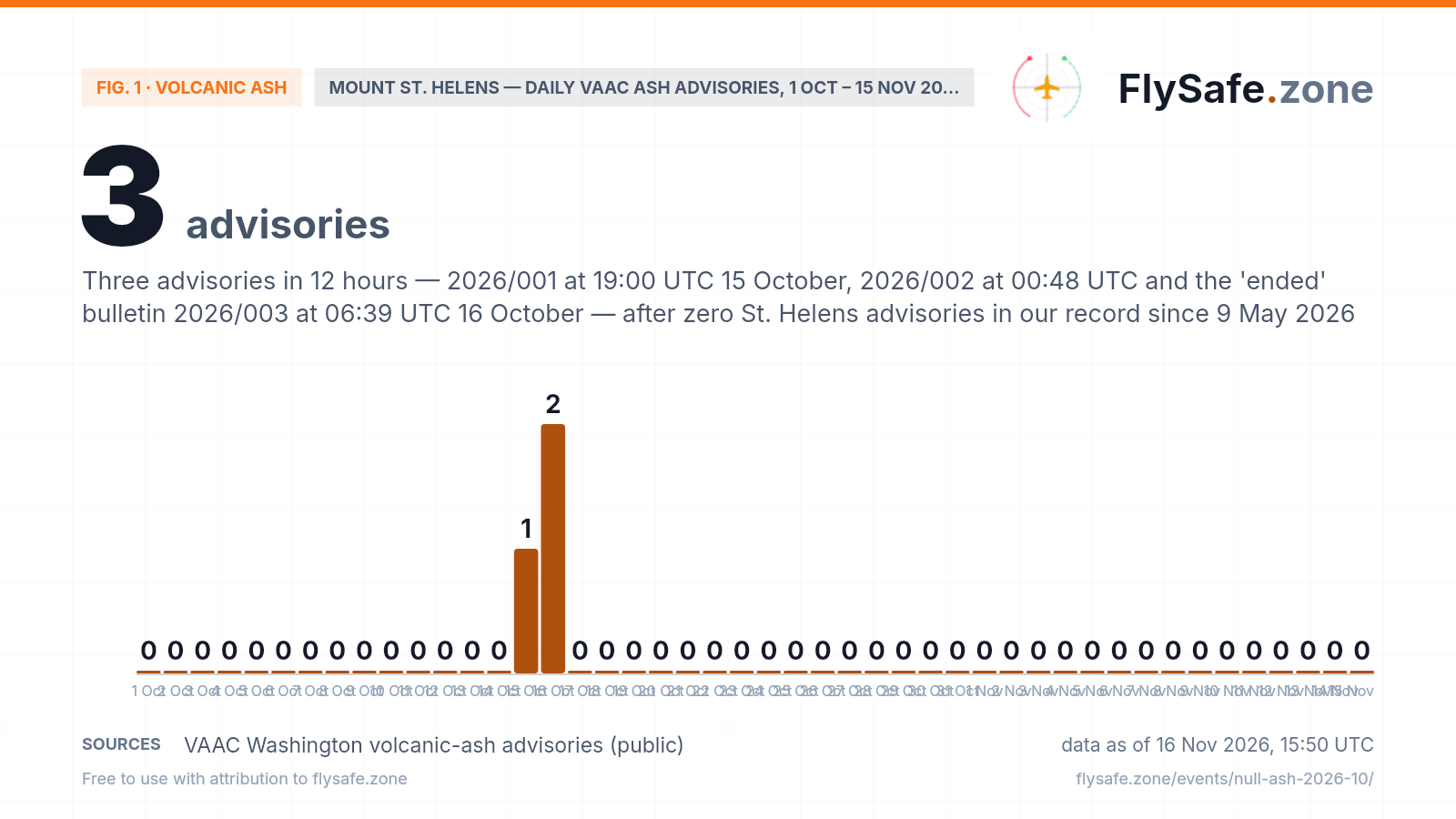
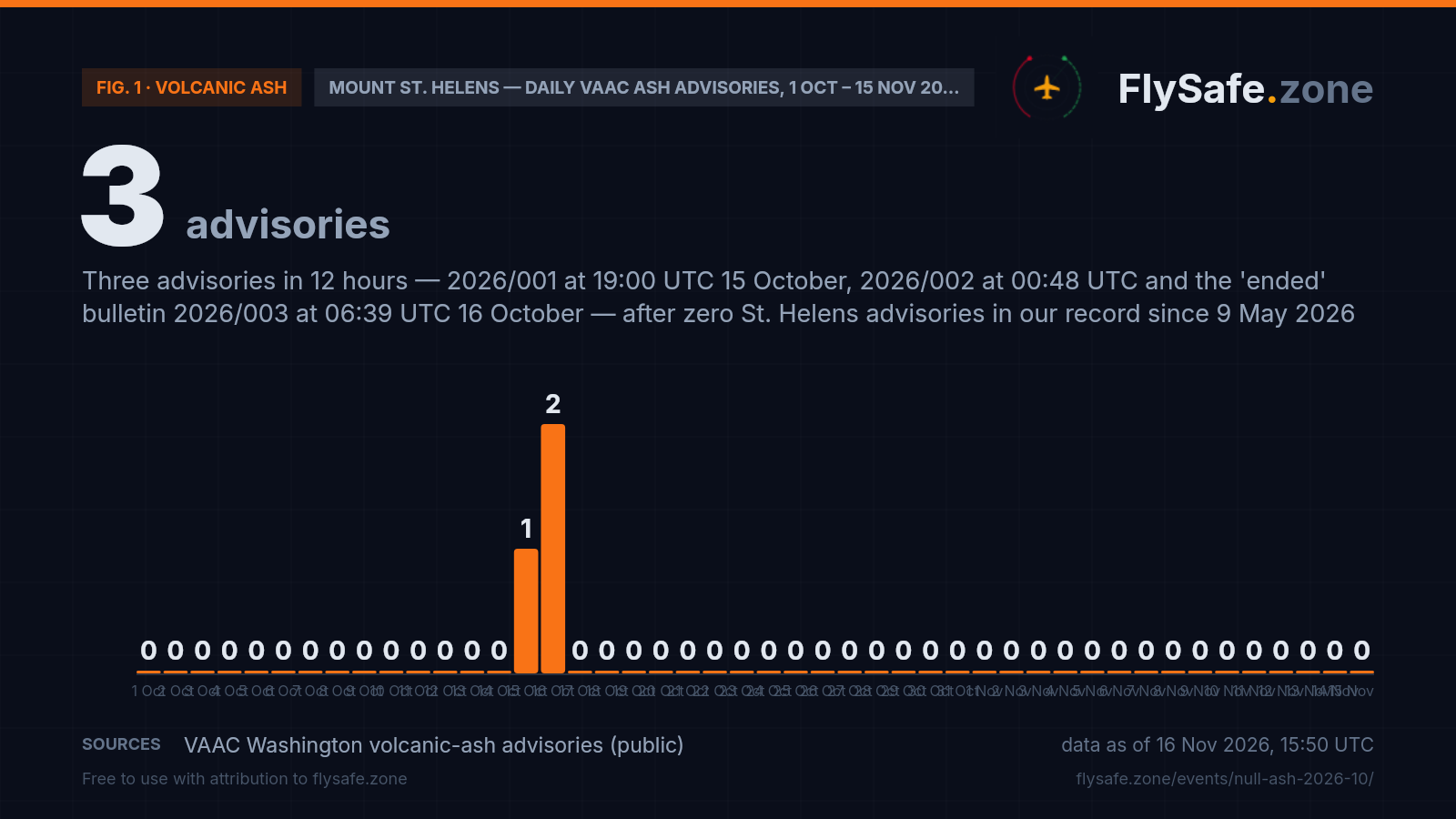
This is not an eruption. VAAC Washington's advisory 2026/001 for Mount St. Helens, issued at 19:00 UTC on 15 October 2026, states no eruption — re-suspended volcanic ash: wind lifting old ash deposits off the volcano and carrying them downwind, detected in GOES-18 satellite imagery and seen on webcam as a thin plume moving north-west. The observation is timed 18:41 UTC: ash from the surface to FL100 (about 10,000 ft), moving 315° at 30 kt, in a narrow band whose far edge lies about 51 km north-west of the 8,363 ft summit and about 15 km wide at that end. The centre wrote that winds were forecast to decrease and that the event should last no more than six hours. Advisory 2026/002 at 00:48 UTC on 16 October shrank the picture: ash not detected on satellite, the Cascades Volcano Observatory reporting minor re-suspended ash still present, an estimated area from the surface to FL100 whose far edge sits about 15 km north-west of the summit, moving 315° at 25 kt, the same area forecast for 06:30 UTC and no ash expected at 12:30 and 18:30 UTC. Advisory 2026/003 at 06:39 UTC closes the sequence: re-suspended ash ended, no longer discernible in satellite imagery, no recent reports received, no drawn area, and no volcanic ash expected at 12:30, 18:30 and 00:30 UTC on 17 October. These are the first advisories for this volcano in our collection, which begins on 9 May 2026 — zero St. Helens advisories in the 90 days before — and the numbering says the same about the centre's own year. No further St. Helens bulletin has arrived since; the stream itself is live — VAAC centres issued 47 bulletins on 17 October, 49 on 18 October, 44 on 19 October, 42 on 20 October, 44 on 21 October, 37 on 22 October, 42 on 23 October, 51 on 24 October, 54 on 25 October, 61 on 26 October, 62 on each of 27 and 28 October, 53 on 29 October, 70 on 30 October and between 26 and 48 a day from 31 October to 15 November, the latest at 15:30 UTC on 16 November — so the silence after 06:39 UTC is the volcano's, not the feed's. Daily advisory count, 1 October – 15 November:
Fig. 1 — Mount St. Helens daily ash advisory count, VAAC Washington (1 October – 15 November 2026) · Data as of 16 Nov 2026, 15:50 UTC · Source: VAAC Washington volcanic-ash advisories (public).
Airports in the exposure zone
| Airport | Size | Distance from summit | FIR |
|---|---|---|---|
| Portland International (PDX) | large | 74 km · south-south-west of the summit — about 73 km outside the 15 Oct 19:00 UTC ash area (the largest drawn) and 74 km from the smaller 16 Oct 00:48 UTC area; the 06:39 UTC advisory draws none; the band went north-west, away from Portland | KZSE |
| Olympia Regional (OLM) | small | 104 km · north-west — the airport nearest the 15 Oct band: about 59 km from its observed area and 57 km from its 00:30 UTC forecast area; about 89 km from the 16 Oct 00:48 UTC area | KZSE |
| Tacoma Narrows (TIW) | small | 125 km · north — about 73 km from the 15 Oct observed area, 71 km from its forecast area; about 109 km from the 16 Oct area | KZSE |
| Seattle–Tacoma International (SEA) | large | 141 km · north — about 90 km from the 15 Oct observed area, 88 km from its forecast area; about 126 km from the 16 Oct area | KZSE |
| King County Boeing Field (BFI) | medium | 150 km · north — about 99 km from the 15 Oct observed area, 97 km from its forecast area; about 135 km from the 16 Oct area | KZSE |
Distance alone does not determine impact — wind direction and the flight levels the ash reaches decide which airports and routes are affected on a given day. FIR = Flight Information Region.
What our monitoring shows: Portland kept its usual observed level through the advisory — 564 movements on 15 October (settled), 568 on 16 October (settled), 542 on 17 October (settled), 484 on 18 October (settled, a Sunday), 545 on 19 October (settled), 592 on 20 October (settled), 539 on 21 October (settled), 534 on 22 October (settled), 572 on 23 October (settled), 530 on 24 October (settled), 449 on 25 October (settled, a Sunday, the lowest day of the window to that date), 548 on 26 October (settled), 575 on 27 October (settled, flagged partial), 539 on 28 October and 533 on 29 October (both settled) against a ~547 baseline; November read lower at Portland and across the region, 10–15 November not readable
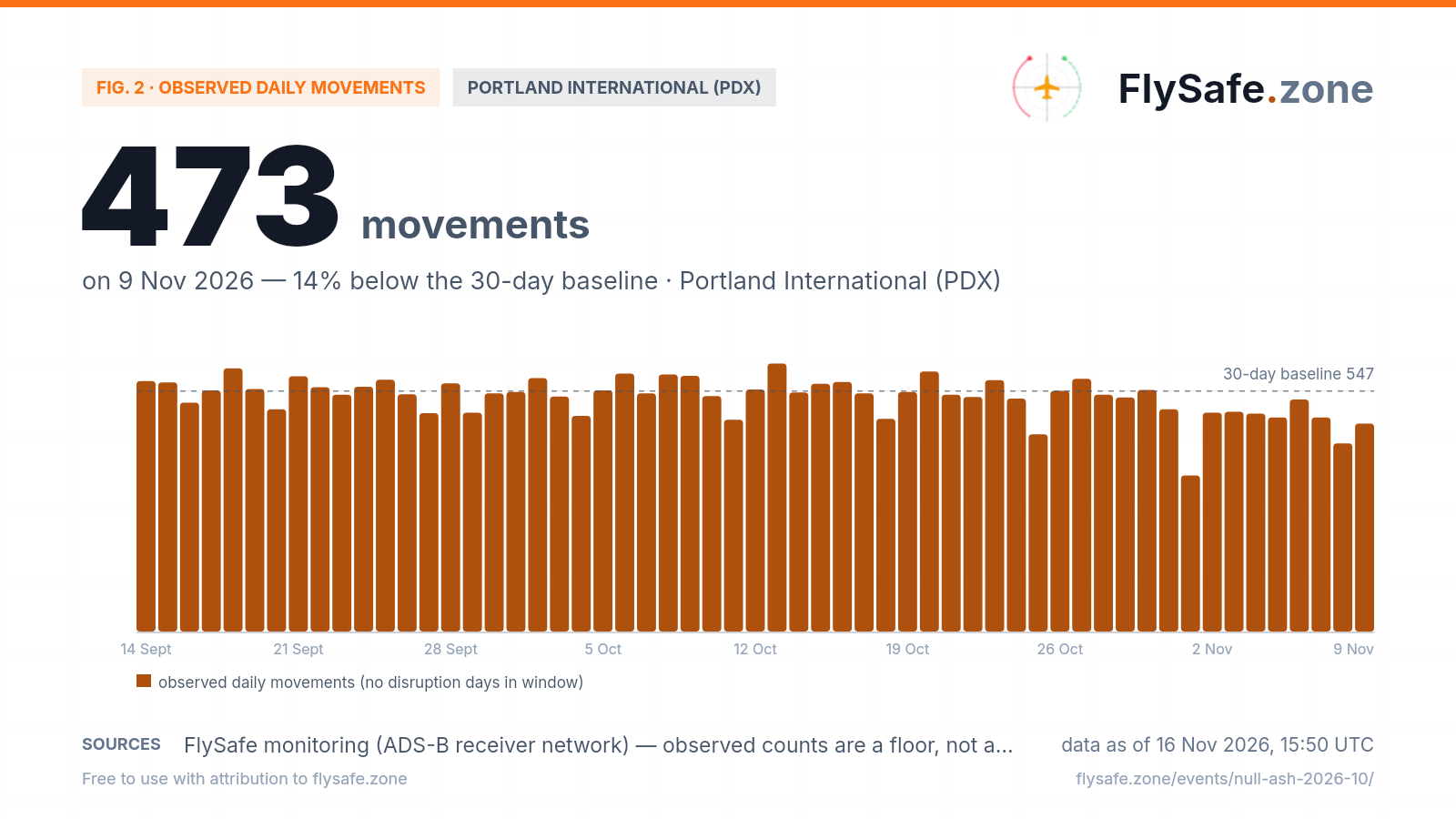
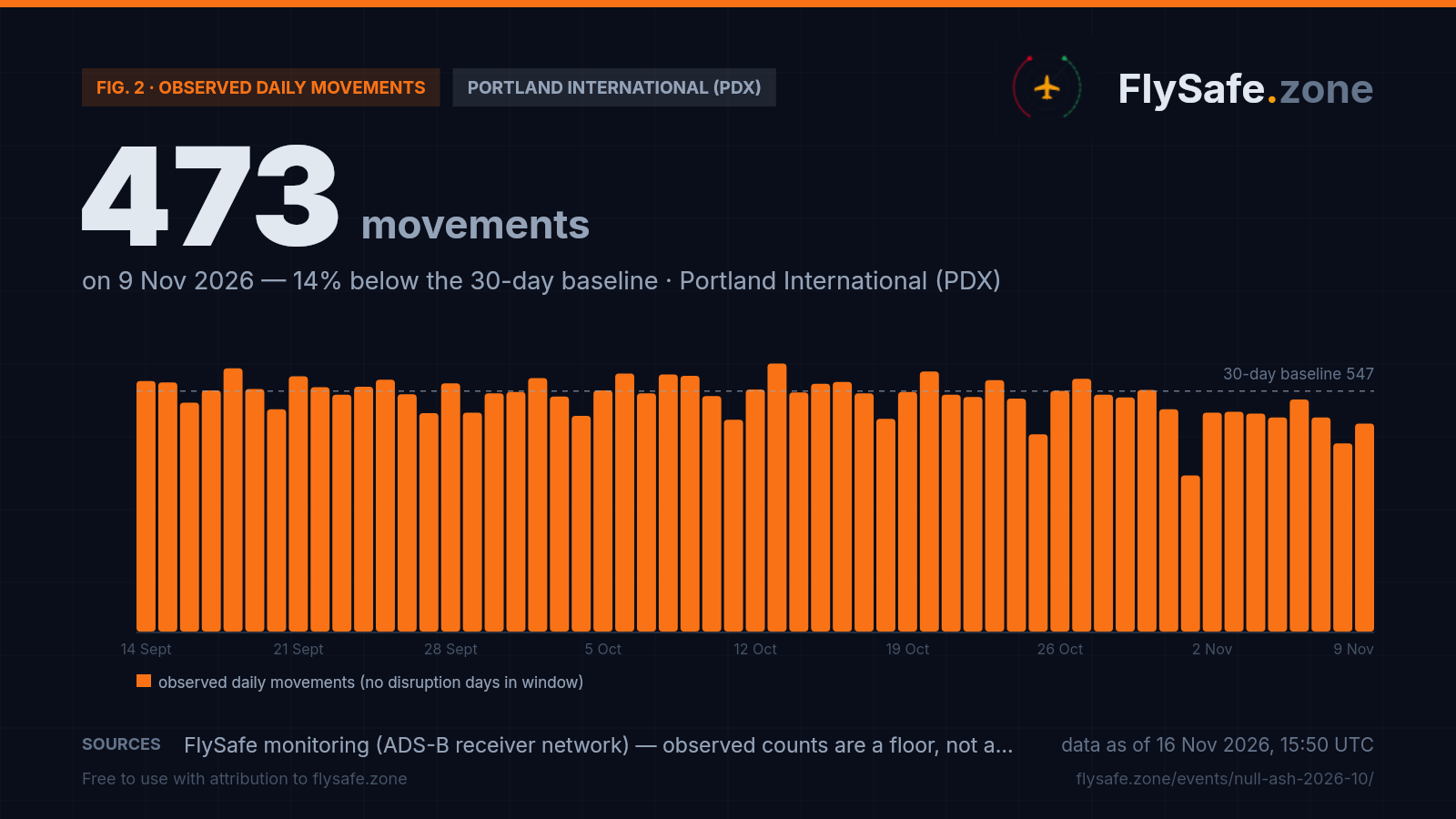
FlySafe tracks observed departures and arrivals at 493 airports from crowdsourced ADS-B receiver data. Observed counts are a floor, not a total — receiver coverage varies — but an airport measured against its own baseline is a reliable shape. Portland International's last 30 days:
Fig. 2 — Observed daily movements at PDX, 14 Sept – 9 Nov (latest complete UTC day). Data as of 16 Nov 2026, 15:50 UTC · Source: FlySafe monitoring (ADS-B receiver network).
- Baseline: ~547 observed movements/day at PDX — the mean of the 28 settled days from 14 September to 11 October (range 482–599). The week before the advisory (5–11 October) averaged 552; the four Mondays before 12 October read 570, 581, 565 and 549.
- The advisory days and after: Thursday 15 October 564 (+3%, settled), Friday 16 October 568 (+4%, settled), Saturday 17 October 542 (−1%, settled), Sunday 18 October 484 (−12%, settled), Monday 19 October 545 (0%, settled), Tuesday 20 October 592 (+8%, settled), Wednesday 21 October 539 (−1%, settled), Thursday 22 October 534 (−2%, settled), Friday 23 October 572 (+5%, settled), Saturday 24 October 530 (−3%, settled), Sunday 25 October 449 (−18%, settled), Monday 26 October 548 (0%, settled), Tuesday 27 October 575 (+5%, settled, flagged partial for a one-hour collection hole), Wednesday 28 October 539 (−1%, settled) and Thursday 29 October 533 (−3%, settled). 15–29 October are all settled; each matches its recount from the raw flight records. 17 October settled at 542 on the 21 October nightly rebuild — inside the range of the four Saturdays before it (535–552, mean 541). 18 October settled at 484 on the 22 October nightly rebuild — a Sunday, consistent with the four prior Sundays in the window (506, 497, 491, 482); it had read 476 on 20 October and revised up as more data landed. 19 October settled at 545 on the 23 October nightly rebuild — a Monday, below each of the four Mondays before it (581, 565, 549, 551). 20 October settled at 592 on the 24 October nightly rebuild, up from 583 — a Tuesday, inside the range of the four Tuesdays before it (556, 498, 587, 610). 21 October settled at 539 on the 25 October nightly rebuild — a Wednesday, level with the lowest of the four Wednesdays before it (539, 542, 542, 544). 22 October settled at 534 on the 26 October nightly rebuild, up from the 524 plotted on 24 October — a Thursday, below each of the four Thursdays before it (557, 545, 585, 564). 23 October settled at 572 on the 27 October nightly rebuild, up from the 559 plotted on 25 October — a Friday, inside the range of the four Fridays before it (573, 577, 582, 568). 24 October settled at 530 on the 28 October nightly rebuild, up from the 523 plotted on 26 October — a Saturday, below each of the four Saturdays before it (540, 535, 536, 542). 25 October settled at 449 on the 29 October nightly rebuild, up from the 437 plotted on 27 October — a Sunday, still below each of the five Sundays before it in the window (506, 497, 491, 482, 484) and the lowest day of the window to that date. The hour-by-hour count runs lighter across the whole day rather than showing a missing block of hours, and the independent aggregate below also reads its lowest Sunday of the window, so the dip is not confined to our feed. It comes nine days after the 'ended' bulletin; we report it and do not attribute it. The days after it read back at the usual level: 26 October settled at 548 on the 30 October nightly rebuild, unchanged from the reading on 29 October — a Monday, inside the range of the four Mondays before it (565, 549, 551, 545); 27 October settled at 575 on the 31 October nightly rebuild, up from the 562 plotted on 29 October — a Tuesday, inside the range of the four Tuesdays before it (498, 587, 610, 592) — and is flagged as partial (see Bookkeeping); 28 October settled at 539 on the 1 November nightly rebuild, up from the 524 plotted on 30 October — a Wednesday, level with the lowest of the four Wednesdays before it (542, 542, 544, 539); 29 October settled at 533 on the 2 November nightly rebuild, up from the 525 plotted on 31 October — a Thursday, level with the lowest of the four Thursdays before it (545, 585, 564, 534). Across the 14 settled days from 16 to 29 October Portland averaged 539 movements/day, 1% under the baseline. 17, 18, 19, 20, 22, 23, 24, 25, 27, 28 and 29 October each revised upward on later refreshes, so the latest days are the least final. The days before the first advisory — Monday 12 October 551 (+1%), Tuesday 13 October 610 (+12%, the highest day of the window) and Wednesday 14 October 544 (−1%) — are all settled and are the yardstick.
- After the close signal, 30 October – 9 November (all settled; reported, not attributed). Friday 30 October 550 (+1%) and Saturday 31 October 506 (−7%), both below the four same weekdays before them (Fridays 568–582, Saturdays 530–542). Sunday 1 November read 355 (−35%), the lowest day of the window; Seattle–Tacoma, San Francisco and Los Angeles also read their lowest day since at least 12 October in our feed that Sunday, and the independent aggregate below reads 396 for PDX, so the dip is not Portland's alone. Monday 2 to Monday 9 November read 498, 500, 496, 487, 528, 487, 428 (Sunday 8 November) and 473 — a mean of 487, 11% under the baseline and 11% under Portland's own 12–29 October mean of 546. Seattle–Tacoma ran 7% under its own 12–29 October mean over the same eight days, and the independent aggregate shows the same step at PDX (about 10%), so the lower November level shows in both feeds and beyond Portland. It begins more than two weeks after the 'ended' bulletin, with no St. Helens advisory in between; we report it and do not attribute it. Each of these days matches its recount from the raw flight records. 10–15 November are not readable: the daily aggregate stores 1–29 movements per day at Portland because the collection failed feed-wide on those days (about a tenth of the usual network-wide total); they are a coverage gap, not plotted, not a Portland event.
- Cross-check. A second, independent ADS-B aggregate, which we cross-check against but never plot, reads 623 for PDX on 15 October, 641 on 16 October, 602 on 17 October, 532 on 18 October, 621 on 19 October, 668 on 20 October, 608 on 21 October, 613 on 22 October, 650 on 23 October, 576 on 24 October, 485 on 25 October, 592 on 26 October, 636 on 27 October, 581 on 28 October and 586 on 29 October against its own 583, 659 and 595 on 12–14 October. On settled days (12–29 October) it runs 6–15% above ours at Portland. From 30 October it reads 596, 543, 396 (1 November), 555, 552, 543, 536, no figure for 6 November, then 555, 495 and 540 on 7–9 November — 7–16% above ours — and, on the days our feed cannot read, 576, 533, 598, 493, 362 (Saturday 14 November) and 454 on 10–15 November; we do not substitute it for ours, so those six days are not plotted. Its 485 on 25 October is also its own lowest Sunday in the window to that date (528–570 on the five before), its 581 on 28 October sits just under its own four prior Wednesdays (583–608), and its 586 on 29 October is its own lowest Thursday in the window to that date (607–643 on the six before).
- Bookkeeping. 15 October settled at 564 (298 departures, 266 arrivals). 16 October settled at 568 (301 departures, 267 arrivals). 17 October settled at 542 (282 departures, 260 arrivals) on the 21 October nightly rebuild; the daily aggregate now matches the recount. 18 October settled at 484 (258 departures, 226 arrivals) on the 22 October nightly rebuild; aggregate and recount agree. 19 October settled at 545 (293 departures, 252 arrivals) on the 23 October nightly rebuild; aggregate and recount agree. 20 October settled at 592 (312 departures, 280 arrivals) on the 24 October nightly rebuild, up from the 583 plotted on 23 October; aggregate and recount agree. 21 October settled at 539 (294 departures, 245 arrivals) on the 25 October nightly rebuild; aggregate and recount agree. 22 October settled at 534 (293 departures, 241 arrivals) on the 26 October nightly rebuild, up from the 524 plotted on 24 October; aggregate and recount agree. 23 October settled at 572 (306 departures, 266 arrivals) on the 27 October nightly rebuild, up from the 559 plotted on 25 October; aggregate and recount agree. 24 October settled at 530 (281 departures, 249 arrivals) on the 28 October nightly rebuild, up from the 523 plotted on 26 October; aggregate and recount agree. 25 October settled at 449 (237 departures, 212 arrivals) on the 29 October nightly rebuild, up from the 437 plotted on 27 October; aggregate and recount agree. 26 October settled at 548 (301 departures, 247 arrivals) on the 30 October nightly rebuild; aggregate and recount agree. 27 October settled at 575 (309 departures, 266 arrivals) on the 31 October nightly rebuild; aggregate and recount agree. It is flagged as partial: the network-wide collection hole between 12:50 and 13:50 UTC (05:50–06:50 local) did not fill — that hour at Portland still holds 12 movements against 20–30 in the same hour on 20, 26 and 28 October — so 575 understates the day by more than this feed usually does. 28 October settled at 539 (287 departures, 252 arrivals) on the 1 November nightly rebuild; aggregate and recount agree (an earlier trailing-days refresh had clipped the stored figure to 395 — a collection artefact, since filled). 29 October settled at 533 (286 departures, 247 arrivals) on the 2 November nightly rebuild, up from the 525 plotted on 31 October; aggregate and recount agree. 30 October settled at 550 (298 departures, 252 arrivals) — the 24 movements it stored on 31 October were a not-yet-collected day. 31 October – 9 November each settled four days later and match their recounts. 10–15 November store 1–29 movements a day — a feed-wide collection failure, not plotted. No other day in the window is a coverage gap.
- Honesty note — this is not an attribution. These are observed movements from a crowdsourced ADS-B receiver network: a floor, not the airport's official total, and recent days revise as data backfills. A movement count at PDX can show whether the airport kept operating at its usual observed level while the ash band stayed 70-plus km away; it cannot see reroutes, holding or added track miles.
FIR level: across the Seattle FIR (KZSE), observed en-route traffic ran 0.93× its 28-day baseline on 13 October, 0.94× on 14 October and 1.03× on both 15 and 16 October, the advisory days, 0.98× on 17 and 18 October, 1.01× on 19 October, 0.99× on 20 October, 0.97× on 21 October, 0.98× on 22 October, 1.02× on 23 October, 0.99× on 24 October, 0.94× on 25 October, 1.02× on 26 October, 0.94× on 27 October, 0.95× on 28 October, 1.01× on 29 October and 1.00× on 30 October (1,077, 1,084, 1,189, 1,184, 1,129, 1,114, 1,135, 1,114, 1,093, 1,104, 1,146, 1,117, 1,056, 1,141, 1,058, 1,067, 1,125 and 1,116 aircraft against ~1,116–1,159), after 1.00× on 12 October, then 0.90–1.08× from 31 October to 15 November (1,009–1,207 aircraft against ~1,114–1,117) apart from 0.81× on Saturday 14 November (906 aircraft) — a FIR-wide band we report and do not attribute. Our detection layer has opened no airspace-disruption entry for KZSE since 1 October, and its daily state check found no published closure or restriction for the FIR through 16 November. Our NOTAM collection carries no Seattle FIR notice collected since 15 August, so this page makes no NOTAM claim either way. One volcanic-ash SIGMET did follow the advisory: SIGMET NOVEMBER 1 from the Aviation Weather Center, valid 02:37–06:36 UTC on 16 October — volcanic ash below FL100 from Mt St Helens, stationary, reported by aircraft, due to suspended ash, not active eruption — over a box in Washington bounded by points 40 NM south of the Seattle VOR and 20 to 50 NM north and north-east of the Battle Ground VOR. By our reading of those fix-relative coordinates the box's southern corner lies roughly 50 km north-east of PDX; the box does not include the airport. It expired as written at 06:36 UTC, three minutes before the 'ended' advisory, and no later volcanic-ash SIGMET for the area appears in our feed, which was live to 12:55 UTC on 16 November. Live view: PDX airport brief · SEA airport brief · live ash map.
What it means for flights
Resuspended ash is a wind event, not a volcanic one — and the advisory says so. Old ash on a volcano's flanks does not disappear; a dry, strong wind can lift it and carry it downwind as a plume that satellite sensors and webcams pick up exactly as they would fresh ash. VAAC Washington's remarks are explicit: no eruption, re-suspended volcanic ash, with the Cascades Volcano Observatory among the information sources. Operationally the distinction matters in both directions. Ash is ash to an engine regardless of how it got airborne, so the advisory and its polygon are handled like any other; but the supply is finite and the driver is wind, which is why the centre could forecast an end — no more than six hours — rather than track an open-ended emission, and why the sequence ran 19:00 UTC observed, 00:48 UTC estimated and minor, 06:39 UTC ended. This page follows the advisories, not the volcano's alert level, which our data does not carry for St. Helens.
FL100 is a low ceiling — that shapes who cares. Ash to FL100 (about 10,000 ft) sits far below the cruise levels of traffic crossing the Pacific Northwest between California, Seattle, Vancouver and the trans-Pacific tracks; overflights are not the exposed traffic. The band matters for anyone climbing or descending through the lower levels around the southern Washington Cascades and for lower-level general-aviation and regional routes — a corridor between the Columbia River and Puget Sound that happens to hold no airport within 57 km of the drawn area. That is why a thin, low plume can produce a formal advisory without a single scheduled flight changing.
Why Portland is outside the area — wind geometry. PDX lies 74 km from the summit on a bearing of about 207° — south-south-west. The ash moved on 315°, north-west, so the observed band points away from Portland and its far edge sits about 51 km from the summit in the other direction; the nearest point of the polygon to PDX is about 73 km away, essentially the same as the distance to the summit. The airports in the band's direction are Olympia (OLM, 59 km from the edge), Tacoma Narrows (TIW, 73 km) and Seattle–Tacoma (SEA, 90 km): still clear, but they are the ones a wind shift toward 340–350° would bring nearer. Distance is a measured fact about this advisory's polygon, not a safety verdict: go/no-go decisions belong to operators and authorities.
A first in our record — read the cadence accordingly. Our advisory collection runs from 9 May 2026 and contains no St. Helens advisory before this one, so this page has no episode history for the volcano to compare against; the Smithsonian catalogue's last eruption year for St. Helens is 2008. Resuspension events at Cascade volcanoes typically come and go within a single advisory cycle, which is what VAAC Washington's six-hour expectation described and what happened: a second advisory with a much smaller estimated area at 00:48 UTC on 16 October, then the 'ended' bulletin at 06:39 UTC. That bulletin is the close signal we set at publication; the post-advisory traffic through 29 October had settled in our feed by 2 November, and the page closed on 16 November with no further St. Helens advisory in between.
Three signals we watched — and what fired. First, the next advisory: it came at 00:48 UTC on 16 October with a smaller, estimated area, and the one after it at 06:39 UTC declared the ash ended — the wind eased roughly as modelled. Second, reported tops climbing above FL100 or the polygon turning toward Olympia, Tacoma or Seattle: neither happened; tops stayed at FL100 and the 16 October area reached about 15 km from the summit. Third, any airspace signal in the Seattle FIR: one fired — a volcanic-ash SIGMET below FL100, reported by aircraft and valid 02:37–06:36 UTC on 16 October over south-west Washington, explicitly suspended ash, not active eruption, and not including PDX. No airspace-disruption entry opened in our detection layer, and PDX observed movements read 564 on 15 October (settled), 568 on 16 October (settled), 542 on 17 October (settled), 484 on 18 October (a Sunday, settled), 545 on 19 October (settled), 592 on 20 October (settled), 539 on 21 October (settled), 534 on 22 October (settled), 572 on 23 October (settled) and 530 on 24 October (settled) against a ~547 baseline — its usual level; Sunday 25 October settled at 449, the lowest day of the window to that date, Monday 26 October settled back at the usual level at 548, Tuesday 27 October settled at 575 (flagged partial for a one-hour collection hole), and 28–29 October settled at 539 and 533. Live traffic for both airports continues on the PDX and SEA briefs.
What our traffic data can and cannot say today. The movement counts on this page are a floor from a crowdsourced ADS-B receiver network, and every post-advisory day through 9 November has now settled in that feed. What we can say is that Portland went into the advisory and through it at its usual observed level: 551, 610 and 544 movements on 12–14 October, then 564 on 15 October, 568 on 16 October, 542 on 17 October, 484 on 18 October (a Sunday consistent with the prior four), 545 on 19 October, 592 on 20 October, 539 on 21 October (settled), 534 on 22 October (settled), 572 on 23 October (settled), 530 on 24 October (settled), 449 on 25 October (a settled Sunday, the lowest day of the window to that date), 548 on 26 October (settled), 575 on 27 October (settled, flagged partial), 539 on 28 October and 533 on 29 October (both settled), against a ~547 baseline, and Seattle FIR en-route traffic at 0.93–0.94× its 28-day baseline on 13–14 October, 1.03× on 15–16 October, 0.98× on 17–18 October, 1.01× on 19 October, 0.99× on 20 October, 0.97× on 21 October, 0.98× on 22 October, 1.02× on 23 October, 0.99× on 24 October, 0.94× on 25 October, 1.02× on 26 October, 0.94× on 27 October, 0.95× on 28 October, 1.01× on 29 October and 1.00× on 30 October, a FIR-wide band we report and do not attribute. A steady count shows the airport kept operating; it does not show reroutes or added track miles. We also say what we cannot check: our NOTAM collection carries no Seattle FIR notice collected since 15 August, so no claim about NOTAMs appears here. Automated multi-signal analysis opened this page on the advisory alone; the operating decision on any given day stays with the airport, the airline and the relevant authorities.
What the data showed (close-out, 16 Nov 2026). The sequence ended where VAAC Washington said it would: three advisories in under twelve hours, the 'ended' bulletin 2026/003 at 06:39 UTC on 16 October, and no St. Helens advisory in the 31 days since while the advisory stream itself kept running (26–70 bulletins a day, the latest at 15:30 UTC on 16 November). No later volcanic-ash SIGMET for the area appears in our feed, our detection layer opened no airspace-disruption entry for the Seattle FIR, and its daily state check found no published closure or restriction through 16 November. The closing number: Portland averaged 539 observed movements a day across the 14 settled days from 16 to 29 October, 1% under its ~547 baseline, after 564 and 568 on the two advisory days — there was no dip to recover from, and the one low day in that stretch, Sunday 25 October (449), came nine days after the 'ended' bulletin and stays unattributed. November then read lower: Sunday 1 November 355, and a 2–9 November mean of 487 (−11%), with Seattle–Tacoma about 7% and the independent aggregate at Portland about 10% under their own late-October levels over the same days — a regional step that begins more than two weeks after the ash ended, which we report and do not attribute. 10–15 November cannot be read in our feed (a feed-wide collection failure) and are not plotted. Seattle FIR en-route traffic ran 0.90–1.08× its 28-day baseline from 31 October to 15 November apart from 0.81× on Saturday 14 November, a FIR-wide figure we report and do not attribute. Our NOTAM collection still carries no Seattle FIR notice collected since 15 August, so the page closes without a NOTAM claim either way. This brief is closed; live conditions for Portland and Seattle continue on the PDX and SEA airport briefs and the live ash map.
Passenger questions, answered from the data
No. VAAC Washington's advisory 2026/001, issued at 19:00 UTC on 15 October, states no eruption — re-suspended volcanic ash: wind lifted old ash deposits off the volcano and carried them north-west as a thin plume, detected in satellite imagery and on webcam. The centre expected the event to last no more than six hours, and its third advisory, 2026/003 at 06:39 UTC on 16 October, declared the re-suspended ash ended.
As of 15:50 UTC on 16 November 2026, VAAC Washington has declared the re-suspended ash ended (advisory 2026/003, 06:39 UTC 16 October) with none expected through 00:30 UTC 17 October, and has issued no St. Helens advisory since. Portland International lay about 73 km outside the 15 October ash area and 74 km from the summit and from the smaller 16 October area, on the opposite side from the ash's north-west drift; no airport in our exposure list fell inside any area, and the 02:37–06:36 UTC volcanic-ash SIGMET did not include PDX. Observed PDX traffic read 564 movements on 15 October (settled), 568 on 16 October (settled), 542 on 17 October (settled), 484 on 18 October, 545 on 19 October, 592 on 20 October, 539 on 21 October (settled), 534 on 22 October (settled), 572 on 23 October (settled), 530 on 24 October (settled), 449 on 25 October (settled), 548 on 26 October (settled), 575 on 27 October (settled, flagged partial for a one-hour collection hole), 539 on 28 October and 533 on 29 October (both settled; 18 October a Sunday consistent with the prior four, 25 October a Sunday below all five before it) against a ~547 baseline — a 16–29 October mean of 539 — after 551, 610 and 544 on 12–14 October. November read lower at Portland and across the region (2–9 November mean 487), more than two weeks after the ash ended, and 10–15 November are a feed-wide coverage gap. This brief closed on 16 November 2026. Conditions can shift with wind — check your airline's status on the day of travel.
The advisory reports ash from the surface to FL100 — about 10,000 ft — observed at 18:41 UTC on 15 October, moving 315° at 30 kt in a narrow band whose far edge lies about 51 km north-west of the 8,363 ft summit. That is well below the cruise levels of traffic crossing the region; it concerns lower-level operations around the southern Washington Cascades.
Seattle–Tacoma lies 141 km north of the summit and about 90 km from the edge of the observed ash area; Olympia (OLM, 59 km from the edge) and Tacoma Narrows (TIW, 73 km) are nearer because the ash drifted north-west, but none is inside the area. Our Seattle FIR (KZSE) en-route count ran 0.93–0.94× its 28-day baseline on 13–14 October, 1.03× on 15–16 October, 0.98× on 17–18 October, 1.01× on 19 October, 0.99× on 20 October, 0.97× on 21 October, 0.98× on 22 October, 1.02× on 23 October, 0.99× on 24 October, 0.94× on 25 October, 1.02× on 26 October, 0.94× on 27 October, 0.95× on 28 October, 1.01× on 29 October, 1.00× on 30 October and 0.90–1.08× from 31 October to 15 November apart from 0.81× on 14 November, a FIR-wide figure we report and do not attribute, with noairspace-disruption entry open.
Aircraft do not fly through reported ash — dispatchers file around the advisory polygon, and regulators restrict airspace if ash reaches it. We publish the measured picture (the advisory's area and flight levels, airport distances from it, observed traffic); routing and go/no-go decisions belong to operators and authorities.
For media — the full kit
Everything on this page — charts, CSV, quotes — is published under CC BY 4.0: free to reuse with attribution to FlySafe.zone. Charts come in dark (social/web) and light (print/light layouts) versions; attribution and license are embedded in every file.
“Mount St. Helens did not erupt on 15 October 2026: VAAC Washington's first advisory for the volcano this year, issued at 19:00 UTC, reported wind-lofted old ash from the surface to FL100 in a narrow band about 51 km north-west of the summit, and its third advisory at 06:39 UTC on 16 October declared the ash ended, while Portland International airport, 74 km away on the opposite side, stayed outside every drawn area and its observed traffic read 564, 568, 542, 484, 545, 592, 539, 534, 572, 530, 449, 548, 575, 539 and 533 movements on 15 to 29 October against a ~547 baseline, according to flight-monitoring service FlySafe.zone.”
Boilerplate — about the source (for your article footer)
FlySafe.zone monitors airspace risk and observed airport activity worldwide: 334 flight-information regions scored daily, GPS-interference signals, volcanic-ash exposure and daily observed movements at 493 airports from the crowdsourced ADS-B receiver network. Methodology: flysafe.zone/methodology.
Need a different cut of the data, a comment, or numbers for another airport? Leave an email — we answer fast during active events.