Guatemala City (GUA) Traffic Flag — a −37% Sunday After Another Busy Weekend, October 2026
- No layer we track shows a disruption at La Aurora around the 18 October flag. The −37% compares a Sunday (225 movements, settled) against a week that included the airport's busiest Friday since 15 September (445) and a strong Saturday (423). Against other Sundays the day is −19% and inside the normal range; Monday 19 October settled at 270, Tuesday 20 October at 368, Wednesday 21 October at 335, Thursday 22 October at 317, Friday 23 October at 391, Saturday 24 October at 327, Sunday 25 October at 291, Monday 26 October at 326, Tuesday 27 October at 350, Thursday 29 October at 412, Friday 30 October at 474, Saturday 31 October at 339, Sunday 1 November at 291, Monday 2 November at 303 and Tuesday 3 November at 364; Wednesday 4 November (387), Thursday 5 November (438) and Friday 6 November (440, provisional) are not below their weekday ranges. Closed 8 November: the nineteen days after the flag averaged 359 observed movements a day.
- This is the second time the same pattern has triggered at GUA; the September flag (−36% on a Sunday) was investigated and closed as no disruption.
- Fuego, 40 km away, paused its advisories after 18 October and resumed them on 20 October (ash reported moving west at first, north-east to east on 23–24 October, south-east to west-south-west from 25 October, FL140). On 28 October, ten days after the flag, one advisory placed the ash area over La Aurora (10:10 UTC observation, ash moving east, surface to FL140); the next, from 15:40 UTC, had it south to south-east and clear of the airport, and the airport's weather reports showed no ash. That day settled at 391 movements, above the four prior Wednesdays. For a specific flight, check your airline, as always.
Advisory timeline — how active is this episode
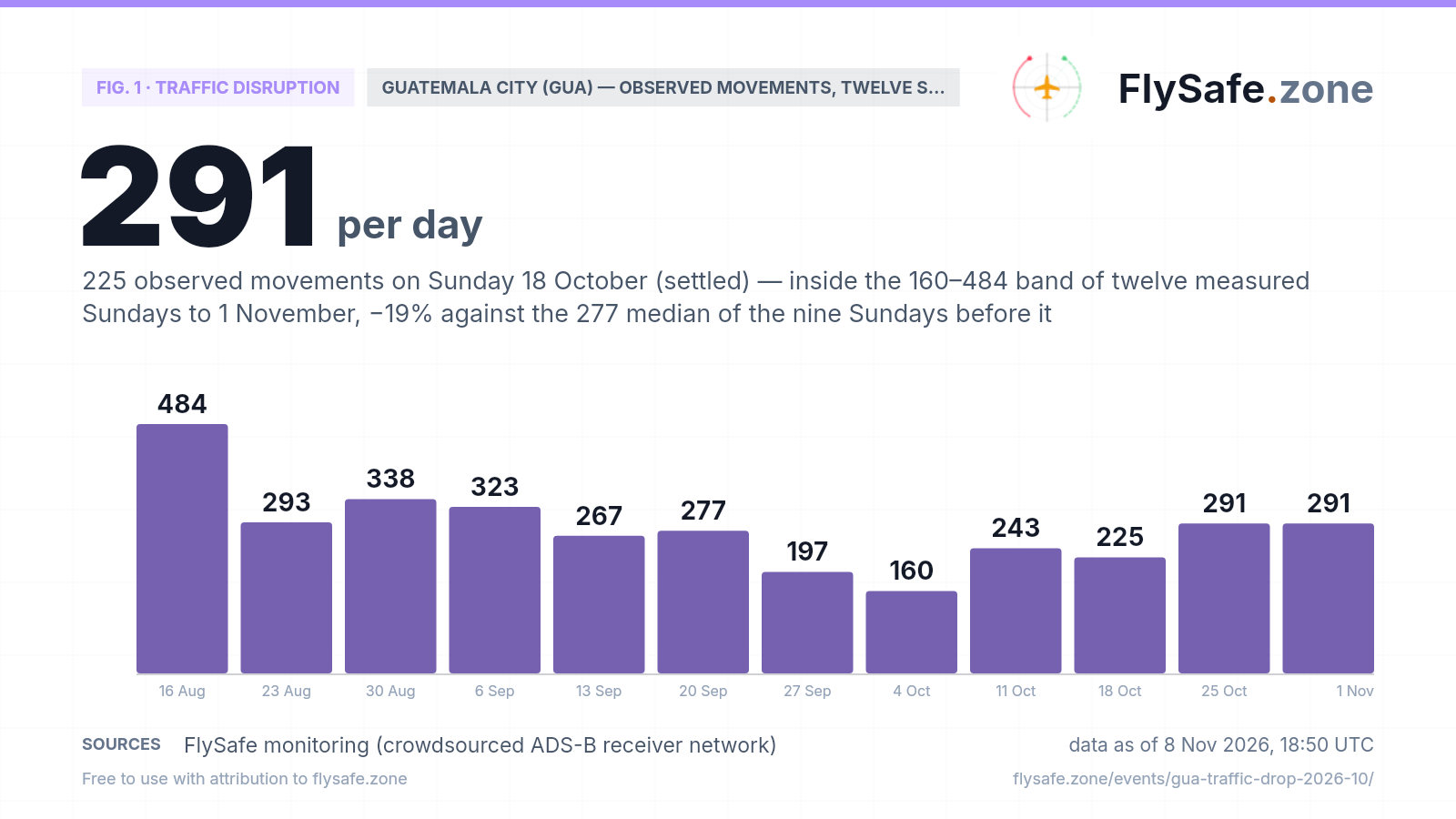
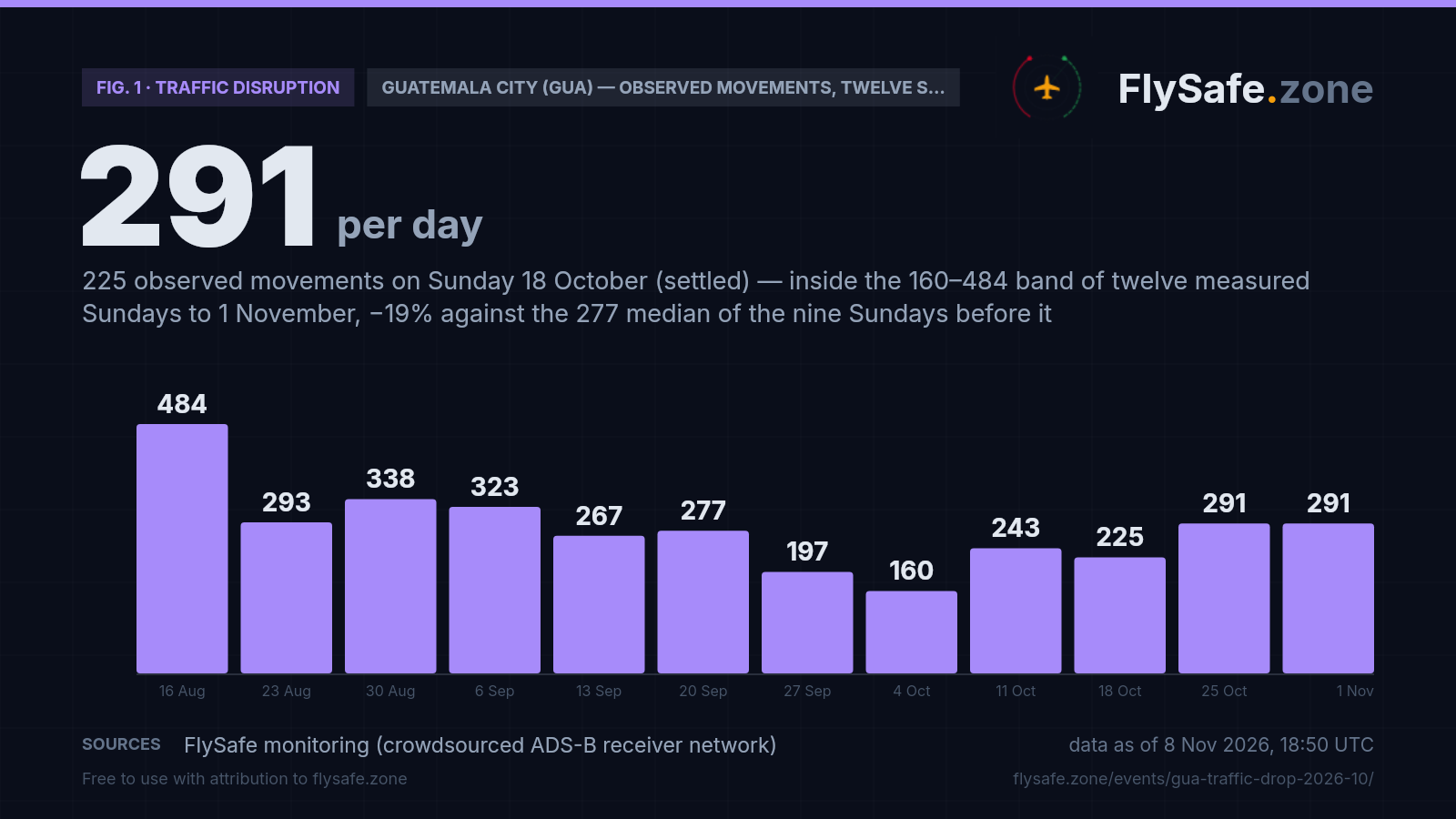
This chart shows Sundays only, because a Sunday is the fair comparison for a Sunday. Across the twelve Sundays from 16 August to 1 November, our receiver network observed between 160 and 484 movements at La Aurora. The median is 284 (277 for the nine Sundays before the flag). October Sundays have run lower than the August peak: 160 on 4 October, 243 on 11 October, 225 on 18 October; the two Sundays after the flag, 25 October and 1 November, both settled at 291, above the median. The −37% headline comes from the other end of the week: the seven-day average (349 when the flag fired; 351 with the settled Saturday) includes Friday 16 October (445) and Saturday 17 October (423). This is the same mechanism that fired the September flag at GUA: a busy weekend lifts the rolling average, and the quieter Sunday after it crosses the threshold.
Fig. 1 — Observed daily movements at La Aurora International (GUA) on each Sunday from 16 Aug to 1 Nov 2026 (all settled; 1 Nov settled on the 5 Nov refresh) · Data as of 8 Nov 2026, 18:50 UTC · Source: FlySafe monitoring (crowdsourced ADS-B receiver network).
Airports in the exposure zone
| Airport | Size | Observed signal | FIR |
|---|---|---|---|
| La Aurora International (GUA) | large | — · Closed 8 Nov · Sun 18 Oct: 225 observed (settled) vs 277 Sunday median (−19%) · Mon 19 Oct to Tue 3 Nov settled (270, 368, 335, 317, 391, 327, 291, 326, 350, 391, 412, 474, 339, 291, 303, 364), Wed 4 Nov 387, Thu 5 Nov 438 (recount, gap-marked day), Fri 6 Nov 440 provisional, none below weekday range, mean 359/day · Fuego 40 km, ash area over the airport in one advisory on 28 Oct (10:10 UTC observation), clear again from 15:40 UTC; 28 Oct settled 391, above the four prior Wednesdays | MHCC |
Distance alone does not determine impact — wind direction and the flight levels the ash reaches decide which airports and routes are affected on a given day. FIR = Flight Information Region.
What our monitoring shows: a repeat of September's pattern — busy Friday and Saturday, quiet Sunday
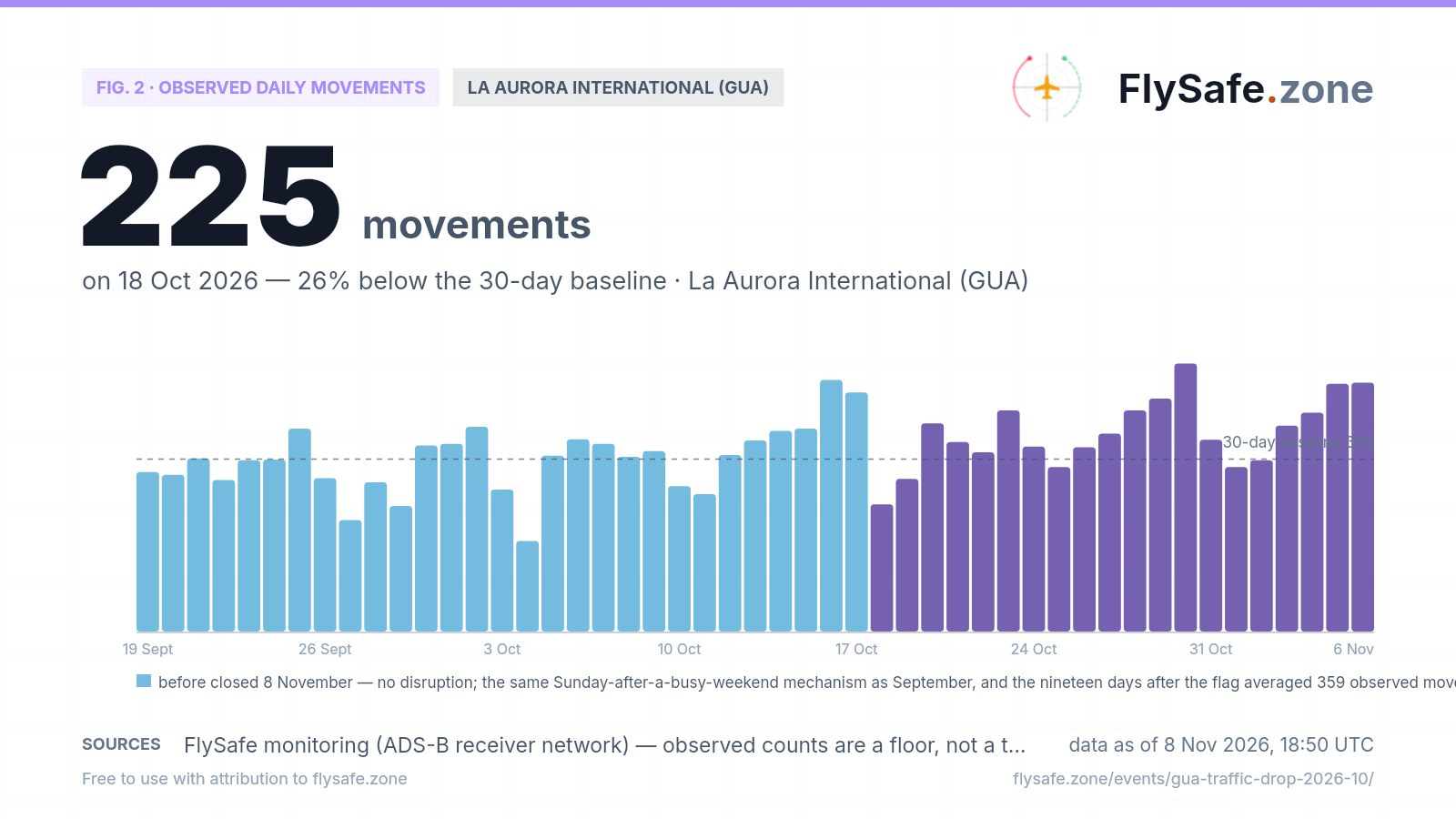
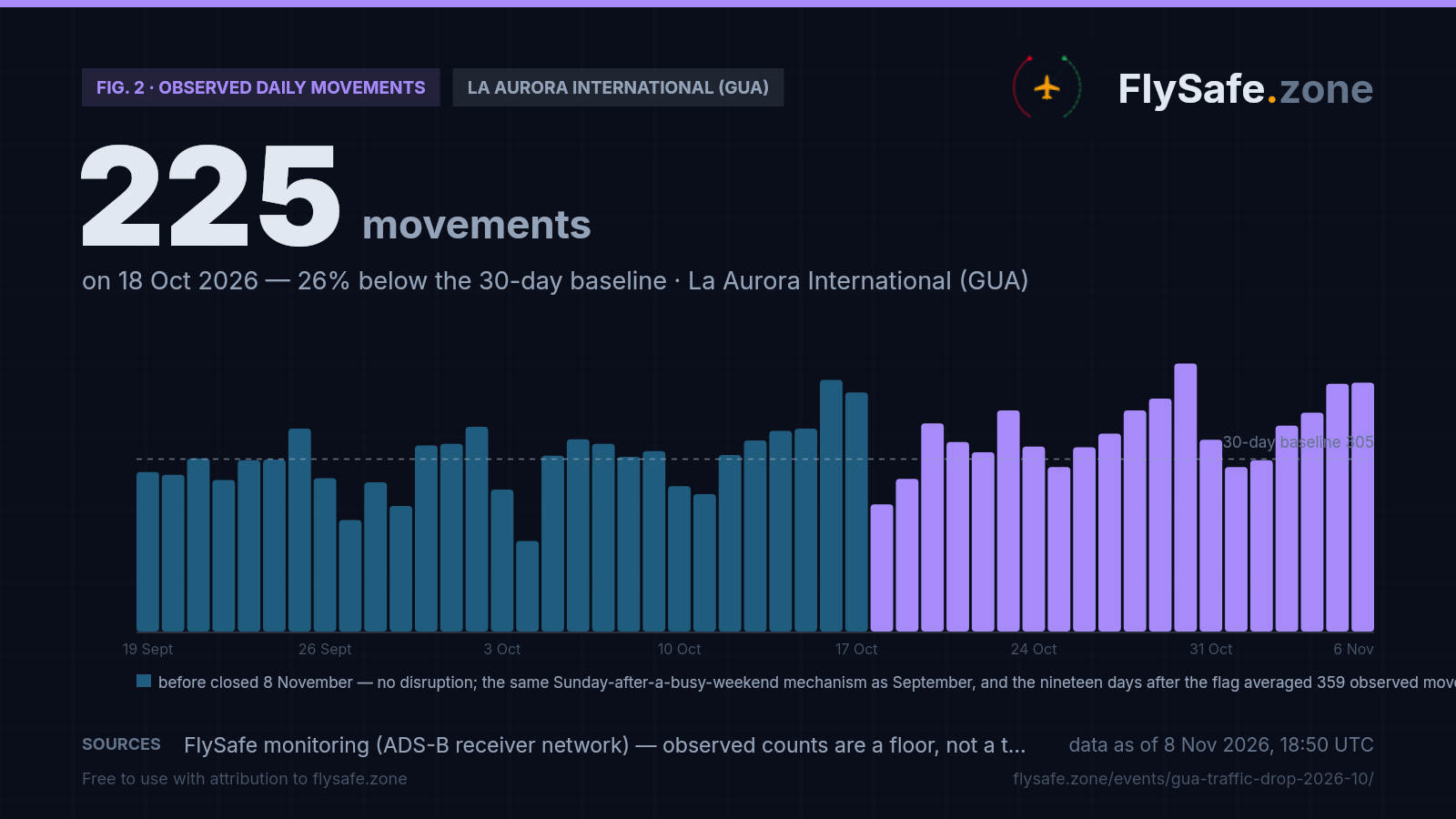
FlySafe tracks observed departures and arrivals at 493 airports from crowdsourced ADS-B receiver data. Observed counts are a floor, not a total — receiver coverage varies — but an airport measured against its own baseline is a reliable shape. La Aurora International's last 30 days:
Fig. 2 — Observed daily movements at GUA, 19 Sept – 6 Nov (latest complete UTC day). Data as of 8 Nov 2026, 18:50 UTC · Source: FlySafe monitoring (ADS-B receiver network).
- What tripped the detection: a provisional 221 observed movements on Sunday 18 October against a 349/day average for the seven days to 18 October, which read as −37%. The Sunday settled at 225 on the 22 October refresh (116 departures, 109 arrivals) and Saturday 17 October settled at 423; the same comparison now reads −36% (225 against 351).
- That average is inflated. Friday 16 October measured 445 movements, the busiest day at GUA since 15 September's 534. Saturday 17 October settled at 423. Together those two days pull the seven-day mean up by roughly 30 movements (351 with them, 318 without).
- Same-weekday view: 225 against the Sunday median of 277 (nine prior Sundays, 16 Aug to 11 Oct) is −19%. Our GUA airport brief weekday-adjusted verdict classifies the day as normal (−7% against its own Sunday baseline of 243).
- Monday 19 October settled at 270 (145 departures, 125 arrivals) on the 23 October refresh, unchanged from its provisional value. The four prior Mondays measured 306, 264, 311 and 312; against their median of 311 the day reads −13%, above the 264 low of that set. Tuesday 20 October settled at 368 (184 departures, 184 arrivals) on the 24 October refresh, above the four prior Tuesdays in the window (268, 222, 340, 338) and +9% against the airport brief's Tuesday baseline of 338. Wednesday 21 October settled at 335 (187 departures, 148 arrivals) on the 25 October refresh, inside the four prior Wednesdays (303, 329, 332, 355) and +1% against the airport brief's Wednesday baseline of 332. Thursday 22 October settled at 317 (170 departures, 147 arrivals) on the 26 October refresh, unchanged from the previous pass, inside the four prior Thursdays (304, 332, 309, 359) and −5% against the airport brief's Thursday baseline of 332. Friday 23 October settled at 391 (203 departures, 188 arrivals) on the 27 October refresh, unchanged from the previous pass, inside the four prior Fridays (359, 362, 319, 445) and +8% against the airport brief's Friday baseline of 362. Saturday 24 October settled at 327 (171 departures, 156 arrivals) on the 28 October refresh, up from 321 on the previous pass, inside the four prior Saturdays (271, 251, 257, 423) and +27% against the airport brief's Saturday baseline of 257. Sunday 25 October, the first Sunday after the flag, settled at 291 (146 departures, 145 arrivals) on the 29 October refresh, the same figure we had plotted from the flight-record recount, above the four prior Sundays (197, 160, 243, 225) and +5% against the Sunday median of 277. Monday 26 October settled at 326 (180 departures, 146 arrivals) on the 30 October refresh, the same figure we had plotted from the flight-record recount, above the four prior Mondays (264, 311, 312, 270) and +5% against the Monday baseline of 311. Tuesday 27 October settled at 350 (184 departures, 166 arrivals) on the 31 October refresh, the same figure we had plotted from the flight-record recount, inside the four prior Tuesdays (222, 340, 338, 368) and +3% against the airport brief's Tuesday baseline of 340. Wednesday 28 October, the day a Fuego advisory placed the ash area over the airport (see below), settled at 391 (204 departures, 187 arrivals) on the 1 November refresh, the same figure we had plotted from the flight-record recount, above the four prior Wednesdays (329, 332, 355, 335); against the airport brief's Wednesday baseline of 335 that is +17%. From 10:10 to 16:00 UTC, between that advisory's observation and the next bulletin, our receiver network recorded 140 movements at GUA (94 departures, 46 arrivals), against 131 in the same window on Wednesday 21 October. Thursday 29 October settled at 412 (210 departures, 202 arrivals) on the 2 November refresh, up from 398 on the previous pass, above the four prior Thursdays (332, 309, 359, 317) and +24% against the airport brief's Thursday baseline of 332. Friday 30 October settled at 474 (249 departures, 225 arrivals) on the 3 November refresh, the same figure we had plotted from the flight-record recount and the highest daily count at GUA since 15 September, above the four prior Fridays (362, 319, 445, 391) and +21% against the Friday baseline of 391. Saturday 31 October settled at 339 (173 departures, 166 arrivals) on the 4 November refresh, up from 332 on the previous pass, inside the four prior Saturdays (251, 257, 423, 327) and +4% against the airport brief's Saturday baseline of 327. Sunday 1 November, the day of the second FIR-level flag (see the honesty notes), settled at 291 (158 departures, 133 arrivals) on the 5 November refresh, the same figure we had plotted from the flight-record recount, level with the highest of the four prior Sundays (160, 243, 225, 291) and +5% against the Sunday median of 277. Monday 2 November settled at 303 (158 departures, 145 arrivals) on the 6 November refresh, the same figure we had plotted from the flight-record recount, inside the four prior Mondays (311, 312, 270, 326) and −3% against the airport brief's Monday baseline of 312. Tuesday 3 November settled at 364 (194 departures, 170 arrivals) on the 7 November refresh, unchanged from the previous pass, inside the four prior Tuesdays (340, 338, 368, 350); the airport brief scored it as normal (+4% against its Tuesday baseline of 350). Wednesday 4 November measured 387 (196 departures, 191 arrivals; the stored figure matches the flight-record recount), inside the four prior Wednesdays (332, 355, 335, 391) and +9% against the Wednesday baseline of 355. Thursday 5 November, the day of the third FIR-level flag, measured 438 by flight-record recount (224 departures, 214 arrivals), above the four prior Thursdays (309, 359, 317, 412) and the highest Thursday since this page's window opened on 19 September; against the Thursday baseline of 359 that is +22%. Friday 6 November reads 440 (218 departures, 222 arrivals; provisional), inside the four prior Fridays (319, 445, 391, 474); the airport brief scores it as normal (−1% against its Friday baseline of 445).
- October Sundays as a group run lower: 160 on 4 October, 243 on 11 October, 225 on 18 October, then 291 on 25 October (settled), the first October Sunday above the 277 median. The October Sunday mean is 230 with 25 October included (209 for the first three), against an August–September Sunday mean of 311. Whether this reflects seasonal change or noise we cannot say from four October Sundays.
- This is the second time the same pattern triggered. On 13 September GUA fired at −36% on a Sunday after a record Friday (610) and Saturday (497); the investigation closed it as no disruption — international service held, composition was normal, every other layer was clear.
- Honesty notes. These are observed movements from a crowdsourced ADS-B receiver network: a floor, not the airport's official total. The 18 October (225), 19 October (270), 20 October (368), 21 October (335), 22 October (317), 23 October (391), 24 October (327), 25 October (291), 26 October (326), 27 October (350), 28 October (391), 29 October (412), 30 October (474), 31 October (339), 1 November (291), 2 November (303) and 3 November (364) figures settled on the 22 October to 7 November refreshes, one day per refresh; 4 November (387) matches the flight-record recount, and 6 November (440) is provisional. 5 November is marked as a collection gap in our daily table: it stores 158 (67 departures, 91 arrivals), 280 short of the full recount from individual flight records (438), which is what Fig. 2 plots. The nightly refresh restored the same kind of clip on 19 October (stored 214, settled 270), 20 October (stored 264, settled 368), 21 October (stored 194, settled 335), 22 October (stored 33, settled 317), 23 October (stored 48, settled 391), 25 October (stored 256, settled 291), 26 October (stored 256, settled 326), 27 October (stored 210, settled 350), 28 October (stored 144, settled 391), 30 October (stored 447, settled 474), 1 November (stored 270, settled 291) and 2 November (stored 271, settled 303 — in the last seven cases exactly the recount we had plotted). Separately, our consensus layer logged a low-confidence FIR-level flag for MHCC on 21 October (a night-time snapshot in which the handful of aircraft tracked across the FIR fell to zero, paired with a standing NOTAM); it is not airport-specific, carries the lowest confidence tier, and the same shape was logged on 13 October while GUA measured a normal 338. GUA's count for that day settled at 335 (+1% against its Wednesday baseline), and no further flag was logged for 22 to 31 October. A second flag of the same shape was logged for 1 November (an early-morning snapshot at 12:45 UTC in which the aircraft tracked across the FIR fell from 10 to 2, paired with the same standing route-closure notice); our receiver network recorded GUA departures in the hours that followed, and that day's count settled at 291, +5% against the Sunday median. No flag was logged for 2 to 4 November. A third low-confidence flag was logged for 5 November; it pairs the same standing route-closure notice with a route-shift score rather than a drop in tracked aircraft, and GUA's flight-record recount for that day is 438, the highest Thursday in this window. No flag was logged for 6 or 7 November. A fourth, of the 1 November shape, was logged for 8 November (a 10:45 UTC snapshot in which the three aircraft tracked across the FIR fell to zero, with the same standing notice); GUA's count for that day was not yet measured when this page closed. We list all four because we said we would watch that layer, not because they change the picture. Against the 30-day mean of 305 (the dashed baseline in Fig. 2) 18 October reads −26%; that is a Sunday measured against a mean dominated by weekdays, which is why the same-weekday view above is the one we lean on. 19 September, shown as 0 in the first version of this page, now shows its stored 282 — the zero was an artefact of the window edge in our daily table, not a collection gap.
The shape is the same as September: a busy end of the week followed by a quieter Sunday, measured against an average that carries the busy days, and Monday-to-Friday counts that do not fall below their weekday ranges. Live view: GUA airport brief.
What it means for flights
Why this flag fired, and why this is the second time. Our detection layer flags an airport when observed traffic drops more than a set threshold below its seven-day rolling average. At GUA the threshold fires reliably on Sundays after busy weekends, because this airport's day-of-week spread is wide: Fridays and Saturdays routinely run 1.5–2× a typical Sunday. When those heavy days enter the rolling window, a normal Sunday crosses the line. The same mechanism fired on 13 September (−36% after a record Friday of 610 and Saturday of 497); this time on 18 October (−37% when it fired, after a Friday of 445 and a Saturday that has since settled at 423). We publish both, labeled, because a −37% headline at an ash-exposed airport 40 km from Fuego is exactly the kind of number that gets misread.
The Sunday-specific picture. Across twelve measured Sundays from 16 August to 1 November our receiver network observed between 160 and 484 movements at La Aurora. The median is 284; for the nine Sundays before the flag it was 277. October's first three Sundays (160, 243, 225) all sat below the median, while August peaked at 484; the two Sundays after the flag, 25 October and 1 November, both settled at 291, above it. 18 October at 225 (settled on the 22 October refresh) is −19% against the nine-Sunday median (−21% against the twelve-Sunday one), inside the band, and our airport brief's weekday-adjusted verdict classifies it as normal (−7% against its 243 baseline). Whether October Sundays are seasonally softer or this is noise, we cannot distinguish from four October Sundays — we note the pattern and do not overclaim it.
Fuego: one advisory over the airport, ten days after the flag. La Aurora is listed as ash-exposed because it lies 40 km east-north-east of Fuego. VAAC Washington issued approximately 380 volcanic-ash advisories covering Fuego over the past 90 days, at a steady cadence of four to five a day, with ash reported to FL140 near the vent. The October run paused after 18 October (last bulletin 13:10 UTC that day: no ash detected in satellite imagery, no emission reports) and resumed on 20 October at 13:57 UTC; counting that one, eighty-two bulletins were issued to 8 November 15:32 UTC. The 19:59 UTC bulletin on 20 October placed an ash cloud about 17 nautical miles west of the summit around FL140, moving west — away from the airport; from the 23 October 17:54 UTC bulletin the reported drift turned north-east to east, towards the airport side, and the 24 October 11:47 UTC bulletin forecast continued north-east to east movement before dispersal. From the 24 October 17:38 UTC bulletin the forecast shifted to south-south-east, and the 25 October bulletins report ash up to about 27 nautical miles from the summit moving south-east to south; on 26 October ash extended up to about 40 nautical miles south-south-east of the summit, with south, south-west and south-east movement forecast — away from the airport side again. On 27 October ash was reported moving south-south-east to south, up to about 50 nautical miles from the summit, then south-west by 22:53 UTC; the 28 October 04:55 UTC bulletin reports the plume moving west-south-west. Through that bulletin, the ash areas drawn in advisories did not reach La Aurora (their nearest edge stayed at least 13 km from the airport). That changed with the 28 October 10:51 UTC bulletin: with upper winds backing, it reported frequent ash emissions moving east and south-east, and both its observed ash area (10:10 UTC, surface to FL140, moving east at 5 knots) and its six-hour forecast contained La Aurora, about 2 km inside the eastern edge; the volcanic-ash SIGMET for the Central American FIR valid 11:00–17:00 UTC drew the same area. The next bulletin (16:01 UTC, observation 15:40 UTC) had the ash fanning south to south-east, at least 27 km from the airport, and every bulletin since, to 8 November 15:32 UTC, reports or forecasts it moving south-south-east through south-west to west-north-west, at least 35 km away, with one exception: the 6 November 11:39 UTC bulletin observed ash drifting east to south-east about 10 nautical miles from the summit, its nearest edge about 25 km from La Aurora, and the next (17:35 UTC) had it south-south-east, at least 38 km away (two bulletins on 30 October and several on 5–8 November could not see the summit for weather cloud). La Aurora's hourly weather reports from 10:00 to 18:00 UTC that day reported no ash and visibility of 10 km or more, and our receiver network recorded departures through the window; the day settled at 391 movements on the 1 November refresh, above the four prior Wednesdays (329–355). This came ten days after the 18 October flag and does not bear on it. Fuego is a persistent emitter — this is a daily planning input for dispatchers in the region, not a crisis. Wind shifts move ash, which is why this is a statement about the advisory record and not a forecast.
What would have changed this page. The 18 October figure settled at 225 on the 22 October refresh, unchanged from its provisional value and inside the Sunday band; Monday 19 October settled at 270 on the 23 October refresh, Tuesday 20 October at 368 on the 24 October refresh, Wednesday 21 October at 335 on the 25 October refresh, Thursday 22 October at 317 on the 26 October refresh, Friday 23 October at 391 on the 27 October refresh, Saturday 24 October at 327 on the 28 October refresh, Sunday 25 October at 291 on the 29 October refresh, Monday 26 October at 326 on the 30 October refresh, Tuesday 27 October at 350 on the 31 October refresh, Wednesday 28 October at 391 on the 1 November refresh, Thursday 29 October at 412 on the 2 November refresh, Friday 30 October at 474 on the 3 November refresh, Saturday 31 October at 339 on the 4 November refresh, Sunday 1 November at 291 on the 5 November refresh, Monday 2 November at 303 on the 6 November refresh and Tuesday 3 November at 364 on the 7 November refresh. Wednesday 4 November measured 387, Thursday 5 November 438 (flight-record recount over a gap-marked day) and Friday 6 November 440 (provisional). Three things would change this page from an explained flag to an event: the settled Sunday figure falling well below the 160–484 band — it did not; following days (19 October to 6 November) measuring persistently below normal — none of the nineteen did; or a corroborating signal in another layer — a closure event, weather deterioration, or ash from Fuego's resumed advisories reaching La Aurora. The last of these has now happened once: on 28 October, ten days after the flag, one advisory placed the ash area over the airport (see above). It does not explain 18 October, and the airport's weather reports showed no ash; 28 October's settled count, 391, sits above its Wednesday range (four prior Wednesdays 329, 332, 355, 335), the same figure we had plotted before it settled. Our NOTAM set for the MHCC FIR was last refreshed at 05:02 UTC on 1 November; none of its eight current notices concerns volcanic ash or closes the airport (the one closure notice covers an air-route segment and has stood since 2 September), and because the set holds only notices current at each refresh, it cannot show a notice issued and withdrawn between 28 and 31 October. The low-confidence FIR-level flags for 21 October, 1 November and 5 November noted above do not meet that bar on their own; GUA's settled counts for 21 October (335, +1% against its Wednesday baseline) and 1 November (291, +5% against the Sunday median) give the first two no substance, the third coincided with 438 movements by flight-record recount, the highest Thursday in the window, and the fourth (8 November) was not yet measured when this page closed. This page is now closed; the GUA brief keeps updating from the same data.
What the data showed — closing entry, 8 November 2026. The signal is over and this page is closed. The recovery number: the nineteen days after the flag, Monday 19 October to Friday 6 November, averaged 359 observed movements a day (6,814 in all), against the 305 baseline before the flag (the dashed line in Fig. 2) and the 351 seven-day average the flagged Sunday was measured against; none of them fell below its weekday range. The flagged Sunday itself settled at 225, −19% against the 277 median of the nine Sundays before it and inside the 160–484 band; the two Sundays after it, 25 October and 1 November, both settled at 291, above that median. The last week of the ledger: Saturday 31 October 339, Sunday 1 November 291, Monday 2 November 303 and Tuesday 3 November 364 (all settled), Wednesday 4 November 387, Thursday 5 November 438 (flight-record recount; the stored daily figure, 158, is marked as a collection gap) and Friday 6 November 440 (provisional) — a mean of 366 a day, +4% on the 351 average that tripped the detection. Every figure is a floor from a crowdsourced ADS-B receiver network, not the airport's official total. What it was: the same mechanism as the September flag — a busy Friday (445) and Saturday (423) lifted the seven-day average, and the quieter Sunday after them crossed the threshold. No other layer corroborated it: the only Fuego advisory to place ash over La Aurora came ten days later, on 28 October, with no ash in the airport's weather reports and 391 movements that day; the MHCC FIR-level flags logged for 21 October and 1, 5 and 8 November are low-confidence and not airport-specific, and none of the measured ones coincided with a low count at GUA. We publish measured signals, not safety verdicts. The GUA airport brief keeps updating from the same data.
Passenger questions, answered from the data
No layer we track indicates a disruption at La Aurora International (GUA) on 18 October 2026: no closure event for the MHCC FIR on 18–20 October, and the airport's weekday-adjusted verdict scores the day as normal (−7%); Monday 19 October settled at 270, Tuesday 20 October at 368, Wednesday 21 October at 335, Thursday 22 October at 317, Friday 23 October at 391, Saturday 24 October at 327, Sunday 25 October at 291, Monday 26 October at 326, Tuesday 27 October at 350, Thursday 29 October at 412, Friday 30 October at 474, Saturday 31 October at 339, Sunday 1 November at 291, Monday 2 November at 303 and Tuesday 3 November at 364, and Wednesday 4 November (387), Thursday 5 November (438) and Friday 6 November (440, provisional) are not below their weekday ranges. This page closed on 8 November as no disruption. The −37% figure compares a Sunday against a seven-day average inflated by Friday (445) and Saturday (423). On 28 October one Fuego advisory placed the ash area over the airport (10:10 UTC observation); the next, from 15:40 UTC, did not, the airport's weather reports showed no ash, and that day's settled count (391) is above the four prior Wednesdays. For the status of a specific flight, check your airline or the airport's own channels.
The observed count on Sunday 18 October was a provisional 221 movements, −37% below GUA's seven-day average of 349 at the time; it settled at 225 on the 22 October refresh and the same comparison reads −36%. That average includes Friday 16 October (445 movements) and Saturday 17 October (423, settled). Against the Sunday median of 277 from nine prior Sundays the day reads −19%, inside the 160–484 band. This is the same pattern that triggered a September flag, which was closed as no disruption. The count is a floor from a crowdsourced receiver network.
La Aurora is 40 km east-north-east of Fuego and is listed as ash-exposed on that distance. VAAC Washington covered Fuego with approximately 380 advisories over the past 90 days (about 4–5 a day, FL140); the run paused after 18 October and resumed on 20 October, with ash reported moving west at first, north-east to east, towards the airport side, on 23–24 October, and south-east to west-south-west from 25 October. The ash areas in advisories did not reach La Aurora until 28 October, when one advisory (10:10 UTC observation, ash moving east, surface to FL140) placed it over the airport; the next, from 15:40 UTC, had the ash south to south-east and clear of the airport, and La Aurora's weather reports that day showed no ash. Conditions can shift with wind; check the GUA brief and your airline on the day of travel.
We publish measured signals, not safety verdicts; operating decisions belong to airlines, the airport and the Guatemalan aviation authorities. Nothing in the layers we track (closure events, ash-advisory polygons, receiver coverage) indicates anything unusual at La Aurora on 18 October beyond a quiet Sunday after a busy weekend — the same pattern we documented in September.
For media — the full kit
Everything on this page — charts, CSV, quotes — is published under CC BY 4.0: free to reuse with attribution to FlySafe.zone. Charts come in dark (social/web) and light (print/light layouts) versions; attribution and license are embedded in every file.
“Observed traffic at Guatemala City's La Aurora International fell to 225 movements on Sunday 18 October, 37% below its seven-day average when the flag fired, but that average included the airport's busiest day since mid-September; against its own Sunday median the day was 19% lower and inside its normal range, and Fuego's advisories, paused after 18 October and resumed on 20 October, placed no ash over the airport until a single advisory on 28 October, ten days after the flag, according to flight-monitoring service FlySafe.zone.”
Boilerplate — about the source (for your article footer)
FlySafe.zone monitors airspace risk and observed airport activity worldwide: 334 flight-information regions scored daily, GPS-interference signals, volcanic-ash exposure and daily observed movements at 493 airports from the crowdsourced ADS-B receiver network. Methodology: flysafe.zone/methodology.
Need a different cut of the data, a comment, or numbers for another airport? Leave an email — we answer fast during active events.